THE RISE AND FALL OF THE OTTOMAN EMPIRE... By Jason Goodwin |  | Published in Cornucopia 26, Spring 2002 Order now Go to the online arts diary Go to the Home Page |  | 
| The Ottoman World:
The Library of Sefik E Atabey and other items
|  |  |  | 
| 
| 
|  | An auction at Sothebys, 35 New Bond Street, London W1A 2AA May 28, 29, 30, 2002 |  | THE RISE AND FALL OF THE OTTOMAN EMPIRE: A SCINTILLATING DRAMA IN 1,800 VOLUMES
The historian Jason Goodwin previews the sale of the decade of books of the Ottoman Empire
--------------------------
All empires are doomed to vanish away, but seldom do they break up as quickly as the famous Atabey collection of Ottoman books (see Cornucopia 14, 1997/98), which Sothebys brings to auction in London on May 29 (as it happens, the exact date that, in 1453, the Ottomans took Constantinople and put an end to the Byzantine Empire). Collectors and historians alike should come and gaze upon it before it is all too late.
Sefik Atabeys cut-off date was 1880, so we are spared the final agonies: in all other respects this delicious hoard of 1,800 or so books, paintings, maps and illustrations - which Atabey spent the best part of a lifetime collecting until he sold them recently - reflects the changing Western response to the Ottoman Empire. It was a broad stage, Crete to Cairo, Athens to Erzurum: a scintillating drama, too, which unfailingly attracted diplomats and artists, soldiers and travellers to seek out its beauties, mine its ruins, question its motives and ponder the causes of its greatness and decay.
--------------------------
But the earliest mood was one of terror and near-despair, as Christendom absorbed the shock of Constantinoples fall and the eruption of a Muslim power into southeast Europe - a mood captured in the three incunabula in the collection, including a letter from the Pope to Mehmet the Conqueror. As for the famous siege itself, one account based on eye-witness reports is to be found in Andrea Cambinis Libro della origine de Turchi et imperio delli Ottomani of 1528, prettily bound in a manuscript leaf of music.
By then, of course, the empire was sweeping to dominion in eastern Europe and the eastern Mediterranean, andthe first inarticulate panic - the letters, the prayers, the prophecies - had given way to a determination to get to the bottom of the Ottoman phenomenon. The Italians were first in line, of course - Genoa and above all Venice had much to lose if ever they misread the signals coming from Istanbul. Lot 1254, a manuscript volume of despatches from a Venetian ambassador 1687-95, reflects their meticulous approach: not one jot of diplomatic nuance or tittle of court gossip escaped the Venetian bailo. Most of the great Ottoman histories, incidentally, are represented here - various editions of Sir Paul Rycauts The Present State of the Ottoman Empire, including a German edition with a splendid frontispiece, Cantemirs Historia, Baudiers histories of the serail, Islam and the various Turkish conquests down to 1617 (lots 76 - 80), and dOhssons Tableau général de lempire ottoman.
--------------------------
Under Süleyman the Magnificent the Ottomans reached the apogee of their power; hence this is an era sprinkled, too, with seeds of weakness. One of the curiosities of the collection is a hand-written account, apparently taken from a printed Dutch source, of the Siege of Vienna in 1683: it seems to have been prepared for James II of England, and has his bindings; it includes among a mass of interesting detail the fact that plunder from the Turkish camp yielded enough lead to make 428,850 bullets. For Vienna was a significant disaster for the Ottomans, representing forever afterwards the point beyond which they could not go. Those bullets sustained a new balance of power: after the Ottoman debacle at Vienna, with minor exceptions, there followed three centuries of gradual attrition. In earlier days, many Christians turned turk; but here is Some Memoirs of the Life of Lewis Maximilian Mahomet of 1727 (lot 793) - Mehmet, captured at Vienna, converted and rose to become Keeper of the Privy Purse to George I of England.
With the failure at Vienna, costly wars against Persia, the rise of first the Habsburgs in the 17th, then the Russians in the 18th century to contest for territory, the Ottomans were forcibly drawn into the wider orbit of European diplomacy. The collection boasts a superb example of one of its finest fruits, the Letters of Baron de Busbecq (lot 174). A century later we have the French ambassadors Mémoire touchant les revenus et les dépenses de lempire ottoman in manuscript (lot 497), written with a knowledge of Turkish: the empire was yielding up its secrets. So when a Spanish squadron delivered presents to the Porte in 1784 to mark a peace, it returned with military observations, plans and a lovely Vista en Perspectiba of Istanbul (lot 38).
--------------------------
From the later years of Süleyman the Magnificent it was possible to gaze, almost calmly, on the Ottoman scene. So it began: the empire as a tableau vivant, a fund of astonishment, of delight, of difference. Pietro della Valle strikes this note, writing here to his lecteur curieux, his wonderfully spry and amusing travels clapped up in four vellum-bound volumes (lots 1244-6). Thévenot (lots 1193-5) judged the urge to travel stronger than at any other time: Le désir de voyager a toujours été fort naturel aux hommes, mais il me semble que jamais cette passion ne les a pressé avec tant de force quen nos jours. Nothing to hold him back in France, so: je résolu facilement de satisfaire ma curiosité - and everyone elses, too.
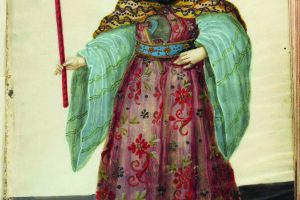
The costume collections - and there are many to chose from here - testify to the exotic enchantment of a society in which colour and costume played such a ravishing role; and they underscore not only the astonishing geographical reach of the empire but also, in a pre-nationalist age, its ability to harmonise a myriad of peoples - Turks, Greeks, Jews, Egyptians, Armenians, Arabs and so on. Its interesting to see here a collection of small oils, apparently done by a native artist to satisfy Western demand (lot 288), as well as an exquisite little volume of glowing gouaches (lot 292). At the same time, these costumed portraits serve as a metaphor for stasis: the Western imagination simply freezes the people of the empire, turning them into types of the changeless East.
--------------------------
Its a bundle of themes which gather strength as the empires own begins to ebb: by the mid-17th century many were aware that the Ottoman system was not running as it was meant to. A link was commonly drawn to the evident rise of the power of the harem, in the so-called Sultanate of the Women - a perception which no doubt helped inspire La Chappelles 1648 folio edition of portraits of the principal ladies of the Porte (lot 645).
Russias pressure on southeastern Europe probably did more than anything to bring the empire down in the 19th century. Here, significantly, is Anquetil Duperrons sympathetic Législation orientaleÉ montrantÉles principes fondamentaux du gouvernement required reading for, say, the rulers of an empire that planned to carve out chunks of Muslim Central Asia and possibly supplant the Ottomans altogether. This edition (lot 29, see page 14) bears the arms of Tsar Paul I. Sometimes it almost seems that the empire was bludgeoned to death by Western books; in 1788 anyone who wanted could add an Idée générale de la Turquie et des turcs; pour servir à lintelligence des opérations de la guerre actuelle to their own library (lot 597).
--------------------------
The empire may have been moribund, but it was still undeniably a Power - until even that claim was punctured by the disaster of Napoleons invasion of Egypt in 1798.
For four years the French ruled the country, and Napoleon marshalled a brilliant army of experts to identify, analyse and describe all aspects of Egypt, from the hieroglyphs to the fauna. The result (lot 341) was a massive series of 16 volumes, Description de lEgypte. Most of them are here in their original bindings. They were the biggest books ever produced by their day, on a specially constructed press. Their size was political, indicating that Western knowledge would help Egypt throw off the barbarism into which it had sunk to rediscover its former greatness.
The 19th century brought one humiliation after another to the Ottomans: it also brought hundreds of foreign travellers to describe their impressions as they clambered over monuments, encountered Ottoman bureaucracy, defeated Ottoman armies, and pried into every nook and cranny of the Levant.
--------------------------
The diplomats have largely surrendered the field. In 1801, in Leicester Square, you could enjoy a 360-degree view of Constantinople provided by Henry Aston Barkers patent panorama (lot 66), father to the astonishing works of Joseph Schranz in Istanbul in the 1850s. Mrs Purdoe writes in 1836 of the manners of the Turks, HEJJerningham (author of Life in a French Chateau) now travels To and From Constantinople, Choiseul-Gouffier - a former ambassador to the Porte - undertakes a Voyage pittoresque. Paying a visit to the terrifying Albanian despot Ali Pasha of Janina, as Byron did, was positively fashionable, the early 19th-century equivalent of dinner with Castro: at least seven travellers here do it (Hobhouse, lot 576, Holland lot 581É).
Of the many dozens of journeys here, Id select Kinglakes magnificent Eothen, which pretends to be another laconic account of the empire by a very imperious young Etonian; its actually an extremely well-worked comedy, and the empire figures in it only as a backdrop to his merciless portrait of an Englishman abroad. What could the French think of it? - its here in its first French edition (lot 628).
|  | 
| Lot 174 Est £1,500-2,000 Sold for £5,019 |  |
NOTES
Sale results total: 5,632,672 GBP
The Sothebys catalogue To order The Ottoman World: The Library of Sefik Atabey with a Supplement, 3 vols, £50, call +44-20 7293 6444 or visit www.sothebys.com.
'Mr Atabey's Books" by Omer Koc tells the story of how this famous collection was made and Mr Koc's many encounters with Mr Atabey. See Cornucopia 14 Back copies of issue 14 cost £24/$36. Order now
The original illustrated catalogue of Sefik Atabey's collection, published six years ago, is available from Bernard Shapero Rare Books, 32 St George Street, London W1S 2EA,. Originally published at £600, the last remaining copies are available for £400. To order, email rarebooks@shapero.com or call +44(0)20 7493 0876, fax +44(0)20 7229 7860
The author of this article: Jason Goodwin's Lords of the Horizon, a history of the Ottoman Empire (Chatto & Windus h/b, £18.99, Vintage p/b, £7.99). is on offer to Cornucopia subscribers for £17.50 and £7.50 postfree worldwide. Order now
| 
| 
| 
| Above: Lot 38 Gabriel Aristizabel's manuscript account of his mission to Istanbul in 1783-4 bearing gifts from the Spanish court. The 91 large folio pages have 46 numbered plates including the panorama of Istanbul and map of the Dardanelles above. Est £60,000-80,000 Sold for £193,650 | 
| 
| Left: Lot 292 A bound collelction of 26 costume drawings on vellum, 18th century. Est £25,000-30,000 Sold for £65,725 | 
| 
| | |  |
| |