
Buy or gift a digital subscription and get access to the complete digital archive of every issue for just £18.99 / $23.99 / €21.99 a year.
Buy/gift a digital subscription Login to the Digital EditionThe Deir Mar Musa al-Habashi monastery perches among the limestone hills halfway between Damascus and Homs. From the upstairs terrace you can see the great wastes of the Syrian desert, where the Hejaz railway once ran, connecting Istanbul to the holy cities of Mecca and Medina. Although now there is talk of rebuilding the railway, it is unlikely to disturb the monastery’s quiet isolation. The climb to Mar Musa is steep, with narrow, winding stairs built into the rock. As we slowly ascend, the monastery’s inhabitants peer down at us from the terraces. Before becoming a monastery this was a Roman fort, built in the 2nd century to guard the desert road from Damascus to Palmyra. At the top of the stairs, Sister Huda, a small nun, welcomes us warmly and sweeps us around. The entrance to the old church is tiny, no bigger than a window. We should remove our shoes before entering – for the first time in my life, in a Christian place of worship. The floor inside is lined with carpets, reminiscent of a mosque. “There on the wall, you see the direction of Mecca marked,” points out Sister Huda. “This is for our Muslim friends. Everyone is welcome to pray here. Our workers are mixed too, both Christians and Muslims.” The frescoes on the wall date back to the 11–13th century. Some might call them primitive but they have their own elegance in a simple Oriental style, with vibrant colours. On the wall facing the altar is the Day of Judgement. Sinners on Christ’s left against a maroon background, the righteous on his right, set against blue. The writing on the walls varies between Arabic, Greek, and Syriac script. Monastic life in these hills dates back to the 6th century. The monastery was abandoned around 1830 and left to crumble. A hundred and fifty years later, Paolo Dall’Oglio, a Jesuit monk from Italy, arrived. He made it his life mission to restore the monastery and preach dialogue across religious and cultural lines. In good Jesuit fashion, he spoke fluent Arabic and was well versed in the Koran and Islamic law. Father Paolo and his companions were missionaries, not here to convert Muslims but to understand them. “To speak with Muslims because they are Muslims, not in spite of it,” as Father Jihad Youssef, the head monk of the monastery, explains. His beard is almost identical to those of the icons. The monastery came to be named after St Moses the Abyssinian, one of the Desert Fathers, early Christian hermits, ascetics, and monks who retreated into the deserts of Egypt, Palestine and Syria in search of solitude and spiritual clarity, beginning in the 3rd century. In their own ways, the current inhabitants of the monastery still follow that tradition. What is believed to be the thumb of Saint Moses is still kept in the nearby town of al-Nabk in silver casing. On the day of the saint, it is brought to the monastery where women queue to kiss, in the belief that it can cure infertility. In the silence of the monastery, lulled by the hospitality of its inhabitants, it is easy to forget the brutality of the past 14 years, and the sound of gunshots still heard in Damascus and Homs. The desert and the lack of phone signal cut off the rumble of the outside world. But even Mar Musa was not left untouched by the civil war. Father Paolo’s absence gapes over the monastery like a missing roof. When the mass protests began in 2011, he openly took sides and spoke up for democratic transition, which led to his expulsion from the country by the former regime. Father Paolo was a stubborn man. His life work included the reconstruction of this dilapidated monastery in the desert and standing up for dialogue in the decades when sectarianism was taking its hold over the whole region. In 2013, he reentered Syria illegally from Iraq with an impossible mission: to personally negotiate with the leadership of the so-called Islamic State for the release of hostages. He set off to Raqqah, and was never heard from again. “We are not sure whether he is still alive or was killed. Nothing is certain,” says Father Jihad. He still hopes he might one day be found in the desert alive. But that hope is wearing thin. “Some say he was executed immediately. Others that those who kidnapped him passed him on to the regime.” When the regime collapsed last December and the prisons opened, Father Paolo’s companions anxiously waited for news – good or bad. But none has come so far. Since Father Paolo disappeared, his writings have been published in Rome, and Pope Francis himself wrote the foreword. “A free spirit, who rejected formalism and phrases of circumstance; sometimes extreme, as he acknowledges with a dose of self-irony,” the late Holy Father described him. The remaining residents of the monastery – three monks, five nuns, and eight laymen – carry on their mission. They hold interfaith seminars, welcome all visitors, and preach peace and understanding instead of religious or ethnic factionalism. Father Jihad agrees, cautiously, that their little monastery could be a model for their country. Youssef, one of the laymen from Aleppo, wants to show us the remaining parts of the monastery. He apologises for his English and offers a range of alternatives: Arabic, Greek, Turkish or Armenian. We settle on Turkish. He proudly shows the cheese-making facility and a room where they make their own candles, and explains the pipe system through which they pump water from the wells at the foot of the hills. In the late afternoon, we have to set out to avoid travelling uncertain roads in the dark. “This place is your home too,” Youssef says encouragingly. “Come back next time you’re in Syria, and stay as long as you want. And you come back too, and bring your family with you!” he turns to my Syrian friend, perfectly aware that he is Sunni Muslim.
USEFUL LINKS For more reading visit the the Royal Toronto Museum website, which explores the history of the monastery and the legacy of the Canadian scholar Erica Dodd whose expedition to the monastery in 1981 inspired Father Paolo-Dall Oglio to bring it back to life. For links visit cornucopia.net/deirmarmusa
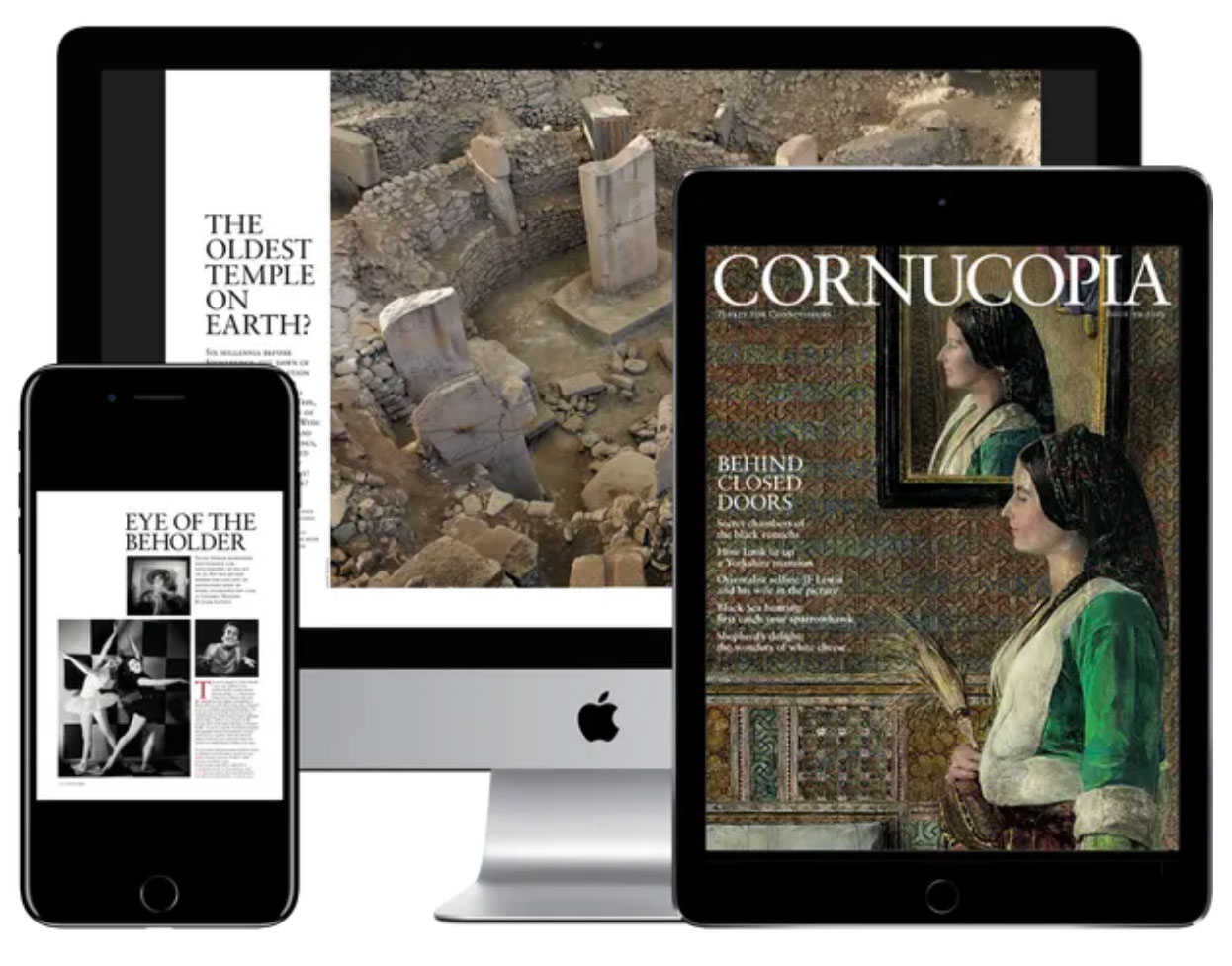
Cornucopia works in partnership with the digital publishing platform Exact Editions to offer individual and institutional subscribers unlimited access to a searchable archive of fascinating back issues and every newly published issue. The digital edition of Cornucopia is available cross-platform on web, iOS and Android and offers a comprehensive search function, allowing the title’s cultural content to be delved into at the touch of a button.
Digital Subscription: £18.99 / $23.99 (1 year)
Subscribe now