The Atatürk Cultural Centre (Atatürk Kültür Merkezi or ‘AKM’), located in Taksim Square and run by the Turkish Ministry of Culture and Tourism, is Istanbul’s premier and most capacious venue for concerts, also hosting theatre and ballet performances. Reopened in October 2021 after being completely rebuilt, the complex now includes a number of spaces dedicated to various functions plus a restaurant and various cafés. During the interval at a performance you can get tea, coffee and basic snacks in a large space with seating accommodation on the lower ground floor. Note that the ticket office is not in the main building, but in a kiosk to the left.
WEDNESDAY, SEPTEMBER 23
Beethoven’s Ninth Symphony
The Atatürk Cultural Centre opens the 2026-2027 season with a performance of Beethoven’s last symphony – the Symphony No. 9 in D minor, Opus 125, composed between 1822 and 1824. The work was commissioned by the Royal Philharmonic Society in 1817, and Beethoven immediately began to plan it out; it was then that the decision to include four vocal soloists and a chorus was made. In fact, this was not his first composition to feature vocalists: in 1808, he had composed a work – the Choral Fantasy, Opus 80 – for piano, vocal soloists, mixed chorus and orchestra. The Symphony No. 9 was, however, the first major Classical symphony to include a chorus, and the idea was taken up by later symphonists such as Mahler. Beethoven, a person of strong ideals, had long been intending to create a setting of Schiller’s An die Freude (‘Ode to Joy’), a poem that had had a profound effect him, and this was his chance: he based the last movement of his Ninth Symphony around it, adding some verses of his own to Schiller’s poem.
In this performance, the Istanbul State Opera and Ballet Orchestra and Chorus are conducted by İbrahim Yazıcı, the chorus having been trained by Paolo Villa. The soloists are Dilruba Bilgi (soprano), Aylin Ateş (mezzo-soprano), Berk Dalkılıç (tenor) and Burak Bilgili (bass).
Atatürk Cultural Centre (Atatürk Kültür Merkezi or ‘AKM’) Türk Telekom Opera Hall, Gümüşsuyu Mah., Mete Cad. No 2 (formerly Tak-ı Zafer Cad.) – i.e., Taksim Square – Beyoğlu, 34437 Istanbul
20.00
Tickets from Biletinial Prices: 400TL, 530TL, 790TL, 1070TL
FRIDAY, SEPTEMBER 25
Royal Philharmonic Orchestra
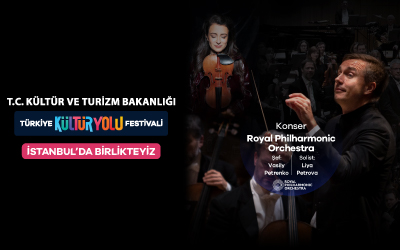
This concert, one of the events of the Kültür Yolu (‘Culture Route’) Festival at the Atatürk Cultural Centre, is given by the Royal Philharmonic Orchestra (London) under the baton of Vasily Petrenko, their Music Director. The first item on the programme is La Princesse lointaine (‘The Distant Princess’) – a richly-orchestrated piece, based on a play by Edmond Rostand about a medieval legend, by the Russian late Romantic composer Nikolai Tcherepnin (1873-1945).
This is followed by the Violin Concerto by Jean Sibelius (1865-1957), in which the solo part is played by Liya Petrova. Sibelius’s three-movement concerto – the only one he ever wrote – was written in 1904 and revised the following year; it has since become a cornerstone of the violin repertoire. The extended cadenza in the first movement, a particularly gruelling test for the soloist, takes on the character of a development section. The finale, which follows a lyrical second movement, was described by the musicologist Donald Tovey, author of Essays in Musical Analysis, as a ‘polonaise for polar bears’. About the work as whole Tovey was more gracious, however, declaring that he had ‘not met a more original, a more masterly, and a more exhilarating work than the Sibelius violin concerto’.
Finally, the orchestra play Tchaikovsky’s Symphony No 5, written in 1888. Shortly before he began composing it, Tchaikovsky described his new symphony as a ‘total submission to fate, or … the inscrutable designs of providence,’ and indeed it has a ‘fate’ motif that is heard in all four movements. Susan Key, writing on the ‘LA Phil’ website, tells us the following: ‘It is not explicitly nationalistic, but a distinctively Russian flavour pervades many of the themes.’ In fact, this symphony can be seen as an expression of bipolarity: the music moves between extremes of depression and euphoria, ending in a triumphant finale. The piece certainly has a strong emotional impact, and it is this – in addition to the masterful use of orchestral colour it displays – that has assured its place as one of the most popular symphonies ever written.
Atatürk Cultural Centre (Atatürk Kültür Merkezi or ‘AKM’) Türk Telekom Opera Hall, Gümüşsuyu Mah., Mete Cad. No 2 (formerly Tak-ı Zafer Cad.) – i.e., Taksim Square – Beyoğlu, 34437 Istanbul
20.00
Tickets from Biletinial
Prices: 2000TL, 3000TL, 4000TL, 5000TL
SATURDAY, SEPTEMBER 26
Royal Philharmonic Orchestra
The second concert by the Royal Philharmonic Orchestra – another of the events of the Kültür Yolu (‘Culture Route’) Festival at the Atatürk Cultural Centre – begins with a performance of Beethoven’s Piano Concerto No. 5 (the ‘Emperor Concerto’) in which the London orchestra, conducted by Vasily Petrenko, their Music Director, accompany soloist Elisabeth Leonskaja.
Beethoven’s Piano Concerto No 5 in E flat major, Opus 73, sometimes called the ‘Emperor Concerto’, was written in 1809 under extremely difficult conditions: Napoleon’s army was bombarding Vienna at the time, and Beethoven said in a letter to his publisher that there was ‘nothing but drums, cannons, men, misery of all sorts’ around him. In order to preserve his hearing, which was becoming seriously impaired, he fled to his brother’s cellar and covered his ears with pillows. Wikipedia describes the concerto as follows: ‘The work’s military aspects and symbolism characterise its heroic style. Beethoven used novel approaches with the piece, such as beginning the solo entrance without orchestral introduction, lengthening the concerto, and creating a new relationship between piano and orchestra. The first of its three movements, Allegro, is in sonata form and is longer than any opening movement of Beethoven’s earlier piano concertos. The second movement, Adagio un poco mosso, is a nocturne that directly builds into the third movement. The last movement, Rondo: Allegro ma non troppo, is in seven-part rondo form.’
In the second half, the orchestra play Ein Heldenleben (‘A Hero’s Life’), a tone poem by Richard Strauss (1864-1949) that was completed in 1898. Although intended by the composer to be a heroic work in the manner of Beethoven’s Symphony No. 3 (the ‘Eroica’), it is generally believed to be autobiographical in nature, and contains many quotations from the composer’s earlier works. There are six movements, tracing the hero’s progress through conflicts, battle, peace restored, and finally ‘the Hero’s retirement from this world, and completion’. Strauss himself wrote: ‘It is entitled ‘A Hero’s Life’, and while it has no funeral march, it does have lots of horns, horns being quite the thing to express heroism.’ (His fondness for this instrument was no doubt due to the fact that his own father was a virtuoso horn-player.) Opinions have always been divided over this piece. Bryan Gilliam, however, writing in the Grove Dictionary of Music and Musicians, takes a balanced view: ‘Various critics see the work as a flagrant instance of Strauss’s artistic egotism, but a deeper interpretation reveals the issue of autobiography to be far more complex. Ein Heldenleben treats two important subjects familiar from earlier works: the Nietzschean struggle between the individual and his outer and inner worlds, and the profundity of domestic love.’
Atatürk Cultural Centre (Atatürk Kültür Merkezi or ‘AKM’) Türk Telekom Opera Hall, Gümüşsuyu Mah., Mete Cad. No 2 (formerly Tak-ı Zafer Cad.) – i.e., Taksim Square – Beyoğlu, 34437 Istanbul
20.30
Tickets from Biletinial
Prices: 2000TL, 3000TL, 4000TL, 5000TL