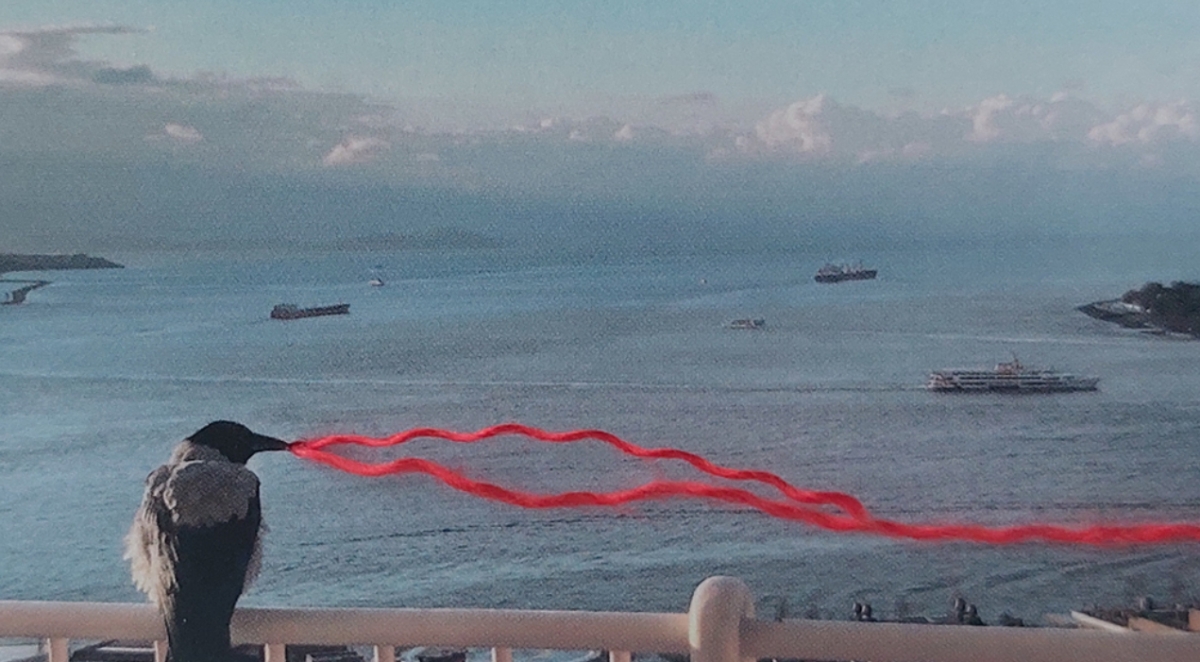
Before Byzantium was founded, the story goes, an older settlement already existed on the Anatolian shore of the Bosporus. One day, its inhabitants sought to build a fortress. They began by driving stakes into the ground, stretching threads between them so that the walls over the future foundation would become straight. But during the night, birds stole the strings. They carried them across the water and let them fall upon the tip of the Istanbul Peninsula. This is why the capital of two empires would later be founded there, on the opposite shore of the strait.
Following the flight of the mythical birds and the threads in their beaks in this legend, we may conceive of Istanbul as an airy fabric. Its threads take us from one side to the other; they form volatile correspondences between here and there, between land and air, between the tangible and the unseen, and between distant times. Some threads carry prayers that were silently spoken into the fine meshes of needlework (dantel) and lace (oya) in the hands of old ladies. Other threads are left behind at holy places. Especially in May, we see ribbons and wishes tied to trees all over Anatolia.
“And hold firmly to the rope of Allah”, the Qur’an says (3:103). People have been clinging to the rope in many ways. Pieces of the silk cover cloth (kisva) of the Kaaba with its gold embroideries used to travel to Istanbul every year, and individual threads of these fabrics have been carefully preserved in Istanbul, up to the present day.
Taking inspiration from the expression ipuçları toplamak (‘to gather thread ends’, ‘to collect the clues’, ‘to follow up traces’), anthropologist Esther Voswinckel Filiz has been collecting a variety of threads. Bringing together different threads – from laundry lines to lines of poetry, from a rare piece of Armenian embroidery to the domestic and ritual uses of white cloth in rites of passage – with threads of narration, the installation is an inquiry into textile forms of knowledge in Istanbul and beyond. Textile research practices invite us to move across boundaries and hierarchies within the established concepts of the meta-language of the humanities; they may offer a moment of destabilisation regarding differences among notions such as method, media, and material.
With contributions by: Ayda, Dilek & Artin Demirci, Ada Martella, Fatma Erol, Hediyeh Nobahar.
Esther Voswinckel Filiz studied anthropology and religious studies. For her doctoral thesis, Aziz Mahmud Hüdayi in Istanbul – Biography of a Place (published 2022), she conducted fieldwork in Istanbul over several years. Since 2020, she has been a researcher at the Orient-Institut Istanbul where she has organised several events and lectures dedicated to textile aspects of religion. In her postdoctoral research, she undertakes enquiries into fabrics, threads, and experiences of touch related to saintly places and Sufi practices in Istanbul, past and present.