Buy or gift a digital subscription and get access to the complete digital archive of every issue for just £18.99 / $23.99 / €21.99 a year.
Buy/gift a digital subscription Login to the Digital EditionIn the last years of empire, Beyoğlu could boast palaces and embassies as grand as any in Paris or Vienna. Abandoned by the moneyed classes in the first years of the Republic, it became a bohemian enclave, ringed by slums and louche nightclubs. At the turn of the millennium, all human life was here, as captured in Timurtaş Onan’s glorious images. Despite the creep of new-builds and chain stores, Beyoğlu, with its teeming streets, remains as joyfully anarchic as ever, as Maureen Freely relates

Beyoğlu, as we now call it, has always been a place apart. The Byzantines made that clear in their name for it: Pera is Greek for “over there”. What began as a small Genoese colony on the wrong side of the Golden Horn had by 1453 become one of the Levant’s principal ports, with a merchant class drawn from Venice, Sicily and Malta as well as Genoa, and an underbelly of taverns and bordellos to rival any port in Europe.
Under Ottoman rule it continued to grow, in both commercial importance and notoriety. And though Muslims began to settle along its shores in the centuries following the conquest, opening medreses and tekkes and building many mosques, the district as a whole held onto its European roots, each new hilltop embassy surrounding itself with the schools, hospitals and churches it had helped to sponsor – not just to serve its own kind, but to bring into its sphere of influence the district’s longtime Greek, Armenian and Jewish residents. The growing prosperity of the city’s non-Muslim communities in the Ottoman Empire’s last century led to a huge surge in construction, with mansions and arcades and grand stairways designed by Europe’s finest architects soon lining its main thoroughfare, and most of the side streets as well. But after Turkey became a republic in 1923, Beyoğlu’s commercial and political importance dwindled. Its embassies were now consulates. The moneyed classes began to leave. Once abandoned, their grand edifices began to crumble. And wherever a fire or an irreversible collapse offered an opportunity, there was soon a concrete monstrosity to fill the gap.
And yet. Even in the darkest days of Beyoğlu’s 20th century, it remained a place where artists, writers and musicians gathered, and journalists exchanged rumours, and melodramas were written, filmed and dubbed, and students could go for a drink and stay for the atmosphere, in dimly lit establishments where it was sometimes hard to tell the gangsters and fallen women apart from the character actors from the film studios down the road. Even after most of Beyoğlu’s minorities were gone, there were still Greek delicatessens, Armenian pharmacies and Russian restaurants, as well as Roma neighbourhoods and transvestite neighbourhoods and too many louche nightclubs to count, and mansions chopped up into 30 ateliers, or 20 dentist offices, with basements that served as all-night coffee houses for the homeless.
And who can say what exactly was the turning point? It could have been the beautiful wreck that a forward-thinking architect returned to its formal splendour, so impressing her friends that they went out in search of their own. Or it could have been the new bookshops, meyhanes, theatres, jazz clubs and coffee houses that were soon filling every side street. Beyoğlu’s transformation was well under way in 2001, when the photographer Timurtaş Onan returned to Istanbul after a long absence: the glorious pictures you see here are a testament to those heady days when it was just opening up, but still holding it own. İstiklâl, the main thoroughfare, had been pedestrianised while he was away, and the old tramline restored. Jumping on board, he photographed the crowds swarming past on either side, and the long line of old mansions he knew so well and could see so much more clearly now that they had been cleaned of their grit and grime. But even more important were his fellow passengers, with whom he had made such good friends by the time he raised his camera that they forgot to pose.
Many of his subjects are much-loved Beyoğlu personages and friends from his youth, when he worked here as a DJ. There is Yakup of the legendary meyhane Yakup 2. İlya of the also legendary corset shop. Feridun Dörtler of the Üç Yıldızlar sweetshop. Namık Denizhan the sculptor. Ahmet Ümit the poet and crime novelist. Others are people he encountered by chance: the new law graduate with her bouquet, the new bride gazing upwards, the Romanian accordionist playing beside her child, the woman leaning out of the window of an old mansion, the retro shop assistant. Some – like the woman buying a newspaper, framed by an arch, and the person hurrying up the Tünel Han’s circular stairs – are small and distant figures, but like so much of Timurtaş Onan’s work, they suggest a story, and never more than in the photograph of the three friends on the bench. There they sit, entranced by a juggler only they can see. This could be a still from a film. In the five-volume anthology of Timurtaş Onan’s Istanbul photographs, which have featured in exhibitions across Europe, you will find many images of poverty and ruin, random destruction and pointless waste. But in his final and most recent volume, from which these images are taken, he has above all dedicated himself to capturing moments of joy, most dramatically in his depictions of Beyoğlu by night, in rooms lit by dancing and laughter, and in Asmalımescit’s outdoor meyhanes, later to be cleared away and banned.
Although some of the photographs in his Beyoğlu collection are recent additions, most were taken between 2001 and 2009. Many of the old friends seen here are no longer with us. Quite a few of the shops have vanished with them. In their place have come chain stores and new-builds that might have been designed by Mussolini. Though some of the cafés, jazz clubs and bookshops of Beyoğlu’s brief bohemian renaissance survive, most have vanished to make way for fast-food restaurants, identikit hotels and malls, and shops selling tourist tack.
But you have only to join the quarter-million pedestrians that walk İstiklâl each day to see that the facelift isn’t quite working. In the streets of Beyoğlu, the old chaos still reigns supreme. To walk up the hill from the bridge, or to step down any street, is to see all expectations defied. A mosque and a synagogue standing side by side, surrounded by chandelier shops. A dozen protestors jumping over twice as many stray cats as they rush past the British-owned private members’ club that began its life as an Ottoman palace and was until recently the US Consulate. A few of them peeling away into one of the hidden alleyways where students hard hit by inflation can still sit for many hours for the price of one beer, while just a street away, 30 or more riot police mill around listlessly checking their phones. Halfway down the steep lane just beyond them, an exhausted porter stumbles, letting go of a cart that must be twice as heavy as he is, and down it rolls, only to be stopped by the five or six men who appear out of nowhere and somehow manage to spring into action in time to stop the cart from ploughing into 50-odd crates of light bulbs. For all that Beyoğlu has lost in recent years, it is still a place apart, thriving in its contradictions. No one has ever been able to tame it. And no one ever will.
Reading the full, illustrated article here
The Istanbul Research Institute celebrates the life and work of Arif Hikmet Koyunoğlu

The wondrous cornelian cherry, by Berrin Torolsan

The ceramic secrets of a 16th-century bath house
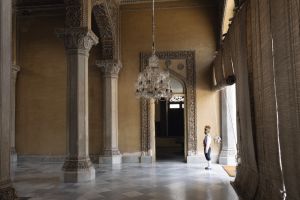
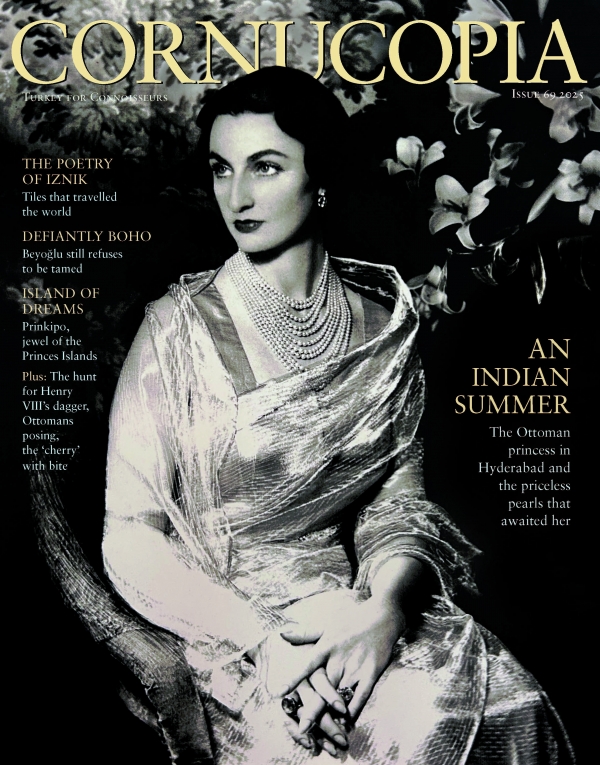
When two exiled Ottoman princesses married into the family of the richest man in the world, the match made headlines around the globe. Cosmo Brockway describes the opulence that awaited them in Hyderabad. Palace photographs by Monica Fritz

Tim Stanley delves into an exhibition about a vanished treasure once believed to have been owned by Henry VIII

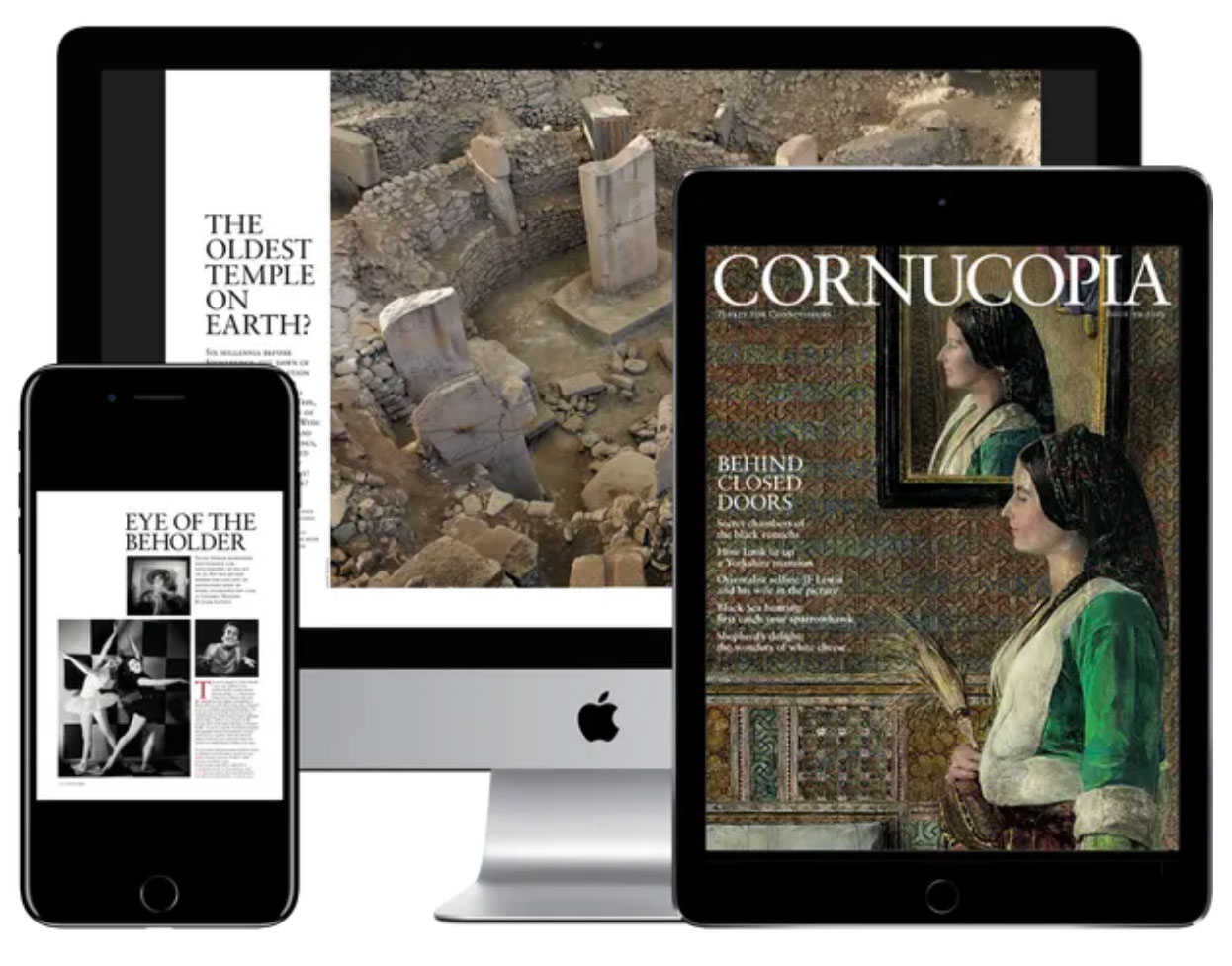
Cornucopia works in partnership with the digital publishing platform Exact Editions to offer individual and institutional subscribers unlimited access to a searchable archive of fascinating back issues and every newly published issue. The digital edition of Cornucopia is available cross-platform on web, iOS and Android and offers a comprehensive search function, allowing the title’s cultural content to be delved into at the touch of a button.
Digital Subscription: £18.99 / $23.99 (1 year)
Subscribe now