
Buy or gift a digital subscription and get access to the complete digital archive of every issue for just £18.99 / $23.99 / €21.99 a year.
Buy/gift a digital subscription Login to the Digital Edition
From the Preface by Sven Becker:
This catalogue comprises a selection of armorial bindings, bindings produced by specific workshops, and fine bindings from historic collections. To a lesser extent, it also includes bindings made distinctive by some particularity. For example, bindings commissioned for presentation, bindings that are stylistically unusual for their time and place, and publisher’s bindings made ad hoc for the author or for an uncommon deluxe issue.
All are drawn from the ‘Ottoman Lands’ shelves of the Ömer Koç library. The six volumes of the library catalogue published to date all had Constantinople as the primary subject. The present catalogue’s broader remit gives a clearer glimpse of the collection’s true extent: the Ömer Koç library is rich in material relating to Egypt, the Caucasus, the Balkans, Palestine, Anatolia and all the lands that were once under Ottoman sway.
The publication of his scholarly five-volume Impressions of Istanbul between 2014 and 2023 has established Ömer Koç’s reputation as the greatest living collector of books on European exploration in Ottoman lands. Now his librarian, Sven Becker, has selected over 300 books, from the 16th to the 20th century, for special scrutiny, focusing on the look of them and displaying them in beautiful detailed colour photographs by Hadiye Cangökçe.
For Koç a book needs to appeal not only to his intellect and imagination, but also to his aesthetic sense, and Becker’s approach reflects this. Each volume is photographed and described in fine detail, with attention given to the significance of its ownership marks, and for each binding its size, material and decoration are meticulously described. There is also a lengthy bibliography, a list of provenances and an index.
The book opens with an introduction by Koç, who pays tribute to his late friend and mentor, Şefik E Atabey, to whom this volume is dedicated. Atabey was a Turkish businessman based in Paris, where he began collecting books, manuscripts and maps of the Ottoman world during the 1960s. It was a time in the antiquarian book trade when fine bindings, often executed for French royal and imperial libraries, could readily be found, and in the superlative condition that Atabey required. As Koç writes, “What makes Atabey’s collection unique is the condition and caparisoning of his books.”
When the Atabey collection was sold by Sotheby’s in 2002, Ömer Koç was the main buyer. He attended the sale with his friend and, as the hammer came down on lot after lot of beautifully caparisoned books, it was clear to all that the mantle had passed to the rightful successor. Since that sale, Koç has taken every opportunity to add to his library, never departing from the early advice of his mentor that a book should be cherished not only for its content but also for its physical enchantment.
Although the books featured in this catalogue were primarily chosen for their fine bindings, the content is not ignored. For centuries the Ottoman Empire was Europe’s greatest source of commercial opportunity and military anxiety. So it’s hardly surprising to find books on the subject in collections belonging to the foreign ruling classes. The personal libraries of female bibliophiles are well represented, including two examples of books bound for the Comtesse de Verrue (1670–1736), whose library was regarded as a diamond set in gold. Books were bound in different-coloured leather for three of Louis XV’s daughters – red for Adélaïde, green for Victoire and citron for Sophie. Books bound for Madame de Pompadour, the King’s favourite mistress, and Marie Leszczynska, his consort, are amusingly shelved side by side.
Books belonging to Pauline Bonaparte, Napoleon’s sister, and his niece, Laetitia Bonaparte-Wyse, are also represented. Colonel Leicester Stanhope gave Laetitia a copy of his book on the Greek Revolution, beautifully bound in coral-red morocco, elaborately gilt with a fine Greek-key border. It’s tempting to speculate that books on the Ottoman lands held a special fascination for women in European society, who had yet to enjoy many of the rights and privileges of their Turkish sisters, so vividly documented in Lady Mary Wortley Montagu’s Turkish Embassy Letters.
From the libraries of two celebrated society beauties comes an elegantly bound copy of Alphonse de Beauchamp’s Napoleonic-era memoirs. The book was published in 1825 and bound for the Duchesse de Berry, the “Queen of the Troubadour style”. It was later acquired by Duff and Diana Cooper, who added their stylish bookplate designed by Rex Whistler. Although Becker manages admirably to avoid adjectives of enthusiasm in his cataloguing, it’s difficult to look at such a copy without experiencing the romance of provenance.
According to the Comte de Laborde, author of a couple of travel books on the Levant, “la reliure est un art tout français”. And so it might seem from the procession of exquisite Parisian bindings in the Koç library, including masterpieces by Bozerian the Younger, the “Beau Brummell” of bookbinding. Bozerian taught Joseph Thouvenin, who was a contemporary of René Simier, and both are binders of artistic and technical perfection, well represented in this catalogue. An unsigned binding executed for one of Louis-Philippe’s sons deserves mention for its “Cathedral” decoration, a style that was popular in English and French bindings in the first half of the 19th century.
Not to detract from the French contribution to every aspect of bibliophily, it’s time to mention some of the handsome bindings that were commissioned from London workshops by William Beckford. A celebrated collector of fastidious taste, Beckford’s books are well represented in the Koç library. Beckford favoured the work of Christian Kalthoeber, who came to London from Germany in the late 18th century. Kalthoeber’s work embodies elegance and restraint, and there are several fine examples in the Koç library, of which the uniform bindings for Robert Wood’s The Ruins of Palmyra and The Ruins of Balbec are typical. There is also a fine example of a Neoclassical binding designed by Robert Adam for a copy of his great architectural folio, The Ruins of the Palace of the Emperor Diocletian at Spalatro in Dalmatia.
It has been said that a gentleman needs three copies of a book – one for his collection, one to read and one to lend to his friends. Ömer Koç already possesses two copies of James Stuart and Nicholas Revett’s The Antiquities of Athens, including one bound by Charles Smith, a favourite of Beckford’s. An ideal third copy would be one of the rare examples of Stuart and Revett’s book bound for presentation in a Neoclassical binding of Stuart’s own design.
The work of foreign bookbinders active in Istanbul from the late 19th century brings this catalogue to a fitting close. Examples include an armorial binding for Sultan Abdülhamid II by Auguste Tarnawski of 575 Grande Rue de Péra. The history of the adoption of European-style heraldry by the imperial Ottoman dynasty from the time of Abdülhamid’s reign to the abolition of the Sultanate is succinctly explained. As Philip Mansel notes in his introduction to a volume of Impressions of Istanbul, the city of the world’s desire lost a great empire but, thanks to Ömer Koç, it gained a library. u
Sheila Markham is the Librarian of the Travellers Club in London and a regular contributor to The Book Collector; sheilamarkham@hotmail.com

1. STANDARD
Standard, untracked shipping is available worldwide. However, for high-value or heavy shipments outside the UK and Turkey, we strongly recommend option 2 or 3.
2. TRACKED SHIPPING
You can choose this option when ordering online.
3. EXPRESS SHIPPING
Contact subscriptions@cornucopia.net for a quote.
You can also order directly through subscriptions@cornucopia.net if you are worried about shipping times. We can issue a secure online invoice payable by debit or credit card for your order.

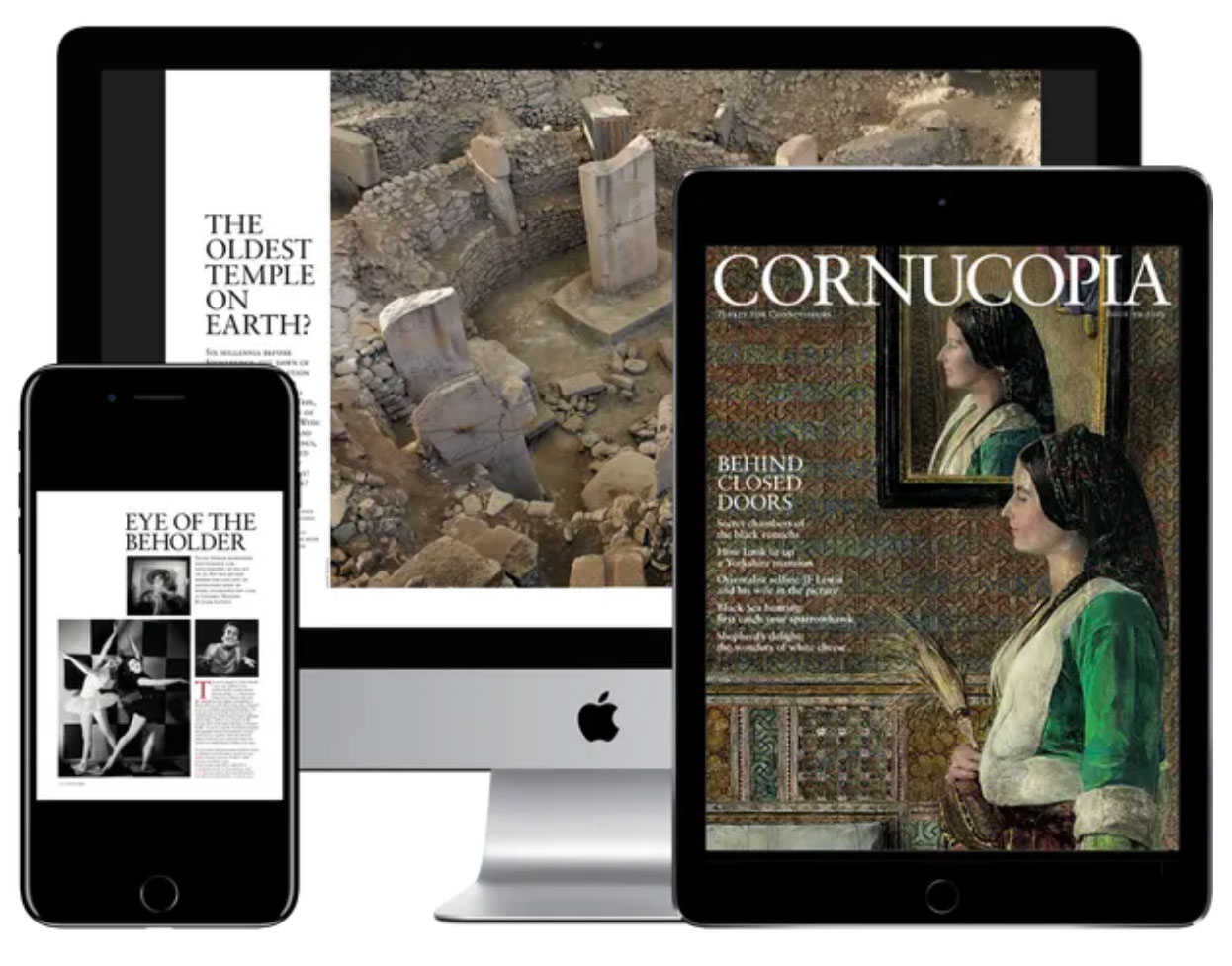
Cornucopia works in partnership with the digital publishing platform Exact Editions to offer individual and institutional subscribers unlimited access to a searchable archive of fascinating back issues and every newly published issue. The digital edition of Cornucopia is available cross-platform on web, iOS and Android and offers a comprehensive search function, allowing the title’s cultural content to be delved into at the touch of a button.
Digital Subscription: £18.99 / $23.99 (1 year)
Subscribe now