
Buy or gift a digital subscription and get access to the complete digital archive of every issue for just £18.99 / $23.99 / €21.99 a year.
Buy/gift a digital subscription Login to the Digital EditionPainters of the Ottoman Empire II European Artists in the Ömer Koç Collection Claude Piening Enderun (Vols I & II) £320

The second volume of Painters of the Ottoman World mirrors the dazzling, layered and contradictory city at its heart: Istanbul, or Constantinople as many of the artists would have known it. Where Volume I (Cornucopia 69), written by the late Briony Llewellyn, charted the work of British, Maltese and Levantine artists, this second volume, written by Claude Piening, catalogues the work of Continental European artists in the Ömer Koç Collection. The result is a fitting testament to Koç’s knowledge and astute eye, honed over more than 30 years of collecting, as well as to the beautiful production values characteristic of the publisher. But, above all, through its bold juxtapositions and layered affinities, this catalogue offers a striking visual argument that reveals the varied modes through which the Ottoman world, and especially Istanbul, has been imagined, reimagined and interpreted.
In contrast to the first volume, which was organised by generation and artistic approach, this book is arranged alphabetically, which creates a wonderfully unpredictable reading experience. Each page becomes a leap across time, geography and style that serves to emphasise the juxtapositions and unexpected connections between the artworks. Piening’s prose is perceptive and learned throughout; he succinctly introduces each artist and draws out visual nuances or revealing historical details in a collection of astounding scope and variety. The catalogue ranges from the 16th century to the 20th, with most examples dating to between 1798 (the year of Napoleon’s Egyptian expedition) and 1909 (when Sultan Abdülhamid II was forced into exile by the Young Turks). More than 350 artworks by some 118 artists are reproduced in sumptuous quality throughout. The Ottoman world they depict is geographically broad: it stretches from Crimea to the Maghreb, from ancient Egyptian temples to classical monuments in Anatolia, but above all it is visions of Istanbul that lie at the heart of this collection.
The two earliest works, by the Veronese artist Jacopo Ligozzi (1547–1627), are a reminder of the long history of European fascination with the Ottomans. There is no evidence that Ligozzi ever travelled to the Orient. His precise imagery is drawn from contemporary Ottoman costume albums, but he subverts this genre with the addition of animals that playfully complicate the scene. In one example, he enigmatically pairs a Greek woman with a ram.
Ligozzi was not alone in refashioning the Ottoman world from afar. Other artists in the collection, such as CW Eckersberg and Johann Heinrich Tischbein, similarly never visited. Their visions of Ottoman society speak to the iterative fascination of this world for so many European artists and to the enduring influence of earlier artistic representations.
Most of the artists in the collection, however, did travel, and for myriad reasons: academic enquiry, adventure, commerce, diplomacy, escapism and opportunism all proved recurring motivations. For some artists, their travels proved transformative; for others, it was less kind. Following their Oriental tours, Jean-Étienne Liotard (1702–89) termed himself “le peintre Turc”while the gloriously named Prosper Marilhat (1811–47) styled himself as “The Egyptian” in his letters and dress. But the poignant fate of the 18th-century Italian painter Andrea Soldi, who died in poverty despite painting elegant, turbaned European merchants, serves as a reminder of the precariousness underlying some of these artistic careers.
One of the revelations of this catalogue is that the artworks, when taken as a corpus, do not present a flattened form of Orientalism. While several works conform to the classic tropes of this artistic vision and style, many others complicate and surprise. Take, for instance, Alois von Anreiter’s sensitive and deeply human portrait of the characterful Nafy Efendi, the Ambassador of the Sublime Porte to Vienna between 1844 and 1846. Or Émile Bernard’s delicate representation of the Sunnet Köprüsü (Circumcision Bridge) at the top of the Golden Horn, which unexpectedly filters Istanbul through the aesthetics of Japanese prints.
This volume catalogues Istanbul from many different angles: architectural plans, costume studies, landscapes, panoramas, portraits and intimate scenes of street life. The alphabetical organisation creates provocative juxtapositions that underline the city’s complexities and contradictions. The turn of a page takes one from the coolly exacting architectural drawings of Antoine-Ignace Melling (1763–1831) to the exuberant impressionistic colouring of Paul Meyerheimer (1842–1915). Charles Stanislas Léveillé’s densely observant watercolour street scene contrasts beautifully with Lucien Lévy-Dhurmer’s ghostly nocturne on the following page, where water, sky, boats and minarets dissolve into one another.
The same sites are treated in splendidly distinct ways. The dreamlike apparition of Ayasofya as conjured by the Dutch artist Marius Bauer (1867–1932) contrasts with Gaspare Fossati’s voluminous interior vision of the same structure, or with Henry Valensi’s disorienting study in which Ayasofya turns in and on itself in a riot of shapes and colours. In these examples, Istanbul emerges not as a
fixed entity but as a shifting construct, refracted through the eyes of a diverse cast
of travellers. This is a book as much about perception as place.
There are also thought-provoking visual threads to trace across the centuries. The Cubist artworks by the Ukrainian painter Alexis Gritchenko (1883–1977) are among the book’s most striking interpretations of
the city. Skewed angles, impossible layers, disorienting perspectives: his work evokes the hilled city’s vertiginous topography in ways that unexpectedly echo the earlier imagery of Eugène Napoléon Flandin (1809–76) or Alexius Geyer (1816–83), who similarly capture the expansive layers of the domed city, albeit in more conventional terms. The work of Paul Signac (1863–1935) is another case of unexpected visual resonances. Guillaume Apollinaire likened Signac’s technique to Byzantine mosaics. The comparison
is apt. Signac’s pointillism is a study in shimmering tessellation. Yet his watercolours offer a quieter, more fluid vision of the city. Here, minarets mingle with boat masts in ways that evoke earlier panoramas of the Bosphorus and the forest of boats that inhabited it. Each vision of the city plays upon the last as well as upon the next in exciting ways.
This catalogue abounds with surprises, such as Johann Jakob Falkeisen’s fascinating 19th-century watercolours of his family’s distillery at the Cave Grotte in the district of Çekirge in Bursa. He recorded the processes of producing wine and distilling rakı, the great vats stored in caves, the company’s offices and warehouses, as well as an idyllic scene of the family garden. Equally extraordinary are the diplomatic fêtes recorded by Fossati, where Ottoman fezzes socialise with the medieval fancy dress of European diplomats.
The volume thus provides invaluable records of absences: rare views of lost monuments, vanished customs and moments of political theatre. These are documents of a world in flux.
Ultimately, the great pleasure of this catalogue lies in its visual rhythm – its provocative disparities, its leaps across centuries and styles, its kaleidoscopic shifts between the canonical and the obscure. This magisterial two-volume set is not merely an invaluable work of reference; like Istanbul, it is a treasure trove that rewards wandering, chance encounters and repeated looking.
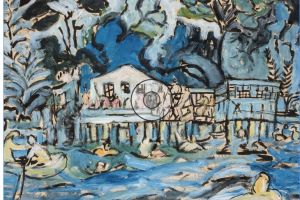
The Turkish modernist painter Fahrelnissa Zeid’s style was constantly evolving, but through it all ran the sadness of a turbulent life
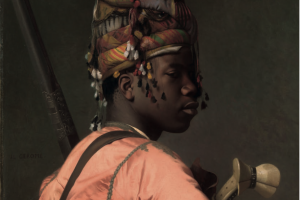
Lucien de Guise admires the Met’s calm reclaiming of the term ‘Orientalist’ for its new show exploring European and Ottoman views of Islamic art
Thomas Roueché loses himself in cabinets of delight at Istanbul’s Meşher
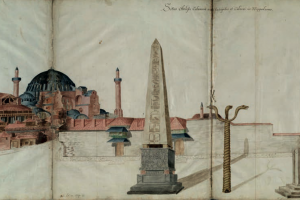
Tim Stanley, curator of ‘Constantinople to Istanbul: One City, Two Empires’ at the V&A, ponders elusive links between the two imperial capitals and relishes the chance to exhibit surprising treasures that show the role this great city has played in fashioning our idea of how to live


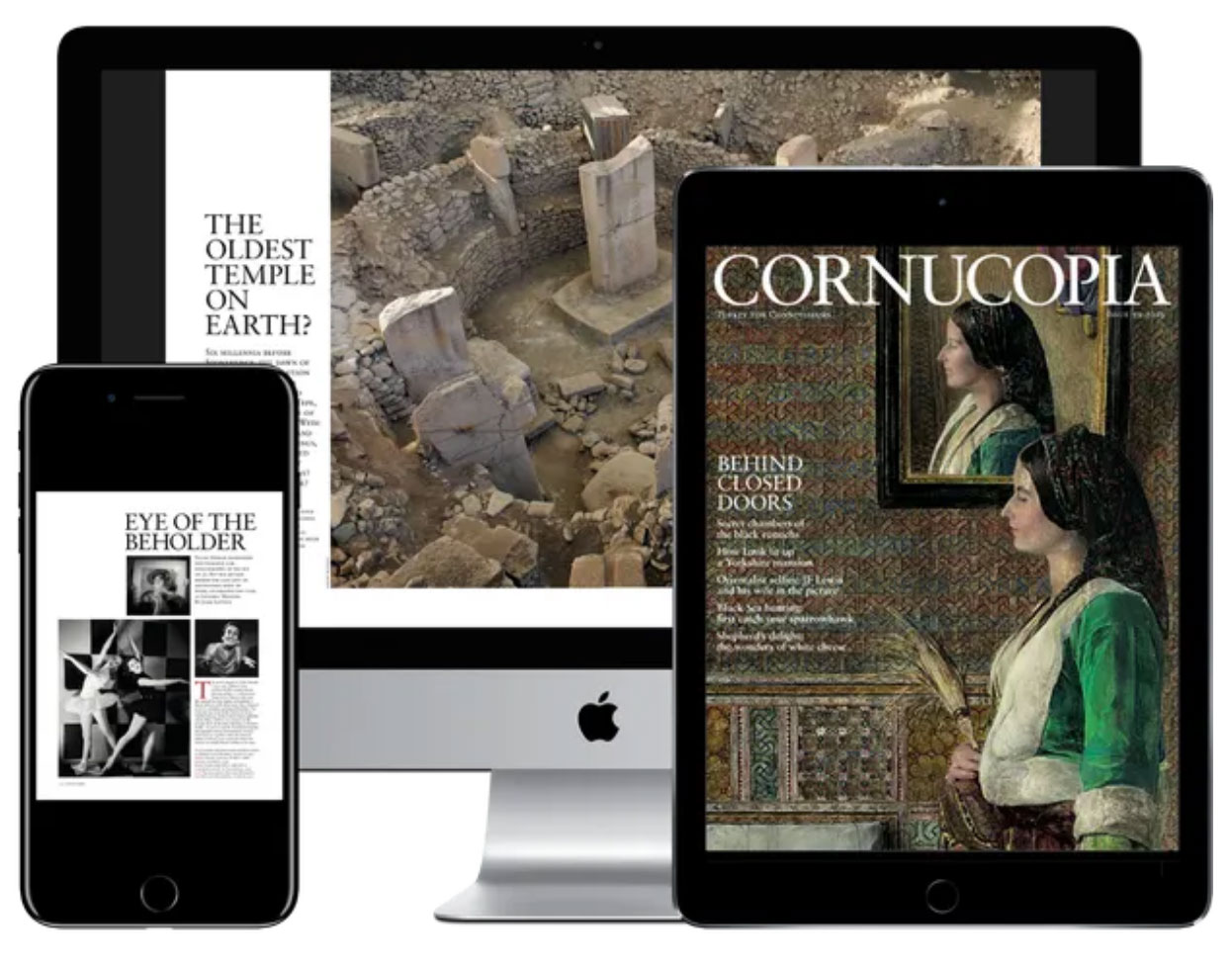
Cornucopia works in partnership with the digital publishing platform Exact Editions to offer individual and institutional subscribers unlimited access to a searchable archive of fascinating back issues and every newly published issue. The digital edition of Cornucopia is available cross-platform on web, iOS and Android and offers a comprehensive search function, allowing the title’s cultural content to be delved into at the touch of a button.
Digital Subscription: £18.99 / $23.99 (1 year)
Subscribe now