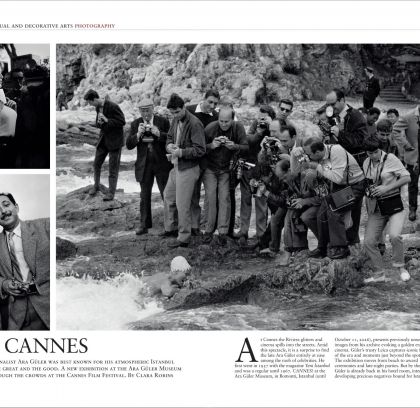
The period that began in the late 1950s and continued throughout the 1960s was one of the most exciting times in the history of cinema – especially so in the case of the Cannes Film Festival! Cannes is the place where the directors we now regard as great masters first emerged as ‘young talents’. These were the years when the films that are now seen as being among the classics received their first showings, and were applauded for their ‘innovative’ approaches; they were also the times when cinema underwent a renewal. The film industry’s leading producers and its brightest stars were still dominating the box offices; meanwhile, a phenomenon known as ‘New Cinema’ was springing up all over the world. Rules that brought restrictions to the way films were made – rules of both a socio-political and a financial nature – were overturned by rebels within the film industry. The golden age of film festivals had begun; people flocked to festivals of this kind, and most of all to Cannes. An ‘Age of the Image’, as yet unnamed, was being inaugurated.
Ara Güler was both a photographer who was a masterly creator of images and a journalist who pursued the stories behind these images. Everyone was striving to achieve ‘the perfect pose’: celebrities and aspiring celebrities were posing on the red carpet, on the beach, or on La Croisette, showing off their most elegant stance and presenting their most appealing facial expression to the cameras. Ara Güler, however, preferred spontaneously-taken shots to poses of this nature; here, in what was probably the most photographed place in the world, he demonstrated his ability to capture the precise moment and conjure a story from an image.
His first visit to the Cannes Film Festival took place in 1957, when Yeni İstanbul (‘New Istanbul’), the newspaper he was working for at the time, asked him to do a piece of photo-journalism about the festival. That was the first of many trips to Cannes that went on until the end of the 1960s; some of the articles he produced were published in Hayat (‘Life’) magazine. This period saw him achieve important successes, and he became a photo-journalist of international repute. All the journalists and photographers would wait outside the sumptuous Carlton Hotel, a place whose name had become synonymous with the festival, and that hosted all the celebrities of the era. Very few of them, however, managed to get in the lift with Sophia Loren by pretending to be part of her entourage, enter the great star’s room, join in the conversation there, and – after obtaining permission – photograph her reclining on her bed, thus achieving a major scoop*. It was at around this time that thanks to his combination of adroit social skills and expertise in the realm of image creation he came to the attention of Paris Match, and received an offer of work from them.
Ara Güler was a genuine cinephile. As he demonstrated in End of a Hero, the documentary about the battleship Yavuz that he made in 1975, he always had the potential to be a director. During his childhood, he was already holding showings of film sequences he had put together himself for his friends at his family’s summer home in the Istanbul suburb of Suadiye. It was for this reason that he was able to engage several of the people from the world of cinema that he met in Cannes in meaningful and informed dialogue, make friends with them, and maintain these relationships throughout the years that followed. Thus, his trips to the Cannes Film Festival were not merely a requirement of his profession: they were also visits to friends.
This is the first time that almost all of the photographs in one of our exhibitions – in this case, images that reflect the pleasure Ara Güler derived from being in Cannes – have been taken from the archive. Accompanying them are newspapers, contact prints, his press cards and ephemera of various kinds. As Ara Güler the cinephile, standing beneath the palm trees, gazes at us through the lens of the camera that always hung around his neck, he brings to us all the glitter of a bygone age. You are hereby invited to set out on a journey through time that will make you wonder how black-and-white photographs could possibly reproduce all the colours of the Cannes Film Festival!