Find it

AKM highlights, April 2026

April 1, 2026 – April 30, 2026

Atatürk Cultural Centre / Atatürk Kültür Merkezi (AKM), Gümüşsuyu Mah., Mete Cad. No 2 (i.e., Taksim Square), Beyoğlu, 34437 Istanbul


Thursday April 23 Saturday April 25 Wednesday April 29

Opera

Wagner’s ‘The Flying Dutchman’

Richard Wagner’s German-language opera The Flying Dutchman (‘Der fliegende Holländer’, 1843), in which both the libretto and the music are by the composer, is based on a satirical novel by Heinrich Heine. The Dutchman, a sailor who has been ‘stripped of his mortality because he defied the seas and storms without yielding’, has been condemned to sail the seas forever on a ghost ship. Allowed to go ashore only once every seven years, he will be rescued from his fate only if he can secure the true and faithful love of a woman. On one of these seven-yearly shore leaves, the ship brings him to a spot close to a village in Norway. There, he meets a man named Daland and stays the night in the house. He then discovers that this man has a daughter. Will her love for the Dutchman save him from his fate?

In his autobiography, Wagner claimed to have been inspired to write this opera by a violently stormy sea crossing from Riga to London that he had made in 1839; during this trip, the ship had been forced to take refuge in the Norwegian fjords. His favourite themes of penance, redemption through love, death and escape from a cruel destiny are once again evident in this work, in which some have seen parallels between the main character’s psychology and that of the composer himself.

In this performance, directed by Sebastian Welker, the Istanbul State Opera and Ballet Orchestra will be conducted by İbrahim Yazıcı, and the chorus by Volkan Akkoç.

Atatürk Cultural Centre (Atatürk Kültür Merkezi or ‘AKM’) Türk Telekom Opera Hall, Gümüşsuyu Mah., Mete Cad. No 2 (formerly Tak-ı Zafer Cad.) – i.e., Taksim Square – Beyoğlu, 34437 Istanbul

Thursday April 23 – 20:00 Saturday April 25 – 15:00 Wednesday April 29 – 20:00

Tickets from Biletinial Prices: 240TL, 335TL, 440TL, 660TL, 890TL

Event website

Friday, April 3

Flute concerto, ballet music

Istanbul State Symphony Orchestra, Bülent Evcil, İlke Kodal

At this event, one of the DenizBank Concerts, the Istanbul State Symphony Orchestra, under the baton of Swiss-American guest conductor John Axelrod (a student of Leonard Bernstein in the USA and of Ilya Musin at the St. Petersburg Conservatory), will begin its programme with the 1932 Flute Concerto by the French composer Jacques Ibert (1890-1962), the solo flute part being played by Bülent Evcil, a member of the orchestra.

This three-movement work, dedicated to the French flautist Marcel Moyse and often described as ‘eclectic’ in style, is regarded as one of the most challenging pieces in the entire flute repertoire. Georg Predota, writing on the ‘Interlude’ website, tells us the following: ‘At the heart of the French flute tradition are pace, tempo and suppleness of tone. Ibert combined them with a high degree of musical charm that speaks directly to the great majority of listeners. … The first movement is elegant and exudes classical poise, while the slow movement sounds an extended reverie with a passionate climax. … A French commentator described the concluding Allegro Scherzando as ‘a blast of fireworks suspended in mid air’.’ This work only takes about 20-25 minutes to play, by the way, so I wonder whether any other piece will be performed to ‘pad out’ the first half of the concert.

After the break, the orchestra will play Igor Stravinsky’s Firebird Suite, a work derived from the composer’s 1910 ballet score for Sergei Diaghilev’s Ballets Russes. Based on Russian folklore, the music – which demonstrates superb use of orchestral colour (Stravinsky had taken to heart the lessons he had received from master orchestrator Nikolai Rimsky-Korsakov) – depicts Prince Ivan’s battle with the sorcerer Kastchei with the help of a magical bird.

Stravinsky created three different suites (in 1911, 1919 and 1945) from the original full-length ballet score; the most frequently performed version – designed for concert performance rather than ballet, but including more scenes from the ballet than the other two versions – is the 1919 orchestral suite. The work was an immediate success at its first performance in Paris, bringing international fame for the young, and until then relatively unknown, Stravinsky and leading to further collaborations with Diaghilev such as Petrushka (1911) and The Rite of Spring (1913). Here are two accounts of The Firebird: an article by Herbert Glass on the ‘La Phil’ website, and the Wikipedia entry. This performance features dancer İlke Kodal, who is also responsible for the choreography.

Atatürk Cultural Centre (Atatürk Kültür Merkezi or ‘AKM’) Türk Telekom Opera Hall, Gümüşsuyu Mah., Mete Cad. No 2 (formerly Tak-ı Zafer Cad.) – i.e., Taksim Square – Beyoğlu, 34437 Istanbul

20:00

Tickets from Biletinial Prices: 260TL, 325TL, 455TL, 520TL, 650TL Students: 130TL, 162.50TL, 227.50TL, 260TL, 325TL

Event website

Saturday, April 4

Coffee Concert: ‘Morning in Bakü’

Bogatay Köprülü, Birce Polat (piano)

This Türk Telekom Prime Coffee Concert features Burcu Karadağ, a player of the ney (the end-blown flute, usually made of cane or giant reed, that is traditionally used in Turkish Classical and Sufi music) and pianist Nicat Aslanov. Their programme consists of Azeri and Turkish pieces interpreted in a style that makes use of jazz harmonies.

Atatürk Cultural Centre (Atatürk Kültür Merkezi or ‘AKM’) Türk Telekom Opera Hall lower floor foyer, Gümüşsuyu Mah., Mete Cad. No 2 (formerly Tak-ı Zafer Cad.) – i.e., Taksim Square – Beyoğlu, 34437 Istanbul

11:00

Tickets from Biletinial Price: 350TL

Event website

Friday, April 10

Clarinet concerto, orchestral music

Istanbul State Symphony Orchestra, Darko Brlek

The Istanbul State Symphony Orchestra, under the baton of Italian guest conductor Alfonso Scarano, will first accompany the Slovenian clarinettist Darko Brlek (who was also President of the European Festivals Association from 2005 to 2017) in Mozart’s Clarinet Concerto in A major, K 622. This popular three-movement piece, written for Anton Stadler (a virtuoso clarinettist who was also a friend of the composer) was the last major work Mozart wrote.

In the second half, the orchestra will play Igor Stravinsky’s Pulcinella Suite and Ottorino Respighi’s Pines of Rome. The Pulcinella Suite, written for Sergei Diaghilev’s Ballets Russes and first performed in Paris in 1920, is the first work in the composer’s ‘neo-classical’ period. Inspired by the Neapolitan commedia del arte tradition, it makes use of the music of 18th-century composers, especially Pergolesi. The costumes and sets for the first performance were designed by Picasso.

Pines of Rome by Ottorino Respighi (1879-1936) – a master orchestrator (like Stravinsky, he was a pupil of Rimsky-Korsakov) – is a tone poem in four movements that was completed in 1924. It depicts various landscapes in Rome, each featuring pine trees, at different times of day. This event is one of the DenizBank Concerts.

Atatürk Cultural Centre (Atatürk Kültür Merkezi or ‘AKM’) Türk Telekom Opera Hall, Gümüşsuyu Mah., Mete Cad. No 2 (formerly Tak-ı Zafer Cad.) – i.e., Taksim Square – Beyoğlu, 34437 Istanbul

20:00

Tickets from Biletinial Prices: 260TL, 325TL, 455TL, 520TL, 650TL Students: 130TL, 162.50TL, 227.50TL, 260TL, 325TL

Event website

Saturday, April 11

Coffee Concert

Violin and piano recital

In this Türk Telekom Prime Coffee Concert, subtitled 3 Maskeli Hikaye (‘Three Masked Stories’), violinist Alican Süner and pianist Deniz Gür first perform the Much Ado About Nothing Suite, Opus 11, by the Austrian-American composer, pianist and conductor Erich Wolfgang Korngold (1897-1957). Written in 1918-19, this is his most famous incidental music for the theatre. After emigrating from Austria to the USA in the mid-1930s (smart move – he was Jewish), Korngold made a name for himself as a composer of music for Hollywood films. The second work on their programme is Brahms’s Sonata No 2 in A major for Violin and Piano, a lyrical and relaxed piece written while the composer was holidaying beside Lake Thun (in the Bernese Oberland) in 1886. Finally, they play the Italian composer Ottorino Respighi’s Six Pieces for Piano, P 044, written between 1903 and 1905 in a number of different styles ranging from Baroque and Classical to Romantic and Impressionist. (Whether or not this piece will be played by the pianist only or in an arrangement for violin and piano is not specified.)

Atatürk Cultural Centre (Atatürk Kültür Merkezi or ‘AKM’) Türk Telekom Opera Hall lower floor foyer, Gümüşsuyu Mah., Mete Cad. No 2 (formerly Tak-ı Zafer Cad.) – i.e., Taksim Square – Beyoğlu, 34437 Istanbul

11:00

Tickets from Biletinial Price: 350TL

Event website

Tuesday, April 14

Violin concerto, orchestral music

Sibelius, Rimsky-Korsakov

This event, sub-titled Mum Işığında Senfonik Gala (‘A Candle-Lit Symphonic Gala’), features the Istanbul Philharmonic Orchestra, conducted by Orçun Orçunsel, and violinist Elvin Hoxha Ganiyev. The AKM website tells us that this concert will take place in an ‘enchanting’ atmosphere lit by 3000 candles. One wonders how precisely this will be achieved without fire risk or wax dripping everywhere, but no doubt a solution has been found.

The first work in the programme is the Violin Concerto in D minor, Opus 47, by Jean Sibelius (1865-1957). The soloist will be Elvin Hoxha Ganiyev, born to a musical family in 1997 (his grandfather was the Azeri violinist and musicologist Server Ganiyev, 1935-2010) and trained at the Zurich Conservatoire and the Escuela Superior de Música Reina Sofía in Madrid; he is currently pursuing his studies at the Hochschule für Musik Theater und Medien in Hanover. Sibelius’s three-movement concerto – the only one he ever wrote – was written in 1904 and revised the following year; it has since become a cornerstone of the violin repertoire. The extended cadenza in the first movement, a particularly gruelling test for the soloist, takes on the character of a development section. The finale, which follows a lyrical second movement, was described by the musicologist Donald Tovey, author of Essays in Musical Analysis, as a ‘polonaise for polar bears’. About the work as whole Tovey was more gracious, however, declaring that he had ‘not met a more original, a more masterly, and a more exhilarating work than the Sibelius violin concerto’.

In the second half, the orchestra will play Nikolai Rimsky-Korsakov’s 1888 symphonic suite Scheherazade, Opus 35, based on the One Thousand and One Nights or Arabian Nights. On the subject of this piece, Wikipedia expresses the following opinion: ‘The reasons for its popularity are clear enough: it is a score replete with beguiling orchestral colours, fresh and piquant melodies, a mild oriental flavour, a rhythmic vitality largely absent from many major orchestral works of the later 19th century, and a directness of expression unhampered by quasi-symphonic complexities of texture and structure.’ Scheherazade is a landmark in the development of programmatic symphonic music in that – in addition to its brilliant, colourful orchestration and its exoticism – it uses a recurring virtuosic violin theme as a narrative device that weaves together the four movements.

Atatürk Cultural Centre (Atatürk Kültür Merkezi or ‘AKM’) Türk Telekom Opera Hall, Gümüşsuyu Mah., Mete Cad. No 2 (formerly Tak-ı Zafer Cad.) – i.e., Taksim Square – Beyoğlu, 34437 Istanbul

20:00

Tickets from Biletinial Prices: 2500TL, 2650TL, 2800TL, 2950TL, 3250TL Students: 1200TL

Event website

Friday, April 17

Violin concerto, orchestral music

Istanbul State Symphony Orchestra, Alena Baeva

In this, one of the DenizBank Concerts, the Istanbul State Symphony Orchestra, under the baton of their British-Hungarian guest conductor Gilbert Varga, will first accompany the Russian violinist Alena Baeva (born in Kyrgyzstan with Slavic-Tatar ancestry) in the Violin Concerto in A minor, Opus 53, by Antonín Dvořák. This three-movement work, written in 1879-80 and subsequently extensively revised in accordance with the advice of the violin virtuoso Joseph Joachim, was premiered in 1883 – but not by Joachim, a strict classicist who may have objected to some of the piece’s formal novelties.

In the second half, the orchestra will play Haydn’s four-movement Symphony No 100 in G major, Hoboken 1/100, the so-called ‘Military Symphony’. This is the eighth of the composer’s twelve ‘London symphonies’, written between 1791 and 1795. After the first performance, one reviewer wrote that the ‘Militaire’ second movement evoked the ‘hellish roar of war increas[ing] to a climax of horrid sublimity’. Here is [a review] (https://www.laphil.com/musicdb/pieces/3915/symphony-no-100-military) of the work by John Mangum on the ‘LA Phil’ website. He tells us that the orchestra for this symphony included ‘a battery of ‘Turkish’ percussion (triangle, cymbals and bass drum) for which there was a great vogue in late-18th-century European music’.

Atatürk Cultural Centre (Atatürk Kültür Merkezi or ‘AKM’) Türk Telekom Opera Hall, Gümüşsuyu Mah., Mete Cad. No 2 (formerly Tak-ı Zafer Cad.) – i.e., Taksim Square – Beyoğlu, 34437 Istanbul

20:00

Tickets from Biletinial Prices: 260TL, 325TL, 455TL, 520TL, 650TL Students: 130TL, 162.50TL, 227.50TL, 260TL, 325TL

Event website

Friday, April 24

Violin & piano concertos

Istanbul State Symphony Orchestra, Tuncay Yılmaz, Burçin Büke

First, the Istanbul State Symphony Orchestra, conducted by Hasan Niyazi Tura, will accompany violinist Tuncay Yılmaz in Mozart’s three-movement Violin Concerto No 7 in D major, K 271a, probably written in Salzburg in 1777. The second half will consist of Rachmaninov’s Piano Concerto No 2, Opus 18, in which the soloist will be Burçin Büke. This work, written between 1900 and 1901, established its composer’s fame and has been highly popular ever since. The [Wikipedia entry] (https://en.wikipedia.org/wiki/Piano_Concerto_No.2(Rachmaninoff)) gives you the background to the piece’s composition, which took place following a period of writer’s block that was finally overcome thanks to hypnotherapy sessions from a neurologist. An [unsigned article] (https://www.classicfm.com/composers/rachmaninov/why-piano-concerto-2-epic-work-genius/) on the ‘Classic fm’ website, meanwhile, describes the story of the work’s composition in somewhat more colourful language.

This event is one of the DenizBank Concerts.

Atatürk Cultural Centre (Atatürk Kültür Merkezi or ‘AKM’) Türk Telekom Opera Hall, Gümüşsuyu Mah., Mete Cad. No 2 (formerly Tak-ı Zafer Cad.) – i.e., Taksim Square – Beyoğlu, 34437 Istanbul

20:00

Tickets from Biletinial Prices: 260TL, 325TL, 455TL, 520TL, 650TL Students: 130TL, 162.50TL, 227.50TL, 260TL, 325TL

Event website

Sunday, April 26

Piano recital

Ece Demirci plays Enescu, Prokofiev, Scarlatti & Chopin

This concert, one of the ‘Sunday Recitals’ at this venue, will be given by pianist Ece Demirci, who has in the past received lessons from piano virtuoso Gülsin Onay as well as from Prof. Metin Öğüt (at the Mimar Sinan Fine Arts University State Conservatoire in Istanbul), from Prof. Bernhard Ebert (at the Hochschule für Musik, Theater und Medien in Hanover) and from Prof. Catherine Vickers at the Folkwang University of the Arts in Essen. In addition, she has attended master classes by Prof. Peter Lang and Tatiana Nikolayevna at the Mozarteum Academy in Salzburg. She is currently Professor of Piano at the Mimar Sinan Fine Arts University State Conservatoire.

Her programme will begin with the Toccata from the Piano Suite No 2 in D major, Opus 10, a work written between 1901 and 1903 by the Romanian composer George Enescu (1881-1955). She will then play Prokofiev’s four-movement Piano Sonata No 2 in D minor, Opus 14, composed in 1912. The pianist Boris Berman has said of this sonata that it ‘covers a huge emotional range: from Romantic lyricism to aggressive brutality’. Following this, she will play three of Scarlatti’s Keyboard Sonatas: L 46 in B flat major, L 413 in D minor and L 465 in D major. Domenico Scarlatti (1685-1757) wrote a total of 555 solo keyboard sonatas, probably intended for performance on the harpsichord, throughout his career. The final work on her programme, meanwhile, will be Chopin’s Grande Polonaise Brillante in E flat major, Opus 22, composed between 1830 and 1834. After an opening fanfare, this piece, originally written for piano and orchestra, moves into an ‘ebullient dance form’.

Atatürk Cultural Centre (Atatürk Kültür Merkezi or ‘AKM’) Theatre Hall (Tiyatro Salonu), Gümüşsuyu Mah., Mete Cad. No 2 (formerly Tak-ı Zafer Cad.) – i.e., Taksim Square – Beyoğlu, 34437 Istanbul

20:00

Tickets from Biletinial Price: 350TL

Event website

ATATÜRK CULTURAL CENTRE

Atatürk Kültür Merkezi* or ‘AKM’, Türk Telekom Opera Hall, Taksim – Beyoğlu, 34437 Istanbul
Events at this venue
bilgi@akmistanbul.gov.tr
Tel: ++90 212 372 50 00


......
Find it
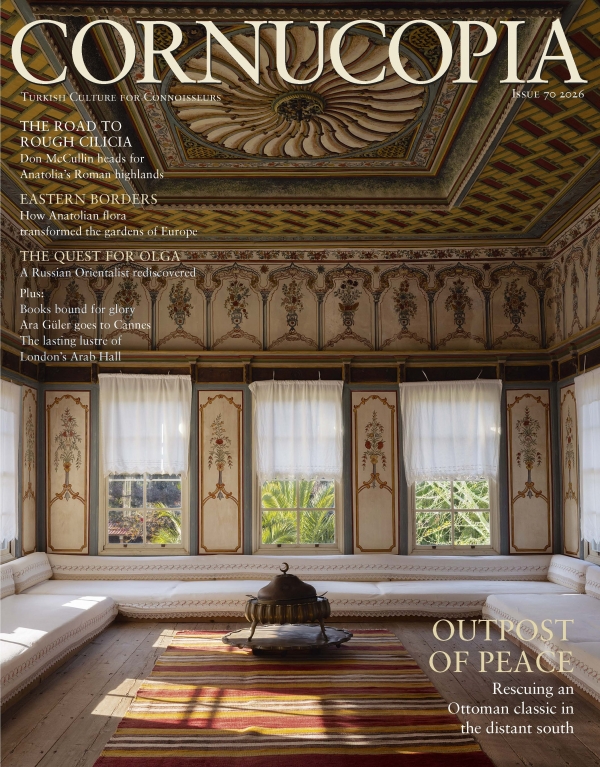
Buy the latest issue
Or browse the back issues here
Issue 69, December 2025 An Indian Summer
£ 15.00