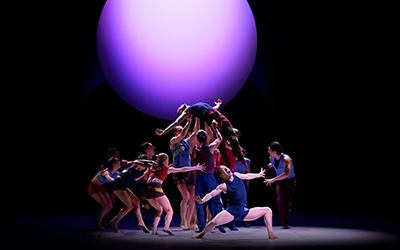
Italy’s internationally renowned contemporary dance company Aterballetto perform at the AKM on 12th & 13th June
Image: Atatürk Cultural Centre
Atatürk Cultural Centre (Atatürk Kültür Merkezi or ‘AKM’), Gümüşsuyu Mah., Mete Cad. No 2 (formerly Tak-ı Zafer Cad.) – i.e., Taksim Square – Beyoğlu, 34437 Istanbul
Events at this venue
E-mail: bilgi@akmistanbul.gov.tr
Tel: +90 212 372 50 00
FRIDAY, JUNE 5
SATURDAY, JUNE 6
Opera
Verdi’s ‘La Traviata’
Verdi’s La Traviata (‘The Fallen Woman’) is a three-act opera by Giuseppe Verdi (1813-1901). Composed in 1853, it is based on the story of The Lady of the Camellias, a play by Alexandre Dumas fils. Both the composer and Francesco Maria Piave, the librettist, intended the opera to be staged with the singers in contemporary dress. However, as Violetta, the heroine, is a courtesan, the censors in Venice (where the work was to receive its first performance) insisted that it should be performed in 17th-century costume. Indeed, La Traviata occasioned in some people a strong sense of moral outrage: Queen Victoria refrained from attending the opera when it was staged at Her Majesty’s Theatre in London in 1856, and the heads of the Church did their best to have it banned. Later that year, it was performed at the Academy of Music in New York, where criticism of the work’s moral stance was less severe: the critic of the Evening Post wrote that ‘Those who have quietly sat through the glaring improprieties of Don Giovanni will hardly blush or frown at anything in La Traviata.’ Subsequently, the work proved extremely popular, and it remains one of the most frequently-performed operas of all time.
In these performances, members of the Azerbaijan State Academic Opera and Ballet Theatre Company are conducted by either Eyyub Quliyev or Zdravko Lazarov, with soprano Inara Babayeva and tenor Ramil Qasimov in the leading roles. The director is Recep Ayyılmaz, and the chorus is trained by Paolo Villa. This is one of the events of the 17th International Istanbul Opera and Ballet Festival.
Atatürk Cultural Centre (Atatürk Kültür Merkezi or ‘AKM’) Türk Telekom Opera Hall, Gümüşsuyu Mah., Mete Cad. No 2 (formerly Tak-ı Zafer Cad.) – i.e., Taksim Square – Beyoğlu, 34437 Istanbul
Friday, June 5 – 20:00
Saturday, June 6 – 20:00
Tickets from Biletinial
Prices: 460TL, 600TL, 830TL, 1050TL, 1500TL
THURSDAY, JUNE 11
Orchestral music, piano concerto
Tekfen Philharmonic Orchestra, Behzod Abduraimov
In this, the opening concert of the 54th İKSV Istanbul Music Festival, the Tekfen Philharmonic Orchestra, conducted by Aziz Shokhakimov, first accompany the Uzbek pianist Behzod Abduraimov in Rachmaninov’s Piano Concerto No 2 in C minor, Opus 18, written between 1900 and 1901. Its composition represented a major psychological breakthrough for the composer: this work was the first thing he wrote after over three months of hypnotherapy and psychotherapy sessions with the neurologist Nikolai Dahl had finally overcome the depression, writer’s block, disturbed sleep pattern and lack of appetite brought on by the unfavourable reaction to his Symphony No 1 in 1897. The second and third movements of the concerto were performed in December 1900, and the first – which he had found much more difficult to write – in November 1901; both times, the solo part was played by the composer himself. The enthusiastic reception the piece received, especially after the 1901 performance, did much to restore Rachmaninov’s confidence in his abilities as a composer; nowadays, it is his most popular work.
After the break, the orchestra will play Igor Stravinsky’s Firebird Suite, a work derived from the composer’s 1910 ballet score for Sergei Diaghilev’s Ballets Russes. Based on Russian folklore, the music – which demonstrates superb use of orchestral colour (Stravinsky had taken to heart the lessons he had received from master orchestrator Nikolai Rimsky-Korsakov) – depicts Prince Ivan’s battle with the sorcerer Kastchei, a battle in which he is helped by a magical bird. Stravinsky created three different suites (in 1911, 1919 and 1945) from the original full-length ballet score; the most frequently-played version – designed for concert performance rather than ballet, but including more scenes from the ballet than the other two versions – is the 1919 orchestral suite. The work was an immediate success at its first performance in Paris, bringing international fame for the young, and until then relatively unknown, Stravinsky and leading to further collaborations with Diaghilev such as Petrushka (1911) and The Rite of Spring (1913).
Before the music begins, an award and plaque ceremony will be held. The 54th İKSV Istanbul Music Festival’s Lifetime Achievement Award will be presented to the celebrated Portuguese pianist Maria João Pires, and the Honorary Award to the Turkish composer and educator Turgay Erdener.
Atatürk Cultural Centre (Atatürk Kültür Merkezi or ‘AKM’) Türk Telekom Opera Hall, Gümüşsuyu Mah., Mete Cad. No 2 (formerly Tak-ı Zafer Cad.) – i.e., Taksim Square – Beyoğlu, 34437 Istanbul
20:00
Tickets from Passo
Prices: 1750TL, 2000TL, 2750TL
FRIDAY, JUNE 12
SATURDAY, JUNE 13
Modern ballet, ballet music
Aterballetto ballet company
These two performances by the internationally-renowned Italian ‘CCN/Aterballetto’ modern ballet company begin with interpretations of works by Beethoven (his Moonlight Sonata) and Brahms (his Cello Sonatas Nos 1 and 2) created by leading figures in the contemporary dance scene. The Beethoven is played live by pianist Korkmaz Can Sağlam, and the Brahms by Sağlam together with cellist Dorukhan Doruk. Choreography, meanwhile, is supplied by Angelin Preljocaj (for the Beethoven) and Crystal Pite (for the Brahms). Following this, the dancers will interpret two modern works to the accompaniment of recorded music: Gershwin’s Rhapsody in Blue and Bessie Jones’s Beggin’ the Blues (choreographers: Iratxe Ansa and Igor Bacovich). This is one of the events of the 54th İKSV Istanbul Music Festival.
Atatürk Cultural Centre (Atatürk Kültür Merkezi or ‘AKM’) Theatre Hall (Tiyatro Salonu), Gümüşsuyu Mah., Mete Cad. No 2 (formerly Tak-ı Zafer Cad.) – i.e., Taksim Square – Beyoğlu, 34437 Istanbul
Friday, June 12 – 20:00
Saturday, June 13 – 20:00
Tickets for June 12 from Passo
Prices: 2000TL, 2250TL, 3000TL
Tickets for June 13 from Passo
Prices: 2000TL, 2250TL, 3000TL
MONDAY, JUNE 15
Chamber music, piano duo
Kammerakademie Potsdam, Jussen Brothers Piano Duo
The Kammerakademie Potsdam chamber orchestra first accompany the Jussen Brothers piano duo in the Intermezzo by the Austrian-Jewish composer, conductor, librettist and educator Franz Schreker (1878-1934), who enjoyed much success in Berlin during the years of the Weimar Republic but saw performances of his operas prevented by antisemitic mobs in the 1930s and died young. The next two items on the programme are Mozart’s Piano Concerto No 10 in E flat major for Two Pianos and Orchestra, K 365/316A, presumed to have been written for Mozart to play with his sister Anna (‘Nannerl’), and an arrangement for two pianos of Ravel’s ‘choreographic poem’ La Valse, a ‘tribute to the waltz’ written between 1919 and 1920. The composer George Benjamin said the following about this work: ‘Whether or not it was intended as a metaphor for the predicament of European civilisation in the aftermath of the Great War, its one-movement design plots the birth, decay and destruction of a musical genre: the waltz.’ Having listened to a recital by the Jussen Brothers at The Seed (the concert hall attached to the Sakıp Sabancı Museum in Emirgan) in the years before the pandemic, I can vouch for the fact that their performances are top-notch. Finally, the orchestra play Haydn’s Symphony No 64 in A major, Hoboken 1/64 – a four-movement work, dating from 1773-75, that is often known by its nickname, Tempora mutantur (‘Times change’). This is one of the events of the 54th İKSV Istanbul Music Festival.
Atatürk Cultural Centre (Atatürk Kültür Merkezi or ‘AKM’) Theatre Hall (Tiyatro Salonu), Gümüşsuyu Mah., Mete Cad. No 2 (formerly Tak-ı Zafer Cad.) – i.e., Taksim Square – Beyoğlu, 34437 Istanbul
20:00
Tickets from Passo
Prices: 1500TL, 2000TL, 2500TL
TUESDAY, JUNE 16
Cinema music
Borusan Istanbul Philharmonic Orchestra, ‘Koro İstanbul’ choir
In a performance entitled ‘The Sound of Cinema’, music written by Ennio Morricone for various films is performed by the Borusan Istanbul Philharmonic Orchestra, conducted by Dirk Brossé, and the ‘Koro İstanbul’ choir, trained by Kübra Şenyaylalar. Soloists: Nazlıcan Karakaş (soprano), Veronika Vitazkova (pan flute and sopranino recorder), Pierre Planas (mandolin and guitar), Nurkan Renda (acoustic guitar and electric guitar) and Tunca Olcayto (electric bass).
The Italian composer, orchestrator, conductor, trumpeter and pianist Ennio Morricone (1928-2020) wrote in a wide range of styles; chiefly known as a composer of film music (especially Westerns), he produced over 400 scores for cinema and television as well as more than 100 classical works. Films for which he wrote the music include Once Upon a Time in the West and The Good, the Bad and the Ugly. The concert on June 16 includes soundtracks from these two, as well as from The Battle of Algiers, A Fistful of Dynamite, Inglorious Bastards and many others, plus a concert piece composed by Morricone.
This is one of the events of the 54th İKSV Istanbul Music Festival.
Atatürk Cultural Centre (Atatürk Kültür Merkezi or ‘AKM’) Türk Telekom Opera Hall, Gümüşsuyu Mah., Mete Cad. No 2 (formerly Tak-ı Zafer Cad.) – i.e., Taksim Square – Beyoğlu, 34437 Istanbul
20:00
Tickets from Passo
Prices: 1750TL, 2250TL, 3000TL
TUESDAY, JUNE 23
Orchestral music, piano concerto
Vienna Symphony Orchestra, Bruce Liu
The Vienna Symphony Orchestra (Wiener Symphoniker), conducted by Petr Popelka, accompanies Bruce Liu, winner of the 2021 Chopin Competition, in Beethoven’s Piano Concerto No 3, then plays Schubert’s Symphony No 9 in C major.
Beethoven’s three-movement Piano Concerto No 3 in C minor, Opus 37, believed to have been written at some time between 1800 and 1802, was first performed in 1803 with the composer as soloist. This stormy masterpiece forms a bridge between the composer’s earlier Classical, Mozart-influenced style and his powerful, emotionally dramatic middle period. The long, dramatic first movement, whose first main theme is reminiscent of that of Mozart’s Piano Concerto No 24 in C minor, is followed by a lyrical, meditative slow movement in the remote key of E major that features delicate, hymn-like melodies. This is followed by a spirited, energetic finale that revisits the dark, serious key of C minor before transitioning to A flat major, then (using A flat / G sharp as a pivot) E major, and finally a joyful conclusion in C major.
Beethoven’s friend Ignaz von Seyfried, who turned the pages for him at the first performance, later said: ‘I saw almost nothing but empty pages; at the most, on one page or another a few Egyptian hieroglyphs wholly unintelligible to me were scribbled down to serve as clues for him; for he played nearly all the solo part from memory since, as was so often the case, he had not had time to set it all down on paper. So, whenever he reached the end of some invisible passage, he gave me a surreptitious nod and I turned the page. My anxiety not to miss such a nod amused him greatly, and the recollection of it at our convivial dinner after the concert sent him into gales of laughter.’
Schubert’s Symphony No 9 in C major, D 944, was the last symphony the composer completed before his death in 1828. He had actually begun sketching it out in the summer of 1825, and by the following year had completed the scoring; however, there is no evidence that it was ever given a public performance in his all-too-short lifetime. Robert Schumann, who visited Vienna in 1838, discovered the symphony in a pile of manuscripts shown to him by Schubert’s brother Ferdinand, and took a copy back with him to Leipzig, where it was finally given its first performance by the Gewandhaus Orchestra, under the baton of Felix Mendelssohn, in March 1839. However, owing to its lengthy parts for the woodwinds and strings, the symphony was found to be difficult to play, and when Mendelssohn took it to Paris in 1842 and London in 1844, orchestras flatly refused to play it. In fact, it took until the early years of the 20th century for the work to become part of the standard repertory.
Betsy Schwarm, writing on the ‘Britannica’ website, describes the symphony in the following words: ‘Symphony No 9 reveals the deep influence of Beethoven on Schubert. The elder master had lived in Schubert’s native Vienna for all of the younger composer’s life, and Schubert revered but never dared to meet him. Not only is Schubert’s symphony nearly as long as Beethoven’s own Symphony No 9, but it also draws upon Beethoven’s compositional approaches. Its forms and compositional structures are much as Beethoven would have crafted them. Beethoven himself had learned those ideas in large part from the works of Joseph Haydn and Mozart, but he gave them broader and freer expression. Schubert follows Beethoven’s approach more than that of the earlier masters.’ Here is the full article.
This concert is one of the events of the 54th İKSV Istanbul Music Festival.
Atatürk Cultural Centre (Atatürk Kültür Merkezi or ‘AKM’) Türk Telekom Opera Hall, Gümüşsuyu Mah., Mete Cad. No 2 (formerly Tak-ı Zafer Cad.) – i.e., Taksim Square – Beyoğlu, 34437 Istanbul
20:00
Tickets from Passo
Prices: 1750TL, 2250TL, 3000TL
WEDNESDAY, JUNE 24
Orchestral music, violin concerto
Vienna Symphony Orchestra, Kian Soltani
The Vienna Symphony Orchestra (Wiener Symphoniker) accompanies the Iranian-Austrian cellist Kian Soltani in Dvořák’s Cello Concerto, then plays this composer’s New World Symphony. This is one of the events of the 54th İKSV Istanbul Music Festival.
The Cello Concerto in B minor, Opus 104, was the last solo concerto Antonín Dvořák (1841-1904) wrote. Earlier in his career, he had turned down several requests to write a cello concerto, citing the instrument’s ‘nasal’ high register and its ‘mumbling’ bass as the reason for his misgivings; these, however, were finally overcome by his cellist friend Ludevit Peer. The piece was written between November 1894 and February 1895 while the composer was in New York serving his third term as Director of the National Conservatory of Music of America, and he had received extra motivation to write it after hearing a cello concerto by Victor Herbert, a teacher at the Conservatory who had played in the first performance of his New World Symphony.
After he returned to Bohemia from the USA, his sister-in-law (with whom he had once been in love) died, and as a tribute to her he changed part of the last movement. However, although he took advice from several cellists of his acquaintance, he refused to change the cadenzas he had written. The premiere of the concerto took place in March 1896 at the Queen’s Hall, London, with Dvořák himself conducting. Here is a detailed account of the work and its composition by Marc Mandel on the ‘Boston Symphony Orchestra’ website – this being the orchestra that gave the first American performance of the concerto in December 1896.
Dvořák’s Symphony No 9 in E minor, Opus 95 (nicknamed the ‘New World Symphony’), was written in 1893, the year after he had taken up his post as Director of the National Conservatory in New York. It is in four movements (I Adagio – Allegro molto, II Largo, III Molto vivace – Poco sostenuto, IV Allegro con fuoco). The work, which was commissioned by the New York Philharmonic Orchestra, shows the results of the composer’s interest in Native American music and African-American spirituals: during his time at the National Conservatory, an African-American student named Harry T. Burleigh had sung traditional spirituals to him. The premiere, which took place at Carnegie Hall on 16 December 1893, was one of the greatest triumphs of the composer’s musical career: there was thunderous applause at the end of each movement. The D flat major theme of the second movement, played by the cor anglais, is one of the most famous melodies in the whole of classical music. Indeed, this symphony has become one of the most popular works of all time.
The Wikipedia entry gives a blow-by-blow account of the symphony; this is followed by a fascinating account (in the ‘Influences’ section) of Dvořák’s reactions to the music he heard, and the scenery he observed, in the United States.
Atatürk Cultural Centre (Atatürk Kültür Merkezi or ‘AKM’) Türk Telekom Opera Hall, Gümüşsuyu Mah., Mete Cad. No 2 (formerly Tak-ı Zafer Cad.) – i.e., Taksim Square – Beyoğlu, 34437 Istanbul
20:00
Tickets from Passo
Prices: 1750TL, 2250TL, 3000TL
Italy’s internationally renowned contemporary dance company Aterballetto perform at the AKM on 12th & 13th June
Image: Atatürk Cultural Centre