
Buy or gift a digital subscription and get access to the complete digital archive of every issue for just £18.99 / $23.99 / €21.99 a year.
Buy/gift a digital subscription Login to the Digital Edition
The Many Lives of Arminius Vambéry
The first major study of the extraordinary nineteenth-century traveller
Who was Arminius Vambéry? A poverty-stricken, Jewish autodidact; a linguist, traveller, and writer; or a sometime Zionist, inspiration for Dracula’s nemesis, and British secret agent?
Vambéry wrote his own story many times over. And it was these often highly embroidered accounts of journeys through Persia and Central Asia that saw him acclaimed in Victorian England as an intrepid explorer and daring adventurer. Against the backdrop of the ‘Great Game’, in which Russia and Britain jostled for territory, influence, and control of the borders and gateways to Central Asia and its wealth, Vambéry played the roles of hero and double-dealer, of fascinated witness and imperial charlatan.
The Dervish Bowl is the story of these competing narratives, a compelling investigation of the ever-changing persona Vambéry created for himself, and of the man who emerges from his private correspondence and the accounts of both his friends and his enemies, many of whom were themselves major players in the geopolitical adventures of the volatile nineteenth century – a time when Britain’s ambitions for her empire were at their height, yet nothing and no one was quite as they seemed.
I was anxious about this new biography. I have long maintained a private cult for Arminius Vambéry. This was first fuelled by a youthful reading of his Travels Across Central Asia. I was working in the press office of the Afghanistan Support Committee in London and trying to find my feet. The slippery identity of Vambéry, and his posing as a Sufi dervish embedded in a Haj caravan returning home to Central Asia, added further zest to his dazzling personal achievement.
Ármin Vámbéry, as his compatriots know him, was a Hungarian Jew by birth. He travelled across Central Asia in 1863, just 20 years after the sensational disappearance of two British officers, Captain Arthur Conolly and his rescuer, Colonel Charles Stoddart, imprisoned by the Khan of Bukhara and publicly executed as spies on June 24, 1842.
My admiration for the heroic chutzpah of Vámbéry was enhanced by chancing on a thin blue volume in London’s Charing Cross Road. In Struggles of My Life, he recounted his extraordinary tough childhood in Hungary. His father died when Ármin was a year old, his stepfather was a drunken innkeeper, and, though his mother sounds an enterprising woman, after the age of 12 Ármin was a penniless, crippled orphan. He survived through his wits, always hungry for a home and a proper meal, but driven by his extraordinary questing intelligence and fascination for languages. He became an intellectual artful-dodger, picking up part-time jobs to fund his education, topped up by a growing talent as a tutor. He worked his way up in society, learning how a tutor with good manners could get his knees under the dining-room table at the manor house. Struggles ends, if I remember rightly, with the exhilaration of a young man standing on the bows of a Danube steamer at night, setting off alone on his travels into the East, having at last escaped the privations, caste snobbery, petty humiliations and casual antisemitism of his homeland, the Austro-Hungarian Empire. It is stirring stuff.
Over subsequent years, I was able to add other odd tales to the legend of this extraordinary man. Vámbéry would become a professor of Oriental languages at Budapest University, where he continued his lifelong research into the lost origins of the Hungarian language and translated classic epics from the East. Fluent in a dozen languages and a charismatic speaker, he became a star turn in lecture halls, which he backed up with a stream of public letters, articles and pamphlets. He was a ferocious Russophobe and became a passionate Anglophile, though (as we will discover later) Ottoman Istanbul was also his adoptive homeland. He became a confidential adviser to the Ottoman Caliph-Sultan Abdülhamid II and was a friend of Edward VII, the British King-Emperor. To add a twist of mystery to this already complex picture, he quested after traces of lost libraries, such as that owned by King Matthias Corvinus of Hungary, taken by the Ottomans after the battle of Mohács, and the Ottoman library at Brusa (Bursa), rumoured to have been taken by Tamerlane’s grandson to Samarkand. He lived in the golden era of the train, and, due to his book tours and shuttle diplomacy from one royal court to another, was a familiar figure in all the grand railway stations of the fin-de-siècle worlds of London, Paris, Vienna, Budapest and Istanbul. It was listening to Vámbéry speak about Transylvania after dinner that gave Bram Stoker the nightmare he would turn into the gothic novel Dracula.
I found Anabel Loyd’s biography compelling, not only because of the man but because of his era. The book also completely undermines my hero. Vámbéry is gradually exposed as self-aggrandising, duplicitous, mercenary and self-obsessed. The scholar-mystic becomes just another master of spin, a publicity agent of fake news and a blustering political populist. But if you are interested in adventurers, his life remains utterly fascinating. Time and time again I was reminded of the fictional villainy of a Tom Ripley, Harry Flashman or Becky Sharp.
The old rumours that Vámbéry was a paid agent of the British, which he denied, hinted at and elaborated on throughout his life (even once claiming to have been recruited by Disraeli), are revealed to be true. Papers released by the Foreign Office in 2005 confirm this, but the process, as revealed by Loyd, is more opaque and nuanced than the evidence of the annotated annual payment slips at first suggested. Vámbéry’s first important encounter with the British establishment was as a passing traveller in Tehran in 1863. He had an affable but brief encounter with Charles Alison, the resident British envoy in Tehran, 1860–72. They would almost certainly have been able to identify friends in common, for both had spent many years in Istanbul. Alison asked the 31-year-old traveller to keep his eyes and ears open in the Khanates, for the British were interested in discovering the fate of Lieutenant Wyburd of the Royal Indian Navy. A year later, Alison was able to interview Vámbéry on his return, but stepped up the formality of the occasion by doing this in front of two secretaries. They recorded Vámbéry telling the story of a 24-year-old Englishman “of a beautiful exterior and a very clever mind” who was killed because he expressed an interest in travelling east to Chinese Kashgar.
There is no question where Vámbéry’s true loyalties lay at this moment, for though he might have received tea and a sympathetic ear at the British Legation, he was a guest of the new Ottoman Ambassador in Tehran for two whole months. The Ambassador, Ismail Efendi, had arranged for him to have an audience with the Shah, where he received an order. But the British had their own style of doing things. Vámbéry was invited to lecture in London, but Alison turned their teatime chat into a confidential memorandum which was quickly sent to the Foreign Office and read by such influential figures as Palmerston, Percy Strangford, Henry Rawlinson and John Russell.
So when Vámbéry visited London a year later (arriving June 9, 1864), everything of interest to the Foreign Office was already well known. He was entertained by Lord Strangford (who spoke perfect Turkish, as well as Hungarian and the Romany of the Gypsies). They got on like a house on fire, sealing their linguistic friendship by reciting an ancient Turkic epic in Chagatai together. Vámbéry remembered how Strangford “levelled the ground before me”, while another new ally, Lady Shiel, briefed him on the social laws and tone of London’s West End. After his triumphant lecture at the Royal Geographical Society, he was signed up to write a travel book (with a £500 advance) for John Murray. He did this in just three months, though separated from his field notes, deposited in Budapest with the Hungarian Academy, which had funded his travels. As a publisher fascinated by the genesis of travel books, I found this a biographical gem. It explains at a stroke the odd omissions and errors in Travels in Central Asia, its conversational fluency and the pro-British current that flows through it. This all makes sense when you know Vámbéry was writing in London, for a specific English audience, who were wining and dining him as the hero of the hour.
Within the Austro-Hungarian Empire, he was still treated as a poor boy from the slums. During his time in London, Charles Dickens took him to dinner at the Athenaeum, wrote him up as “the Hungarian Dervish” and introduced him to Matthew Arnold. But Vámbéry was to become even more enchanted with the easy-going nature of English society after he met the 23-year-old Prince of Wales at the late-night Cosmopolitan Club. Our future Edward VII was neither scholar nor saint but an enthusiastic womaniser, bon-vivant and gambler. The Prince was, however, fluent in French and German, a free-thinker and completely untouched by the antisemitism that washed across the rest of Europe. He had a genuine interest in the world, and at the end of his life would become an influential peacemaker. The unlikely friendship between the two men would blossom over the years and included personal visits to Windsor Castle and Sandringham (where Vámbéry charmed the Prince’s mother, Queen Victoria). He would also accompany the Prince, walking arm in arm, to formal dinners in Budapest (in 1873, 1885 and 1888). And it was the influence of the Prince of Wales that first started the annual gift of £100 (about £15,000 today) from the Foreign Office that provides historians with the documentary proof of Vámbéry’s role as a British secret agent. Or does it?
Vámbéry labelled these payments as contributions to his travel expenses and insisted on a certain formality, receiving the cash in notes at the British Embassy directly from the hands of such influential career diplomats as Sir Arthur Nicolson. The FO had at first wanted him to be openly paid from the Civil List but realised that was legally impossible for a foreign citizen.
In return for these travel expenses, Vámbéry fed the FO with a flood tide of his opinions, including his observations of the key characters in the Ottoman court, and filled the press with pro-British and anti-Russian letters and articles. The marginal notes preserved in the FO archive reveal that he was always viewed as a loose cannon. One note to a colleague who had agreed to meet Vámbéry reads: “I pity you, I have seen him.” This was not always Vámbéry’s fault. British foreign policy was going into a slow reversal in this period, with old enemies (France and Russia) turning into “Our Glorious Allies” by 1914. British party politics also rocked the boat of a consistent national foreign policy. The Liberals liked Russia and hated the Ottoman Empire; the Conservatives feared Russia and supported the Ottoman Empire.
But we get even closer to the man, for Loyd has made good use of Theodore Herzl’s diaries to give us an insight into how Vámbéry worked the system. The first meeting of these two charismatic Jewish intellectuals is full of mutual enthusiasm. Herzl describes Vámbéry as “this limping 70-year-old Hungarian Jew who doesn’t know whether he is more Turk than Englishman, writes in German, speaks twelve languages and has professed five religions”. Vámbéry’s first pitch was recorded as: “I am a rich man and cannot even spend half the interest. If I help you, it’s for the sake of the cause.” Yet two meetings later, Vámbéry had pocketed 1,000 guilder (for travel expenses) and negotiated a £5,000 commission from Herzl (£500,000 today) if he could help place a loan (backed by a cabal of pro-Zionist bankers) to the Ottoman court.
After months of negotiation, Vámbéry succeeded in helping to set up a brief meeting between Abdülhamid II and Herzl, on May 17, 1901. Though the Sultan behaved with dignity to his guest, he was also clearly cross with Vámbéry, and banned him from Istanbul at the time of this meeting. Vámbéry was well aware of the Sultan’s attitude and begged Herzl not to mention the Zionist plans to colonise Palestine. He was advised to talk only about assistance in public relations and the consolidated loan. Vámbéry was meanwhile feeding the FO with every snippet of information, and in 1904 managed to get his annual stipend doubled to £250. On another occasion, he had openly talked about receiving an annual salary from both the English Queen and the Sultan. No Turkish receipts have yet been published, but it would seem likely that he felt a lifelong loyalty to the Ottoman dynasty. To understand this, we need to return to his youth in Hungary and how Ottoman Istanbul transformed him.
When Vámbéry was a young man, trying to hold body and soul together, and to cut an academic dash but without an educational certificate to his name, the tables of Budapest’s Café Orczy were his headquarters. The café was dirty but animated, as it was the centre of the grain trade and an informal Jewish labour exchange. Specialist agents would sell (for earnest money) cantors to synagogues and tutors to households on year-long contracts. Vámbéry was presenting himself then as Professor of Seven Languages, but he was also a little bit in disgrace for having fallen in love with the daughter of one of the households he had been employed in, which crossed over with rumours that he had profited from a burglary in the house of another employer. He was rescued by one of the most liberal and progressive figures within Hungarian society. Count József Eötvös recognised Vámbéry’s unique skills, bought him a set of new clothes, gave him letters of recommendation and put him on board a Lloyd steamer to Istanbul in the summer of 1857.
He had crossed the Black Sea and migrated from one Empire to another, but on a personal level he had just moved from one set of café tables to another. He now frequented the Café Flamm de Vienne on the Grand Rue de Pera, inhabited by disappointed adventurers, bankrupts, political exiles from ’48 and Hungarian officers in the Ottoman service, all plotting their next moves. At one such table an impoverished and intelligent cook had introduced him to a Hungarian officer turned book-dealer, which in turn led to his meeting Ismail Pasha (the famous Hungarian soldier of fortune György Kmety), who introduced Vámbéry to his powerful friend General Hussein Daim Pasha (who had started his career as a slave boy from Circassia).
Vámbéry was appointed tutor to the Pasha’s son. He delighted in the cosmopolitan society of Ottoman Istanbul, where scholarship and piety and poetry were so highly regarded, even if their servants quietly judged him by his shoddy boots. He was passed from one household to another and mingled with the Levantine dragomen who worked as interpreters and intelligence gatherers for various foreign powers while keeping their ultimate loyalties to the Ottoman Empire. In 1858 Vámbéry published a pocket German-Turkish dictionary and started researching Chagatai, the archaic but extinct Turkic language of Central Asia. Having served Fuad Pasha and the Chief Chancellor of the Divan well, he was recommended to become the tutor to Princess Fatima, daughter of Sultan Abdülmecid. They met three times a week, divided by a heavy curtain. The Princess’s brother was the future Sultan, Abdülhamid II. His star was now set in the ascendant. A year later, he was invited to become a corresponding member of the Hungarian Academy, which in 1861 agreed to his proposal of a travel fund (1,000 florins) for an expedition to Central Asia, to see if there were any links between the Hungarian language and Chagatai. Aside from settling a linguistic feud (which is still not entirely dead), there was a political angle to this expedition, which could connect the Hungarians and the Turks as distant cousins.
Such an expedition would have been a suicidal act for any Western scholar, but Vámbéry was now a known character within Ottoman court society. The first half of his journey had much more in common with a diplomatic mission than an expedition. He travelled in the entourage of an Ottoman Pasha to Trabzon, and at Erzurum stayed with the Ottoman military governor, who was his former employer, General Hussein Daim Pasha. In Tehran he was equipped with a tent and topped up with some gold coins by the resident Ottoman Ambassador, Haider Efendi. Under the identity of Reshid Effendi, he received a letter of safe conduct from the Persian foreign minister, to be put alongside his Ottoman passport ornamented with the magnificent tuğra of the Sultan. He was also briefed by Haider Efendi about the local political situation. There was a war between Dost Mohammed in Kabul and his son-in-law, Ahmed Khan of Herat, while the rivalry between Uzbeks and Persian-speaking Tajiks needed to be understood, as well as that between the Turkmen tribes, and between the three rival Khanates of Khiva, Bukhara and Kokand, who were always in competition with each other. Men trusted by the Ottoman ambassador, such as Süleyman Efendi in Bukhara and Shukrullah Bey in Khiva, were almost certainly given advance warning of Vámbéry’s journey.
So I gradually learnt from Loyd to distrust Vámbéry’s stories about travelling in disguise as a dervish. It was a literary device that added a shiver of tension to the narrative of his journey across Central Asia. If you were a British reader, this would instantly have translated into the executions of Conolly and Stoddart, the death of Moorcock amid the ruins of Balkh and Bukhara Burnes at Kabul. But Vámbéry was in no danger, for he was a courtier of the Ottoman Sultan. He was protected everywhere by the tuğra signature on his Ottoman passport, which was kissed by each governor he showed it to, or raised in respect above their heads.
It is still just possible to admire the chutzpah of the man. At one point he appears to have been a triple agent, simultaneously paid “travel expenses” by the Zionist Congress, the British and the Ottoman courts. There is one more telling detail in Loyd’s biography. As a professor, he never taught at Budapest University, preferring to teach his one or two students at home. His most brilliant student, Ignaz Goldziher, was appalled by what he unearthed in Vámbéry’s library shelves, such as his fictional journeys to Tibet and to Mecca, and finally lost all faith in his old teacher when he discovered he had been making up his own Koranic quotations. Vámbéry’s last pupil, Gyula Germanus, remembered his old professor with greater affection, but also recalled his habit of casually accosting workmen on the pavements of Budapest and telling them “incredible, fantastic stories from his life”. I bet at least half of them were true.
Barnaby Rogerson is the author of ‘Don McCullin: Journeys Across Roman Asia Minor’ (Cornucopia Books, £95)

 Out of Stock
1. STANDARD
Standard, untracked shipping is available worldwide. However, for high-value or heavy shipments outside the UK and Turkey, we strongly recommend option 2 or 3.
2. TRACKED SHIPPING
You can choose this option when ordering online.
3. EXPRESS SHIPPING
Contact subscriptions@cornucopia.net for a quote.
You can also order directly through subscriptions@cornucopia.net if you are worried about shipping times. We can issue a secure online invoice payable by debit or credit card for your order.

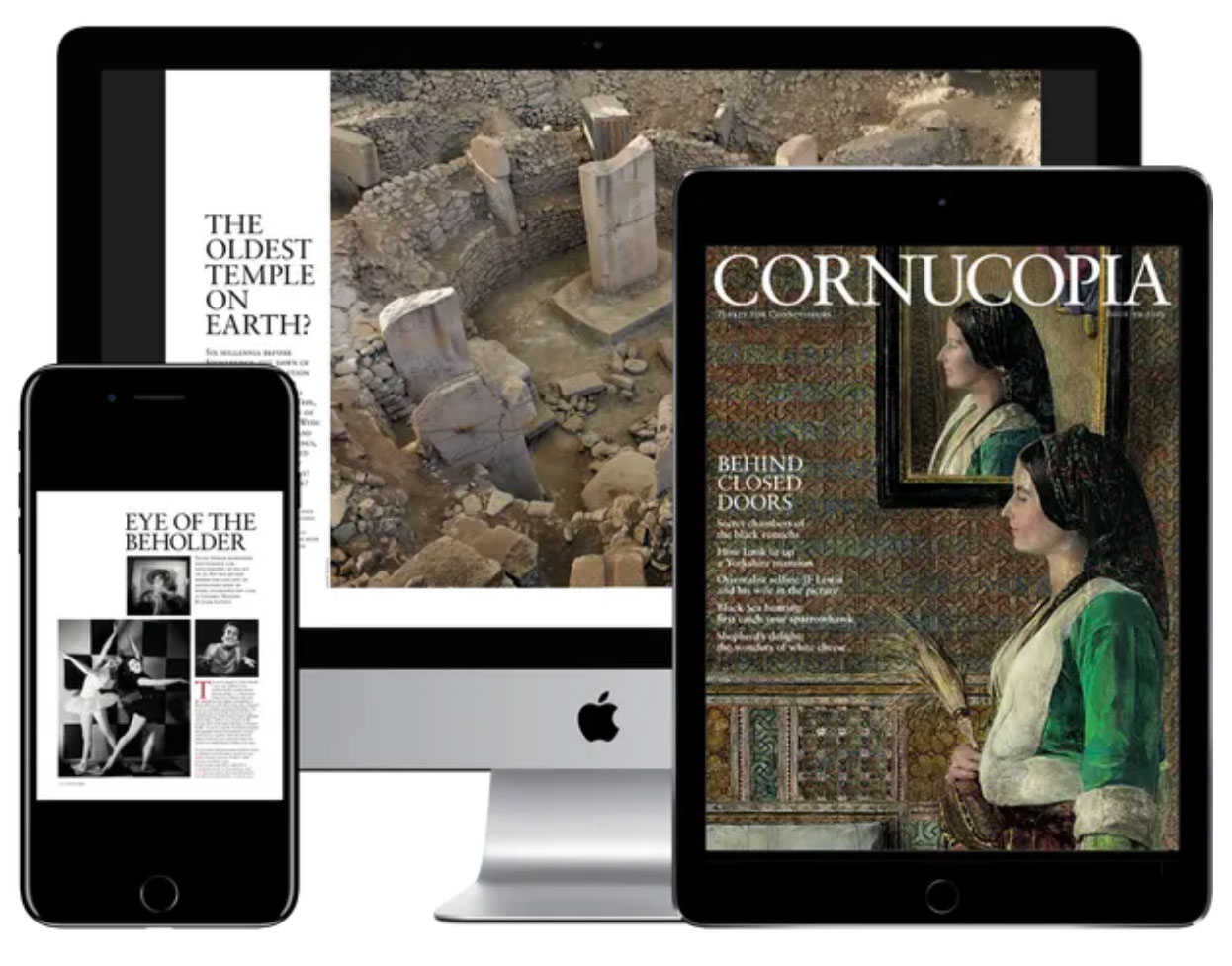
Cornucopia works in partnership with the digital publishing platform Exact Editions to offer individual and institutional subscribers unlimited access to a searchable archive of fascinating back issues and every newly published issue. The digital edition of Cornucopia is available cross-platform on web, iOS and Android and offers a comprehensive search function, allowing the title’s cultural content to be delved into at the touch of a button.
Digital Subscription: £18.99 / $23.99 (1 year)
Subscribe now