Buy or gift a digital subscription and get access to the complete digital archive of every issue for just £18.99 / $23.99 / €21.99 a year.
Buy/gift a digital subscription Login to the Digital EditionFor millions, travelling to the Orient once meant boarding a bus to London’s Olympia. There, they explored a vast plasterboard Constantinople and attended an extravaganza performed by a cast of 2,000. Andrew Finkel rediscovers the fairytale city that transformed the Ottoman Empire in the Victorian imagination
The popular travellers’ companion for those venturing to Ottoman lands, the 1874 Murray’s Handbook to Turkey in Asia and Constantinople, was unflinchingly candid: the journey to Istanbul was not for the faint-hearted. No matter the route, the trip demanded endurance, a thick wallet or both. The quickest option – five days via the Danube – began on a train better suited to carrying mail than passengers, only to be followed by rough-and-ready boat accommodation (“very inconvenient for ladies and invalids”). In summer, travellers risked delays if the river ran low, and an onslaught of hungry mosquitoes even if it didn’t. The more comfortable sea crossing via Trieste or Marseille took eight or nine days, while the most luxurious option – a leisurely steamer cruise – was perfect for those with two months to spare.
The travel became easier if no more affordable when, in 1883, a precursor to the Orient Express set out from Paris with 40 passengers aboard. Even then the trip was piecemeal: a ferry across the Danube, another train, and then a final 14-hour sea voyage from Varna. Only in 1889 did the railroad deliver passengers directly into the heart of Istanbul. This led to an incremental increase in travellers. By the turn of the century their number had reached between 40,000 and 65,000 a year and helped spawn new guides in multiple languages: Hachette, Bradshaw, Macmillan and Cook, Meyers, Baedeker, Guide Joanne. However, the reissued 1900 edition of Murray’s made it clear that the journey could still be a challenge. “There is no good hotel where travellers can break their journey between Vienna and Constantinople,” it warned.
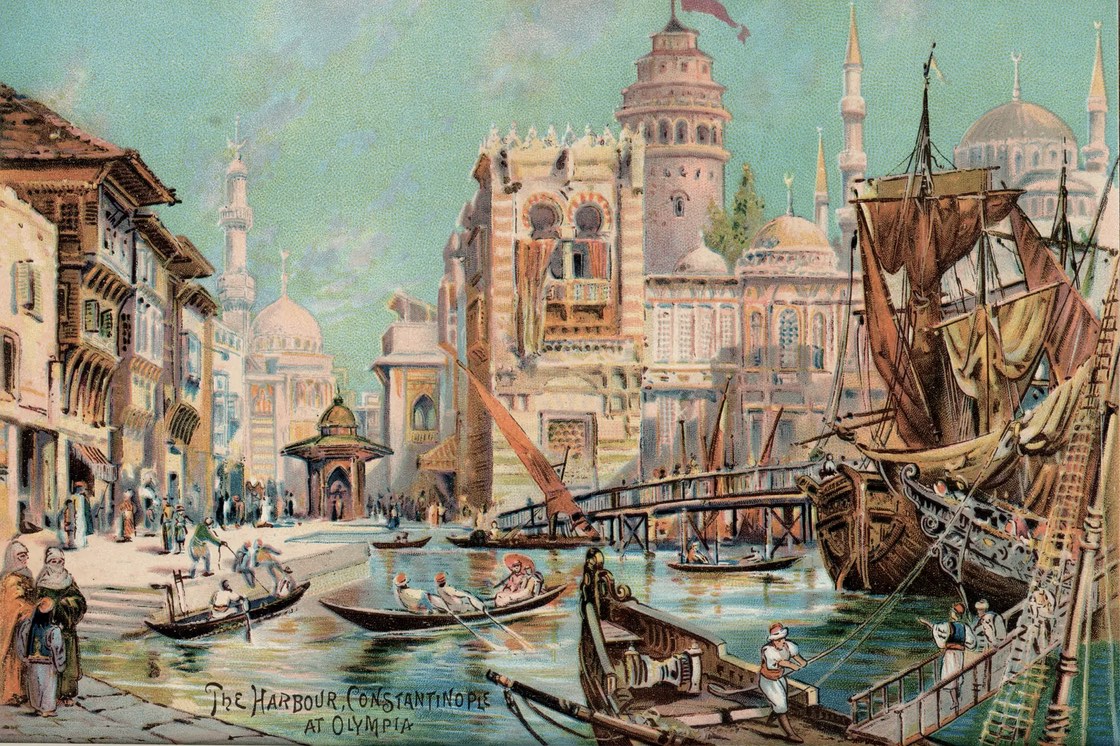
So, with the dawn of mass tourism still a speck on the horizon, it seems astonishing that on one single day a staggering 32,251 visitors descended on Constantinople. Or at least according to a report in The Times. The date was Boxing Day, 1893, and, in truth, the crowds were not flocking to the banks of the Bosphorus. They were embarking on a far shorter odyssey across London to attend the opening of a colossal, what today would be a Las Vegas-style, reproduction of the Ottoman capital. A vast simulacrum of Constantinople had arisen beneath the glass-and-iron canopy of West Kensington’s Olympia exhibition hall, then reckoned to be the largest enclosed space in England and an area roughly the size of Trafalgar Square. The reasoning behind this seemingly outlandish project was simple. If the journey to Constantinople was just too difficult or expensive for the many, why not bring Constantinople to them?

Mardin can only be compared to such cities as Granada and Fez, filled with the palaces of merchants, studded with university colleges, guarded by mountains and fed by their springs

The mountain where Endymion still sleeps, by Ross Atabey and Rupert Scott

Faik Şenol’s camera transports Clara Robins back to Thirties Istanbul

The Islamic Arts Museum Malaysia has claimed its second Osman Hamdi Bey painting. The curator Lucien de Guise reflects on the enduring fascination of the Ottoman world, real and imagined

Martyn Rix on a new wave of botanical illustrators that is transforming a nation’s appreciation of nature every species and producing paintings of selected species for publication

A show on food in art at the İşbank Museum of Painting and Sculpture is a veritable remembrance of times past

Known as the ‘Turkish Henri Cartier-Bresson’, Ara Güler roamed the streets, creating gritty portraits of everyday life

Visitors who climb the long flight of rock-hewn stairs to the monastery of Mar Musa al-Habashi in the Syrian Desert, whatever their faith, will find a place of serenity, a welcome, and frescoes to dazzle them

Istanbul’s mystique has long captivated writers, but, as an exhibition reveals, not all care to visit. Maureen Freely gives us chapter and verse
Ice cream is the feel-good food like no other, imbued with memories of the sunny days of childhood. But Turkish ice cream is especially delicious, thanks to a unique ingredient. Berrin Torolsan has the scoop

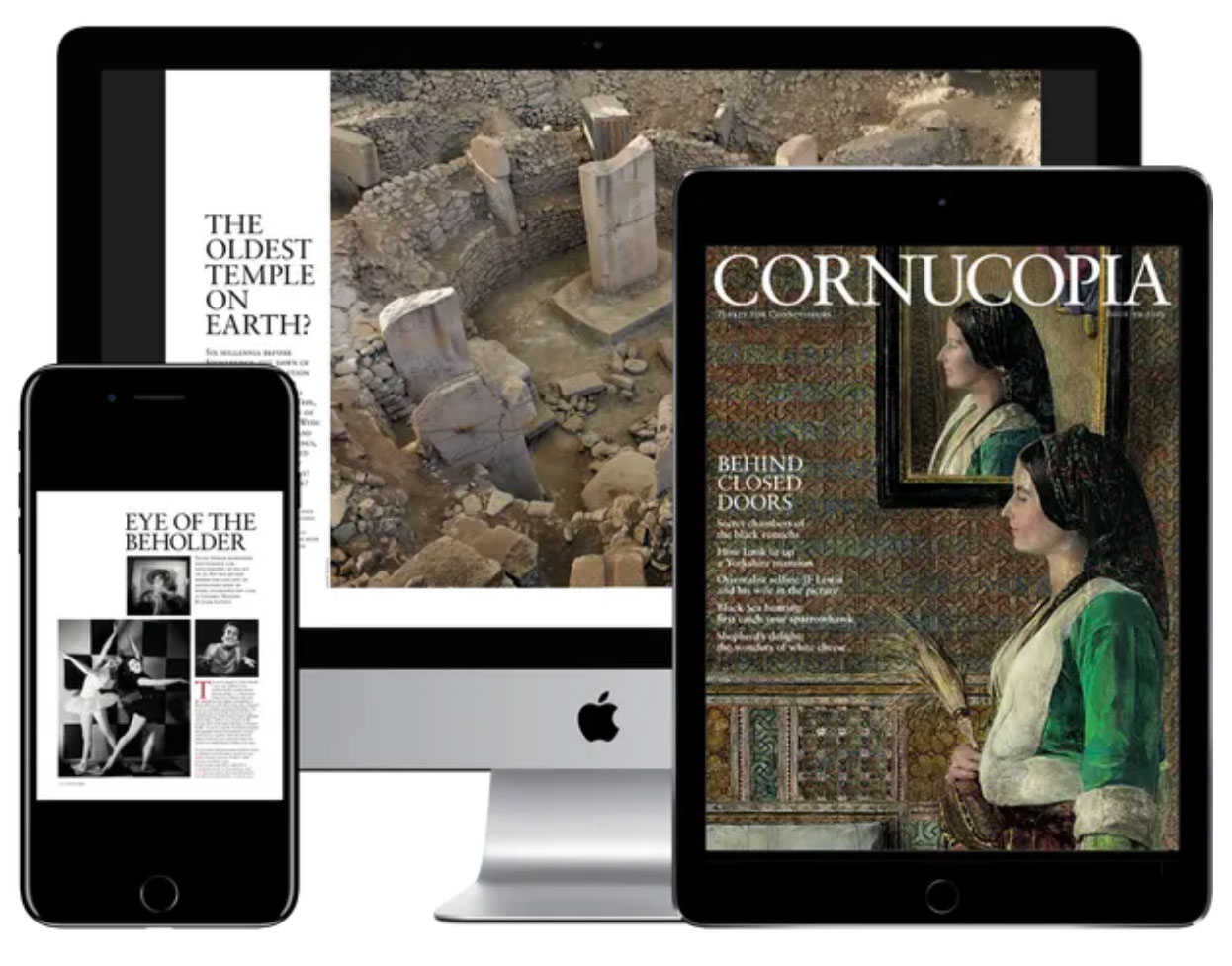
Cornucopia works in partnership with the digital publishing platform Exact Editions to offer individual and institutional subscribers unlimited access to a searchable archive of fascinating back issues and every newly published issue. The digital edition of Cornucopia is available cross-platform on web, iOS and Android and offers a comprehensive search function, allowing the title’s cultural content to be delved into at the touch of a button.
Digital Subscription: £18.99 / $23.99 (1 year)
Subscribe now