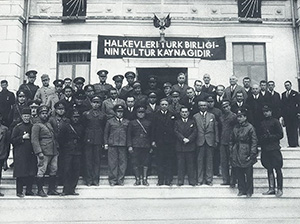
The tenure of the Halkevleri (‘People’s Houses’, 1932–51) spanned most of the single-party period of the early Turkish Republic (1923–46), and their work took place during a widespread public education campaign that focused on literacy, healthcare and the construction of a national identity. In the aftermath of an alphabet reform and in the midst of a major language reform, Halkevleri libraries were tasked with helping a largely illiterate population to read and write. Their journals, bibliographies and library instruction manuals reveal the policies (circulation, collection development, public education, and the twinned operations of publishing and archiving) that prepared these institutions to develop a readership for government propaganda. These strategies were employed to spread literacy as widely as possible throughout the halk (people), enabling community libraries to create and conserve a culture that could absorb their readers in a shared project of nation-building.
About the speaker:
Eve Lacey studied English at King’s College Cambridge, and Library and Information Studies at University College London. She is Librarian at Newnham College Library and the Skilliter Centre Research Library and Archives. The Skilliter Centre for Ottoman Studies supports research into the history, literature and culture of the Ottoman Empire and the early Turkish Republic. Eve’s article on ‘The role of Halkevi libraries in the early Turkish Republic’ appeared in ‘Library & Information History’ in 2023 and won the 2024 Donald G. Davis Article Award and the Library History Essay Award 2024.
 Beyond the myth of Independent Journalism