Buy or gift a digital subscription and get access to the complete digital archive of every issue for just £18.99 / $23.99 / €21.99 a year.
Buy/gift a digital subscription Login to the Digital EditionIce cream is the feel-good food like no other, imbued with memories of the sunny days of childhood. But Turkish ice cream is especially delicious, thanks to a unique ingredient. Berrin Torolsan has the scoop

My earliest memory of ice cream was the sight of the ice-cream boat rowing up to my grandparents’ house in Yeniköy. In the Fifties and Sixties a whole procession of vendors would make their way along the Bosphorus, offering their wares to the yalıs, or waterside houses. In summer they included the dondurmacı – the icecream man – rowing his wooden kayık from house to house, selling tiny cones of ice cream to the children. He would turn up each morning at 11, during our first swim of the day, with the only thing that could get us out of the sea.
The ice cream was white and creamy and irresistible. The grown-ups joined in, of course, and when my grandmother had visitors, fine bowls would be brought out to be filled with shavings of ice cream carefully sculpted like petals with the ice-cream man’s spatula – there were no scoops or balls of ice cream in those days. Then on he rowed leisurely up the Bosphorus, melodiously advertising his nectar: “Dondurmam kaymak!” (My ice cream is the creamiest). On moonlit nights an ice-cream seller, perhaps the same man, would row past after supper, when families would sit out on the water’s edge. Moon-gazing and ice cream were the ultimate treat. My second encounter was with a different kind of ice cream, on the Princes Islands. The ice-cream man on Heybeliada sold his delectable goods from a small cart, his tinkling bell attracting young and old alike. Besides plain kaymak ice cream, he offered fruit ice creams, among them tangy vişne (morello cherry) and fragrant strawberry. I was a little older by then and allowed two helpings – one fruit, one kaymak. I still enjoy them together…
How to make perfect ice cream
An enticing palette of flavours is possible. The following recipes offer just a few, to give an idea of what can be prepared at home with basic ingredients – and none of the noxious additives found in commercial ice cream.
Salep, apart from having its own health-giving properties, helps the milk to homogenise without additional fats – the fat content of home-made ice cream comes only from the milk and is therefore also rich in calcium and protein. If you add fruit or nuts, you benefit from additional vitamins and minerals.
Salep In Turkey
You can buy powdered salep directly from growers such as Salep Evi in Samsun, who produce organic salep (salepevi.com), or by visiting the Egyptian Spice Bazaar, where the coffee vendors Kurukahaveci Mehmet Efendi offer a very good salep powder in 50g and 100g packets. Salep sold abroad could be salep in name only – check the ingredients.
Gum Mastic (sakız in Turkish) comes as crystallised droplets, or “tears”, of resin from the bark of the mastic tree, Pistacia lentiscus (Cornucopia 55). This tree is endemic to the Aegean island of Chios (Sakız Adası in Turkish) and the facing Anatolian shores of the Çeşme Peninsula. Best sources are shops such as Ayfer in the Egyptian Bazaar (Mısır Çarşısı 7) or online.
Saffron There has been a small revival of saffron farming in Safranbolu, which took its name from the flower (and the town’s Gülevi Hotel specialises in saffronflavoured dishes (see page 132). You can order Iranian, and the much rarer Turkish, saffron, through safranbaharat.com.tr.
When serving, remember to remove the ice cream from the freezer 20–30 minutes beforehand and place in the fridge to soften. The recipes here produce about six scoops, the minimum to allow you to try it out a flavour. You can increase the quantities proportionally.
THE RECIPES
The recipes in this issue: Classic ‘salep’ ice cream, pistachio ice cream, ice cream with gum mastic, vişne (morello cherry) ice cream, saffron ice cream, raspberry ice cream and apricot and yoghurt ice cream. For summer sorbets, see Cornucopia 61.
<
p> Classic ‘salep’ ice cream
This recipe using salep is the basis of all milk-based Turkish ice creams. It is a plain, creamy ice cream with the taste of fresh milk and the delicate aroma of salep with its earthy and floral notes. Although simple it is also extraordinarily versatile, as shown in the recipes that follow. Vanilla, gum mastic, saffron, cacao, coffee, or any fruit purée, all make excellent varieties.
1 Combine the basics – cold milk, sugar and salep powder – in a pan and bring to the boil, stirring.
2 Remove from the heat and set aside to cool. While it is cooling, whisk the mixture with a hand or electric whisk to beat air into it, which helps to produce a velvety texture.
3 When the mixture has cooled to room temperature, place it in the fridge to chill.
4 Pour the chilled mixture into the ice-cream maker (if using one), and churn until it thickens. Transfer to a container and store, sealed, in the freezer until needed – there is no need to whisk again, as it will have absorbed the air that gives it the desired texture while being churning. Alternatively, if you are not using an ice-cream maker, pour the chilled mixture directly into a container, seal and place in the freezer. After an hour or so, remove the half-frozen ice cream before it freezes hard and give it a good whisk.
For further recipies, order Cornucopia 68, or subscribe to the digital archive, which inlcludes all of Berrin Torolsan's recipes since Cornucopia No 1.

Faik Şenol’s camera transports Clara Robins back to Thirties Istanbul

The Islamic Arts Museum Malaysia has claimed its second Osman Hamdi Bey painting. The curator Lucien de Guise reflects on the enduring fascination of the Ottoman world, real and imagined

Martyn Rix on a new wave of botanical illustrators that is transforming a nation’s appreciation of nature every species and producing paintings of selected species for publication

A show on food in art at the İşbank Museum of Painting and Sculpture is a veritable remembrance of times past

Known as the ‘Turkish Henri Cartier-Bresson’, Ara Güler roamed the streets, creating gritty portraits of everyday life

Visitors who climb the long flight of rock-hewn stairs to the monastery of Mar Musa al-Habashi in the Syrian Desert, whatever their faith, will find a place of serenity, a welcome, and frescoes to dazzle them

Istanbul’s mystique has long captivated writers, but, as an exhibition reveals, not all care to visit. Maureen Freely gives us chapter and verse

Mardin can only be compared to such cities as Granada and Fez, filled with the palaces of merchants, studded with university colleges, guarded by mountains and fed by their springs
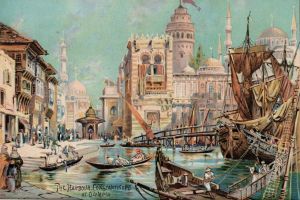
A ‘Constantinople’ spectacular in Victorian London, by Andrew Finkel

The mountain where Endymion still sleeps, by Ross Atabey and Rupert Scott
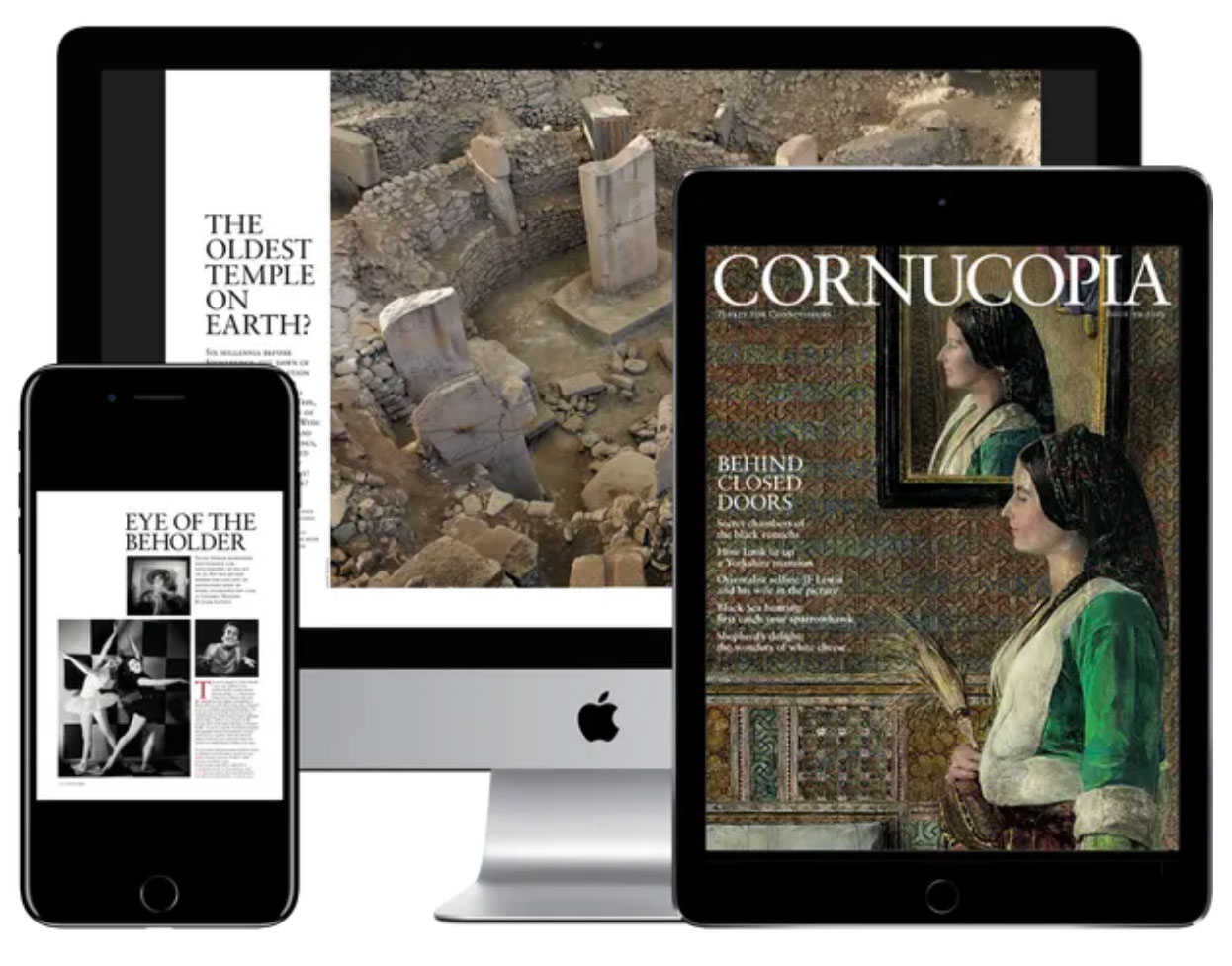
Cornucopia works in partnership with the digital publishing platform Exact Editions to offer individual and institutional subscribers unlimited access to a searchable archive of fascinating back issues and every newly published issue. The digital edition of Cornucopia is available cross-platform on web, iOS and Android and offers a comprehensive search function, allowing the title’s cultural content to be delved into at the touch of a button.
Digital Subscription: £18.99 / $23.99 (1 year)
Subscribe now