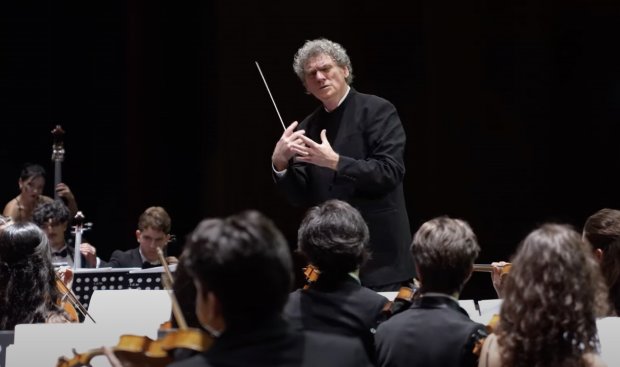
The Turkish National Youth Philharmonic Orchestra held its annual Istanbul concert at the Atatürk Cultural Centre in Taksim Square on August 28. I now look forward to these events with keen anticipation as the standard of playing is always extremely high, thus promising good things for the future of Western classical music performance in Turkey.
But how did this orchestra come into being? Well, it was the brainchild of conductor Cem Mansur. The first time I heard it – in one of its previous incarnations (it is reconstituted with new members each year) – was in September 2018, and after that concert I wrote the following in my blog: ‘The Turkish Youth Orchestra is in fact entirely Mr Mansur’s creation. In 2007, he began scouring the state conservatoires (of which there are currently about 12 in various cities around the country) for promising young talents. Ever since then, in the first two months of each year he has held auditions not only in the major cities but also in Mersin, Edirne and places in between to identify suitable candidates aged between 16 and 22, and has then invited the best of the best to come to Istanbul in the summer for rehearsals, followed by concerts.’ Note that at that time the orchestra did not have any financial input from the Turkish State, so I deliberately did not include the word ‘National’ in its title.
At this year’s concert, I noted with gratification that the orchestra now has the – limited – support of the Turkish Ministry of Culture and Tourism as well as that of the Sabancı Foundation, who (to their credit) have up to now contributed the lion’s share of its funding. However, I do think the Turkish State, which for the last three years has been putting half a shoulder to the wheel, needs to make more effort to publicise the country’s National Youth Orchestra. After all, a little more media exposure on the international platform for a Turkish youth orchestra playing Western classical music, and playing it well, would surely not harm Turkey’s image. So why not send it to perform in Beijing, Tokyo, New York, Dubai, Singapore and Sydney?
Will this message reach the ears of the Great and Good in Ankara? In the words of the heroine’s father in Balzac’s novel Eugénie Grandet, ‘Nous verrons cela’ (‘We shall see’) ...
At the concert on August 28, the ticket I had purchased placed me a long way back in the auditorium; however, I was still able to hear fairly well as I was in the middle section – the only part of the hall, I am afraid, where the acoustics are at all satisfactory. First up was the British composer Benjamin Britten’s Four Sea Interludes from his tragic opera Peter Grimes, conceived while the composer was in the USA during the early years of the Second World War and completed on his return to Britain in 1943. The idea for its composition is said to have occurred to him when he read the transcript of a talk by the novelist E.M. Forster about the 18th-century poet George Crabbe (1754-1832), who lived in Aldeburgh – the town in the county of Suffolk that was also Britten’s birthplace.
It may have been nostalgia for his roots that prompted Britten to write his opera, but neither the poems in Crabbe’s 1810 collection The Borough, with their unsentimental depiction of the lives of working-class folk in the provinces, nor the story of Peter Grimes himself (a misanthropic fisherman described by Crabbe as ‘untouched by pity, unstung by remorse and uncorrected by shame’), are particularly rose-tinted. After three of his apprentices have died in quick succession, Grimes is summoned to the Town Hall to account for himself, and is forbidden to employ another. He then works alone, but the ghosts of his victims come to haunt him, and he sinks both metaphorically (into madness) and literally (when he drowns at sea). Yes, you’ve guessed it: this is a dark piece written by a composer in whose birth chart aggressive Mars (in Scorpio, naturally) is squaring off with king-of-the-underworld Pluto. Howard Posner, writing on the ‘LA Phil’ website, says: ‘There is not a bar in the interludes, no matter how beautiful, that is free of foreboding.’ Here is a link to the full article.
Four Sea Interludes is by no means an easy piece to play, but (to continue the nautical imagery) the Turkish National Youth Philharmonic Orchestra sailed through it. All sections of the orchestra co-ordinated splendidly, the potentially hazardous up-and-down sweeps in ‘Sunday Morning’, the second movement (for these, see 4:22, 4:48 and especially 6:04 in the recording below) went off without a hitch, and the violins stayed in tune even when playing in their highest register – especially in the last movement, ‘Storm’. (The screechy bit comes at 14:06.) The brass section, which hardly gets any down-time at all in this movement, also shone. Turkey isn’t going to have any shortage of good trumpet, horn and trombone-players any time soon, that’s for sure.
Here is a performance of Four Sea Interludes by the WDR Symphony Orchestra (an outfit from Cologne) under the baton of the lady conductor Ariane Matiakh.
Next up was Grieg’s 1868 Piano Concerto in A minor, and at this point a piano was (very) slowly and (extremely) carefully wheeled into the centre of the stage. In this work, the soloist was the young pianist İlyun Bürkev, whom I had previously heard play it in the opening concert of last year’s İKSV Istanbul Music Festival. On that occasion, she had appeared rather nervous (hardly surprising in view of the fact that she was only 15 at the time), and came in with her first, crashing chord well in advance of the orchestral entry with which it was intended to coincide.


This time, however, she seemed much more confident, and played the piece with accuracy and panache. I was especially impressed by the horns’ ability to co-ordinate with the soloist when partnering her in the second movement (accompanying being a feature of musicianship to which I, as a pianist who has done a fair bit of it himself, always pay special attention), and by the perfect woodwind entries at the beginning of the third.
Here is a performance of the Grieg concerto by the Italian pianist Arturo Benedetti Michelangeli (1920-95), the owner of a truly astonishing technique and one of the greatest pianists of the 20th century. Described as ‘reclusive, enigmatic and obsessive’, he hated performing and was famous for cancelling almost as many concerts as he gave. Ill-health, bouts of depression and self-doubt – not to mention a perfectionist obsession with piano mechanics – did not prevent him from preparing some distinguished pupils for the concert platform, however; among these were Maurizio Pollini and Martha Argerich. In his spare time, Michelangeli took part in motorsport endurance races (with that stylish moustache, he could certainly have been a racing driver). Accompanying him in the following 1965 recording of Grieg’s Piano Concerto in A minor is the New Philharmonia Orchestra, conducted by the Spanish maestro Rafael Frühbeck de Burgos (1933-2014).
After the concerto, İlyun Bürkev gave a speech of which – thanks perhaps to the acoustics in the hall, or perhaps to a hitch in the sound system – I heard nothing. I think the piece she played as an encore was by Ahmed Adnan Saygun, but cannot vouch for it. Ms Bürkev is certainly a highly promising performer. She is currently being tutored at the Mozarteum University in Salzburg by Pavel Gililov, a pianist for whose impeccable technique and inflexible discipline I have great admiration (I heard him play in Brahms’s *Piano Quartet No 1* a couple of years ago). Consequently, I am sure she is in exactly the right hands, and I know that the virtuoso pianist Gülsin Onay shares that opinion. Ms Bürkev will be 17 on October 16th, so I will take this opportunity to wish her Alles Gute zum Geburtstag.
The first piece we heard after the interval was by the young Turkish pianist and composer Cem Esen, a native of Adana born in 1997 who received his initial piano training at the Çukurova University State Conservatoire, subsequently studying at the Istanbul University State Conservatoire and in Belgium. I believe he is now a student of Prof. Roland Kruger at the Hochschule für Musik, Theater und Medien Hannover. There is a connection with İlyun Bürkev in that, like her, he has in the past received tuition from Gülsin Onay – who, incidentally, gave a two-piano concert with him in 2012, encouraging young musicians being part of her mission. Cem Esen is also a highly prolific composer who already has over 100 works to his name (see profile in the forthcoming Cornucopia 69).
The piece began with a passage that illustrated Mr Esen’s ability to write a successful duet for the bassoons and percussion, and continued with some interesting xylophone and other percussion effects. (Someone’s ring tone went off at this point, but it didn’t disturb the music in any way. Is that a compliment? I don’t know – the overall feel of the piece was certainly modern, which made the interruption less glaringly inappropriate than it would have been if it had occurred in the middle of a Mozart concerto.) Later on, I noticed some nice contrapuntal writing for the brass department, and a half-comic glissando. Indeed, the work was more than a little tongue-in-cheek throughout, and I saw the fact that the composer had accurately gauged the dose of humour he would be able to get away with as a sign of musical maturity. Towards the end, the orchestral texture became extremely dense, but I expect this, too, was part of the fun, and the surprise ending brought things to an elegant – not to say zappy – conclusion.
Of the works by Cem Esen that are available on YouTube, perhaps my favourite is his Violin Sonata, Opus 24. In this recording, he is accompanying the – absolutely excellent – violinist Elvin Hoxha Ganiyev on the piano. The second movement (which starts at 9:42) is nothing short of schmaltzy, but then we all like a bit of nostalgia now and then, don’t we? For a pianist, Mr Esen has a remarkable talent for writing technically proficient music for stringed instruments. I am curious to know how he acquired it.
And so to the Beethoven. His Symphony No 5 in C minor, no less. When I first saw the programme for this concert, I found it difficult to believe that this symphony had been selected as the main work. But then, because it is so well known, one rarely hears it played – so in a way, this would be (I thought) an opportunity to revisit an old acquaintance, and hopefully listen to this vintage classic with fresh ears.
At this point, I have to confess that both the first and last works on the Turkish National Youth Philharmonic Orchestra’s programme for this concert had less than pleasant associations for me. When my father took me to hear Britten’s opera Peter Grimes at the Free Trade Hall, Manchester, at the age of 14, I began to have an attack of asthma during the performance, so we unfortunately had to leave early. In the winter of 1964–65, aerosol sprays had still not been invented – or at least, they had not yet reached northern England. Those ‘sprays’ that were available at the time had a rubber bulb at the bottom, and at the top a round, orange-coloured perspex tank into which one poured Rybarvin, a fluid that formed a mist when the bulb was pressed, thus allowing one to inhale it. This device was capable of suppressing a few minor wheezes, but a full-scale attack was by no means deterred by it; to be brutally frank, its puny efforts were laughingly shrugged off. So when my father and I eventually got off the bus near our home, I collapsed on the ground and fought for every breath until the spasm passed off.
As for Beethoven’s Fifth, seeing this symphony on the programme sparked memories of a performance by the Hallé Orchestra, again at the Free Trade Hall. Sir John Barbirolli had been a very fine conductor in his prime, but I fear that by 1967 that prime had long passed, and in addition rumour had it that he had become a trifle over-fond of the bottle. So when the maestro, somewhat shakily, raised his baton for that much-celebrated, portentous four-note figure that begins the work, there was a dreadful, long-drawn-out cacophony as each and every instrument came in at a different time. To cap it all, the concert, together with that appalling, staggered armageddon, was broadcast on BBC Radio 3.
I freely admit that before the concert on August 28, I was afraid that the aforementioned Manchester jinx would resurrect itself. But the Turkish National Youth Philharmonic Orchestra gave a competent and convincing performance of Beethoven’s Fifth. True, there were some minor co-ordination issues in the string department in the early stages of the first movement, but things soon sorted themselves out. In the second movement, the gorgeously rounded tone produced by the cellos and double basses was fully worthy of a professional orchestra: one could almost feel the melody vibrating in one’s spinal cord (or chord?). All in all, it was a refreshing performance, with oodles of youthful verve.
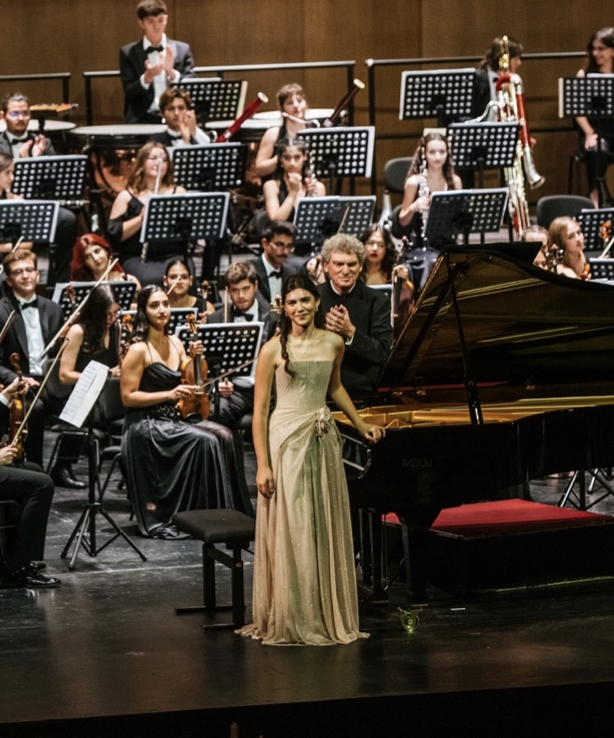
In correspondence with the conductor Cem Mansur after the concert, I found out that his orchestra’s tour of Europe – which followed their performance in Istanbul – had been a most successful one, with full houses and standing ovations at the prestigious Elbphilharmonie Concert Hall in Hamburg during the Schleswig-Holstein Festival (above), at the Smetana Hall in Prague, and in Bratislava and Vienna. The orchestra had also performed in a huge amphitheatre in the ancient city of Laodicea, near Denizli.
And so all that remains is to say “One Thousand Times Mashallah!”, and to express the hope that the day will soon come when thanks to generous state support, the Turkish National Youth Philharmonic Orchestra’s performances are broadcast on megascreens in public squares in Capetown, Calcutta, Kazan, Canberra and Cairo.