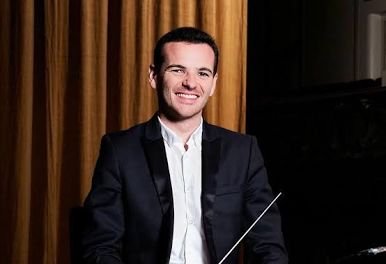
On Friday, February 13 I braved the inauspiciousness of the date to attend a concert at the Atatürk Cultural Centre. This event, one of the DenizBank concerts, brought together two musicians from France: Lionel Bringuier (pictured above), who would be conducting the Istanbul State Symphony Orchestra, and his pianist brother Nicholas. First, the orchestra accompanied Nicholas Bringuier in Beethoven’s Piano Concerto No 5; then they played Hector Berlioz’s Symphonie fantastique.
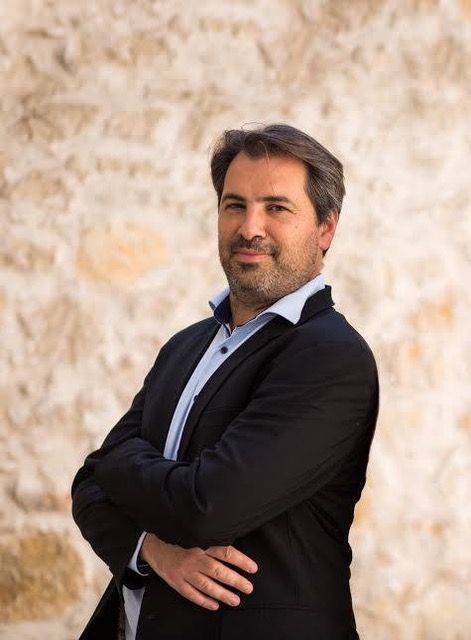
Nicolas Bringuier
Beethoven’s Piano Concerto No 5 in E flat major, Opus 73, sometimes called the ‘Emperor Concerto’, was written in 1809 under extremely difficult conditions: in May of that year Napoleon’s army was bombarding Vienna from the heights surrounding it, and Beethoven said in a letter to his publisher that around him there was ‘nothing but drums, cannons, men, misery of all sorts’. In order to preserve his hearing, which by this time was becoming seriously impaired, he fled to his brother’s cellar and covered his ears with pillows. Despite this precaution, however, his hearing continued to decline, thus preventing him from playing the piano part at the work’s first performance in Leipzig on February 12, 1812. (Interestingly, the concert at the AKM took place within a day of the 214th anniversary of this occasion.)
Although this work is known today as the ‘Emperor Concerto’, this is not a title Beethoven himself gave to it, and the emperor concerned is certainly not Napoleon. The composer had initially seen Napoleon as a liberator who was on track to overthrow Europe’s oppressive monarchies, and indeed had dedicated his Symphony No 3, the ‘Eroica’, to him; however, this dedication was withdrawn when Napoleon had himself crowned Emperor in 1804. Five years, and many bloody battles, later, Beethoven was even less starry-eyed about the man who was causing him – and the armies of the Fifth Coalition, led by Austria and Britain, who were defeated by the French at the Battle of Wagram in July 1809 at the cost of over 70,000 lives – so much grief. The dedicatee of Beethoven’s Piano Concerto No 5 was in fact Archduke Rudolf of Austria, who a few years earlier had begun to study piano and composition with him, eventually became his friend, and continued to meet up with him until 1824. Other works dedicated to Rudolph Johann Joseph Rainier, Archduke of Austria, Prince Royal of Hungary and Bohemia and Cardinal-Archbishop of Olomouc (1788-1831), were the Archduke Trio, the Piano Sonata No 26 (‘Les Adieux’), the Piano Sonata No 29 (the ‘Hammerklavier’), and the Missa Solemnis.
In view of all the military activity that was going on at the time, it is hardly surprising that this concerto should have – especially in the long and somewhat grandiose first movement, which is in the ‘heroic’ key of E flat major – a distinctly military air. First reactions to the work were mostly positive, although its unusual length (approximately 40 minutes) drew some criticism. What those audience members who were musically clued in liked about it were its frequent contrasts of style, mood and key, and its novel features, which were many. Firstly, contrary to tradition (which dictated that a concerto should begin with a statement of the main theme or themes by the orchestra), this one begins with some flourishes from the piano playing on its own – thus continuing a trend begun in the composer’s Piano Concerto No 4. Secondly, while other concertos allowed the soloist to show off his technical skills in a cadenza of his own composition, this concerto has a fully written-out one; in fact, Beethoven specifically forbade pianists to depart from it in any way. Thirdly, the finale follows the previous movement (a relaxing nocturne in which the strings are muted) without a break – another departure from tradition. All these features were adopted, with some individual variation, by subsequent composers.
But the real upsetter of the apple-cart was Beethoven’s redefinition of the relationship between the orchestra and the soloist. In Mozart’s time, a piano concerto had been a ‘polite dialogue’ in which the two acted as co-creators. Beethoven, a far tougher cookie, transformed this relationship into a dramatic dialogue, playing with the tension between them. The orchestra, far from being a mere accompanying element, now becomes a protagonist in the back-and-forth. The piano does not just repeat themes played by the orchestra: it develops them, exploring their possibilities and taking the music into unexpected places, meanwhile allowing the soloist to fully exploit the instrument’s capabilities. Thus, the pianist becomes a vector for the composer’s inventive mind. Here, we see the reason for the ban on alternative cadenzas: Beethoven wanted his cadenza, which he uses as a medium for the further development of his themes, to play its part in the movement’s overall structure, and not be replaced by any irrelevant finger-flexing. And as a result of all this playing around with themes to see what places they could be taken to on their journey of exploration, that overall structure now took on the character of a symphony.
You may have noticed that I rarely list a performance of a work by Beethoven: the reason for this is that so many excellent ones are available, and it is hard to choose between them – as well as unjust to those performances that are rejected. In this instance, however, I will break my rule and list one in which the soloist is Lang Lang. The orchestra is unfortunately unnamed, but the conductor is Christoph Eschenbach. I think Lang Lang’s extraverted – not to say punchy – style goes well with Beethoven’s forthrightness. Others may disagree. (Actually, the current concentration of planets in Mars-ruled Aries may have had something to do with my choice of a feisty pianist rather than a fluffy one.)
The performance of Beethoven’s Piano Concerto No 5 at the Atatürk Cultural Centre on February 13 was marked by some expressive flourishes from the pianist (in terms of arm movements as well as those of an interpretative variety), especially at the end of his phrases. Nicholas Bringuier, born in Nice in 1980, was trained first at the Conservatoire there, then at the Paris Conservatoire (where he was awarded first prize in a piano competition at the age of 16, subsequently going on to complete a Master’s degree at this same institution), and finally at the Berlin University of the Arts, where he was taught by the celebrated pedagogue Klaus Hellwig (1941-). At the beginning of the first movement, Bringuier demonstrated his excellent technique in some rapid arpeggios. I thought his use of the pedal just a tad excessive, but the extra volume certainly added to the grand sweep of this majestic tour de force.
In the second movement, the orchestra’s entries (always a danger area in a slow-moving piece) were invariably perfectly co-ordinated. The woodwinds never strayed out of tune; the horns produced a successful duet, as indeed they had done in the first movement, and an ultra-soft and gentle entry from the pianist showed that he could be sensitive as well as spirited. I have to say that he overdid the diplomacy a little in the finale, in which one of the tunes he played did not come through the orchestral background, but in the main his performance was confident and convincing as well as technically impressive. For an encore, he gave us Chopin’s Revolutionary Étude (Opus 10, No 12 in C minor), playing it in the portentously demonstrative manner the piece demands.
In the second half, the orchestra played the Symphonie fantastique by the French composer Hector Berlioz (1803-69). This programmatic symphony, which mirrors events in the composer’s love life in a highly exaggerated way, depicts the sufferings of a romantic artist who poisons himself with opium because of his unrequited love for a beautiful woman. (In reality this was Harriet Smithson, a Shakespearean actress of Irish extraction with whom Berlioz was obsessed; he eventually persuaded her to marry him, but unfortunately things did not work out at all well between them.) The first movement of this, the composer’s most famous work, is entitled ‘Daydreams – Passions’; it introduces the recurring idée fixe – the love theme. In the second movement, the hero attends a ball. Following this, there is a pastoral interlude (the fact that the symphony has five movements, an unusual number at the time of its composition, is a nod to Beethoven’s similarly five-movement Symphony No 6, the ‘Pastoral’). This rural revel is followed (in the fourth movement) by a hallucinatory march to the scaffold: in this parallel reality, it seems, our hero has unalived his ladylove, and is now receiving his just deserts. In the finale, he finds himself in the middle of a witches’ sabbath – a ‘diabolical orgy’ in which his lover takes part. (Cries of “Shame!”)
In his description of the Symphonie fantastique on the LA Phil website, Herbert Glass makes several important points, one of which is that in this work, Berlioz creates ‘not only a mood (as in Liszt’s symphonic poems), but also states of mind and precise, physical situations. Nothing like it had been attempted on this scale before. Berlioz’s new concept of how far one could go in dramatic music without resorting to a vocal text caused considerable polemicising over whether such music was viable without reference to the ‘story’.’ Glass’s article fills this information gap by telling you what is supposed to be happening in each movement. The Dies irae (‘Wrath of God’) tune that is heard in the finale, by the way, is a 13th-century Latin hymn that forms part of the Roman Catholic Church’s Requiem or ‘Liturgy for the Dead’; it describes the Last Judgement and the world turning to ashes. When I said that this work ‘mirrors events in the composer’s love life in a highly exaggerated way’, I wasn’t joking.
In a blog on a concert last November in which Berlioz’s Nuits d’été was played, I said of the Symphonie fantastique that it ‘has its moments, especially in the witches’ knees-up at the end – a piece of Hollywood grotesquerie that must surely be the ultimate 19th-century Gothfest.’ The conductor Leonard Bernstein, meanwhile, described the work in somewhat more colourful terms: “Berlioz tells it like it is ... You take a trip, you wind up screaming at your own funeral. Take a tip from Berlioz: that music is all you need for the wildest trip you can take, to hell and back.” Tut-tut! Stiff upper lips rule OK. I have to say, though, that whoever programmed this work for Friday 13th must have been making a point of some kind ... Anyway, I was relieved to find that nothing eschatologically untoward took place, and no-one put anything chemically inappropriate in my coffee during the interval.
In this recording, Berlioz’s Symphonie fantastique is being played by the Frankfurt Radio Symphony Orchestra under the baton of the Colombian-Austrian conductor Andrés Orozco-Estrada.
The performance by the Istanbul State Symphony Orchestra was conducted by Nicholas Bringuier’s brother Lionel with great skill. His conscientious and well-timed instructions to the orchestra were admirably clear, and he received the reward for his pains in the form of an excellent rendition. All the speedings-up and slowings-down came off without any co-ordination issues; we heard some fine solos from the horns and woodwinds, and I especially enjoyed the dramatic beginning of the fourth movement, in which the occasional exclamations from the brass department were played to perfection. I found the ‘pastoral’ third movement a little tedious, but that was not the fault of either the orchestra or the conductor: frankly, Beethoven does bucolic stuff better than Berlioz. The ‘bells of hell’ in the finale did not always sound exactly on time, but that is the only criticism of the performance I can make from the technical point of view.
After all this ‘gloom, doom and broomsticks’ stuff, I would like to end with something fresh and innocent: here is Berlioz’s Christmas song L’Adieu des bergers à la Sainte Famille, a moving piece whose title is usually anglicised as ‘The Shepherds’ Farewell’. It comes from his 1854 oratorio L’enfance du Christ. I know it’s out of season, but the beautiful choral writing is something not to be missed, and this recording (which comes with the vocal score and a piano reduction of the orchestral parts) has an exceptionally rich bass line. Enjoy!


_140_88_80.jpg)