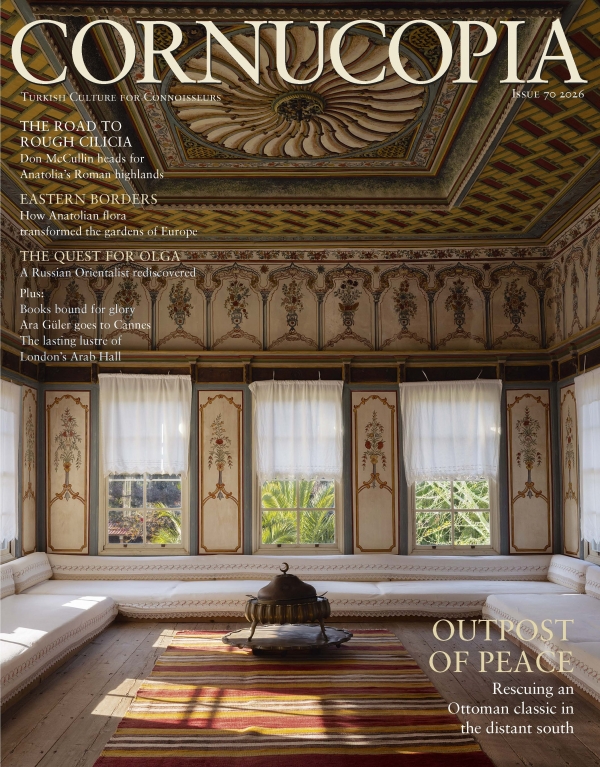
Buy or gift a digital subscription and get access to the complete digital archive of every issue for just £18.99 / $23.99 / €21.99 a year.
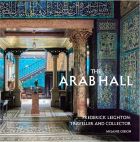
Buy/gift a digital subscription Login to the Digital EditionAn artistic titan of his time, Frederic, Lord Leighton (1830–96) was ennobled just one day before he died. His abiding love of the East permeates his entire mansion-cum-studio in Holland Park, West London. It took an eight-day sale to disperse Leighton’s vast collection, but the magnificently tiled ‘Arab Hall’ was rescued for the nation. Melanie Gibson, author of the first book on its creation, traces his inspiration back to his early travels

On April 1, 1895, eight photographs of different rooms in Frederic Leighton’s London home and studio were taken by Bedford Lemere & Co, a well-known firm of architectural photographers. The images are of sufficiently high quality for some of the objects on show in the rooms to be picked out. In a photograph of the staircase hall (opposite), a tombak ewer stands at the bottom of the stairs next to a stuffed peacock. A copy of an Iznik plate made by Théodore Deck is displayed on a table and a fine Kula rug hangs under the stairs.
Less than a year after the photographs were taken, in January 1896, Leighton died. The images serve as a reminder that his collection of Islamic art was substantial and important. Its extent can never be fully understood or appreciated, however, because after his death it was entirely dispersed at an eight-day auction. His sisters, Alexandra Orr (1828–1903) and Augusta Matthews (1835–1919), inherited the house but without the means to maintain it, and six months later they asked Christie, Manson & Woods to arrange the sale of its contents, which included hundreds of ceramics, textiles and carpets from around the Islamic world.
In the absence of his collection, Leighton’s fame as an Islamophile rests on his creation of the Arab Hall. Sometimes described as “the most beautiful room in London”, this lavishly decorated space, with its golden dome, Syrian and Turkish tiles and golden mosaics, was hailed as an extraordinary creative and artistic triumph from the moment of its first public unveiling in 1881.
In 1926, Leighton House was gifted to the Kensington Borough Council and opened to the public. As a central part of this year’s centenary programme, the museum has organised the first exhibition to be devoted to this remarkable space, The Arab Hall: Past and Present.
Although Leighton’s art collection was to some extent acquired from auctions and dealers in London and Paris, many of the pieces were bought from further afield. By the time he was elected President of the Royal Academy in 1878, Leighton had travelled widely around the southern Mediterranean, visiting southern Spain (twice), Turkey, Egypt, Syria and Sicily. In the years between 1866 and 1877 he was establishing his reputation as an artist and he made sketches during these trips, but his main interest in exploring Granada, Istanbul, Cairo, Damascus and Palermo was to study the distinctive architecture and decoration of the Byzantine and Islamic buildings in these cities.
Leighton’s admiration for the art and architecture of the Islamic world first emerged while he was in his mid-20s and studying in Paris. In September 1857 he stayed for some weeks in Algiers, later writing that this visit had “made a deep impression” on him, leaving him with an abiding love for “the East”. The typical architecture of the old parts of the city struck him forcefully, and eventually he met a local resident who invited him to visit him at home. Leighton was charmed by the house, which he described in detail in a letter to his mother, remarking on the “handsomely cushioned divan”, “the highly wrought embossed chest” and “the fillets of coloured porcelain tiles”.
Two years later, Leighton moved from Paris to London, and, after embarking on the building of a house in Holland Park, he began making a series of long journeys. He went to Turkey in the autumn of 1867, via Vienna, visiting Istanbul, Bursa and Izmir, then stopping on the island of Rhodes before ending up in Athens. To explore Istanbul, known then as Constantinople, he may have followed the five sightseeing itineraries set out in Murray’s Handbook for Travellers in Turkey, which would have taken him around the principal Byzantine and Ottoman monuments.
His appreciation of the buildings he saw in Istanbul can be gleaned from the echoes of their decoration that he later evoked or reproduced in the Arab Hall – in the gold mosaics, coloured glass windows and tile panels. He even considered bringing an entire room back to London: in a diary entry dated June 8, 1868, Henry Cole, the director of the South Kensington Museum (later renamed the Victoria and Albert Museum), noted that the artist was recommending that the museum should acquire the “Sultan’s kiosk”. There are, unfortunately, no more details on this suggestion, which was never was never acted upon, but Leighton was probably referring to the yalı of Amcazade Hüseyin Pasha (1644–1702), grand vizier to the Ottoman Sultan Mustafa II. By the time Leighton was seeing it, the house had fallen into disrepair, leaving only a large, cantilevered reception room that extended out over the Bosphorus (see page 143).
After leaving the capital, Leighton travelled to Bursa, where he made his first sketch of an Islamic building. From Rhodes he wrote to his father that he had bought “a number of beautiful specimens of old Persian faience (Lindos ware), chiefly plates”. Betraying some qualms at the cost of the pieces, no doubt in expectation of paternal disapproval, he added: “I spent a considerable sum, knowing that such a chance would never again be given me. I could, any day, part with the whole lot for at least double – probably treble – what I gave.” This was not his first purchase of Iznik pottery: four years earlier his friend Charles Newton (1816–94), a curator of classical antiquities at the British Museum, had bought about 30 Iznik plates for him in Rhodes, which were described by his young friend Gertrude Jekyll (1843–1932), who was travelling with the party, as: “beautiful, glazed earthenware platters of Persian design, with conventional flower patterns on a white ground, known as Lindos or Rhodian ware”.
The following autumn Leighton travelled to Egypt and spent several weeks in Cairo before sailing along the Nile in a steamboat loaned to him by the ruler of Egypt, the Khedive Ismail Pasha (1863–79). Leighton adored the city, once referring to it as “my wonderful Cairo”, and he would have been happy wandering around the crowded alleys, taking in the noisy, vibrant atmosphere of the historic centre, exploring the heavily dilapidated but still impressive stone mosques, medreses and tombs dating from the Mamluk period (1250–1517), accompanied by a dragoman and armed with a guidebook, probably one from Murray’s series, republished the year before.
Between September 30, 1868, the day after his audience with the Khedive, and January 9, 1869, when he was back in London, Leighton withdrew £300 (approximately £29,000 today), a larger sum than is recorded on his other trips. He returned with hundreds of tiles, which he asked his friend and architect George Aitchison (1825–1910) to install at the bottom of the stairs. The pleasure this wall of tiles gave Leighton, his first attempt at creating a tiled space, can be surmised from his decision to create a divan directly opposite, ingeniously constructed with a combination of carved wooden sections and skirting. It was made by an English craftsman to frame a wooden panel of walnut, finely inlaid in bone and ivory, with flowers in vases and hanging garlands placed on either side of an elaborate central shamsa or sunburst.
In 1873 Leighton travelled to Syria. In the previous year his friends Isabel and Richard Burton, recently returned from Damascus, where Richard had acted as British consul, had paid him frequent visits, while Richard sat for his portrait. The conversations during these sittings had no doubt inspired Leighton to plan a visit to Damascus, which the couple had come to know so well; when he got there in 1873 Leighton painted an oil sketch of their house, perhaps as a gesture of thanks. The Burtons shared practical information with him, as well as an introduction to their friend Reverend William Wright (1837–99), an Irish missionary who spoke perfect Arabic and was well used to assisting visitors in seeking out tiles, woodwork and textiles from the local antique dealers, the antakji. While he was in the city, Leighton wrote to his friend the artist Val Prinsep (1838–1904) that he was spending “a vast deal of time hunting tiles”; he also bought some spectacular pieces of Iznik pottery.
In 1885 the Burlington Fine Arts Club, a private collectors’ club in London of which Leighton was a member, put on an exhibition of “Persian and Arab Art”. The artist loaned 47 of his finest pieces, mostly ceramics. The accompanying catalogue was written by Leighton’s friend the artist and collector Henry Wallis (1830–1916), and it listed descriptions of all the objects, with some illustrated in black-and-white photographs. The purchase places of several of Leighton’s loans were identified: a large Iznik dish decorated with a floral pattern in vibrant blue, turquoise and olive green had been bought by Wright directly from a family in Damascus; a tall pear-shaped bottle with decoration of vases, tulips and prunus blossom in blue, turquoise and black was “obtained by Sir F. Leighton from a family at Baalbec [Baalbek]”.
From the vast collection of Islamic pieces that Leighton put together over his lifetime, tiles, woodwork and coloured glass windows became permanent fittings in the Arab Hall, but other objects were arranged throughout the house. In every room the floors were covered in carpets of different sizes, and pieces of furniture were draped with patterned and embroidered textiles. Much of his ceramic collection, particularly the Iznik plates, tankards and other vessels, was displayed on the walls and shelves of the dining room, but dishes were also hung on the two sides of the drawing room alcove, and groups of objects were arranged on surfaces and cabinets in the studio. From the auction catalogues, the scale of the collection is apparent. Up for sale were works by contemporary European artists, as well as 14th-century Italian paintings, Michelangelo drawings, Dürer engravings and Japanese prints, together with furniture, carpets, textiles and quantities of ceramics. The first three days were devoted to the sale of “The Collection of Old Rhodian, Persian, Anatolian and Hispano-Mauro Pottery, Bronzes and Oriental China, Inlaid Furniture, Persian Prayer Rugs & Costumes”, which included about a hundred pieces of “Persian, Rhodian and Anatolian” ceramics (double the number of Chinese and Japanese pieces), 69 carpets and dozens of costumes and textiles. Clearly, Islamic art objects represented a very significant part of Leighton’s overall collection of furnishings and decorative objects.
Some of these lots would end up at what is now the Victoria and Albert Museum, thanks to Leighton’s dealings with Caspar Purdon Clarke (1846–1911), from whom he had bought a number of pieces, including tiles for the Arab Hall. Clarke was a trained architect who travelled to Egypt, Iran and Syria between 1871 and 1877. He was both interested in the architectural and artistic traditions of these countries and commercially minded – alongside his official assignments he made time to buy artefacts for clients who included Leighton. His trip to Damascus in 1877 was at the request of the South Kensington Museum, for whom he was acting as a buying agent, and he also took a commission from Leighton and was able to acquire the two large tile panels decorated with grapevines that form the main focus of the west wall of the Arab Hall. Clarke’s ascent at the museum was swift, and in June 1896 he was appointed its overall director. Only a month later he authorised the acquisition of a number of lots from the sale of Leighton’s collection. The agent bidding for pieces in the sale, named as Mr Stuart, paid over £200 (today approximately £22,000) for an assortment of items that included Syrian and Turkish ceramics and tiles as well as carpets.
The auction catalogues remain the most comprehensive inventory of Leighton’s collection, and a testimony to the extent of his love of Islamic objects, which was at least equal to his other collecting interests. The sale and dispersal of the collection have totally obscured his keen appreciation of this field. One contemporary critic singled him out as one of the most discerning carpet connoisseurs alongside the well-known collector Baron Edmond de Rothschild (1845–1934) and the Paris dealer Albert Goupil (1806–93). Today, his reputation as an Islamophile rests entirely on the Arab Hall, but the retrieval and identification of just a few of his pieces of Islamic art show that he can also be ranked as one of the great collectors of the late 19th century.
Melanie Gibson is a lecturer and writer on the history of Middle Eastern ceramics. Her interest began when she was studying Arabic at Oxford University. She gained her doctorate at SOAS and is a Trustee of the Friends of Leighton House
Berrin Torolsan on the wonder bulb

Doyenne of curators, Nazan Ölçer, by Andrew Finkel
Around the World
Barnaby Rogerson and the photographer Don McCullin set out from Turkey’s capital for Rough Cilicia

Martyn and Alison Rix chronicle Turkey’s extraordinary botanical legacy

This grand mansion, an Ottoman outpost on the remote southern peninsula of Datça, was rotting away when it was rescued by an enterprising new owner. It has now regained every inch of its early-19th-century charm. By Rupert Scott. Photographs by Monica Fritz

A new exhibition turns the limelight on Halil Pasha, pioneer of Turkish impressionism. By Ayla Jean Yackley
A show that turns the spotlight on two women painters eclipsed by their artist husbands
A new exhibition at the Ara Güler Museum follows Turkey’s adored photojournalist to the French Riviera

The beauty of bindings
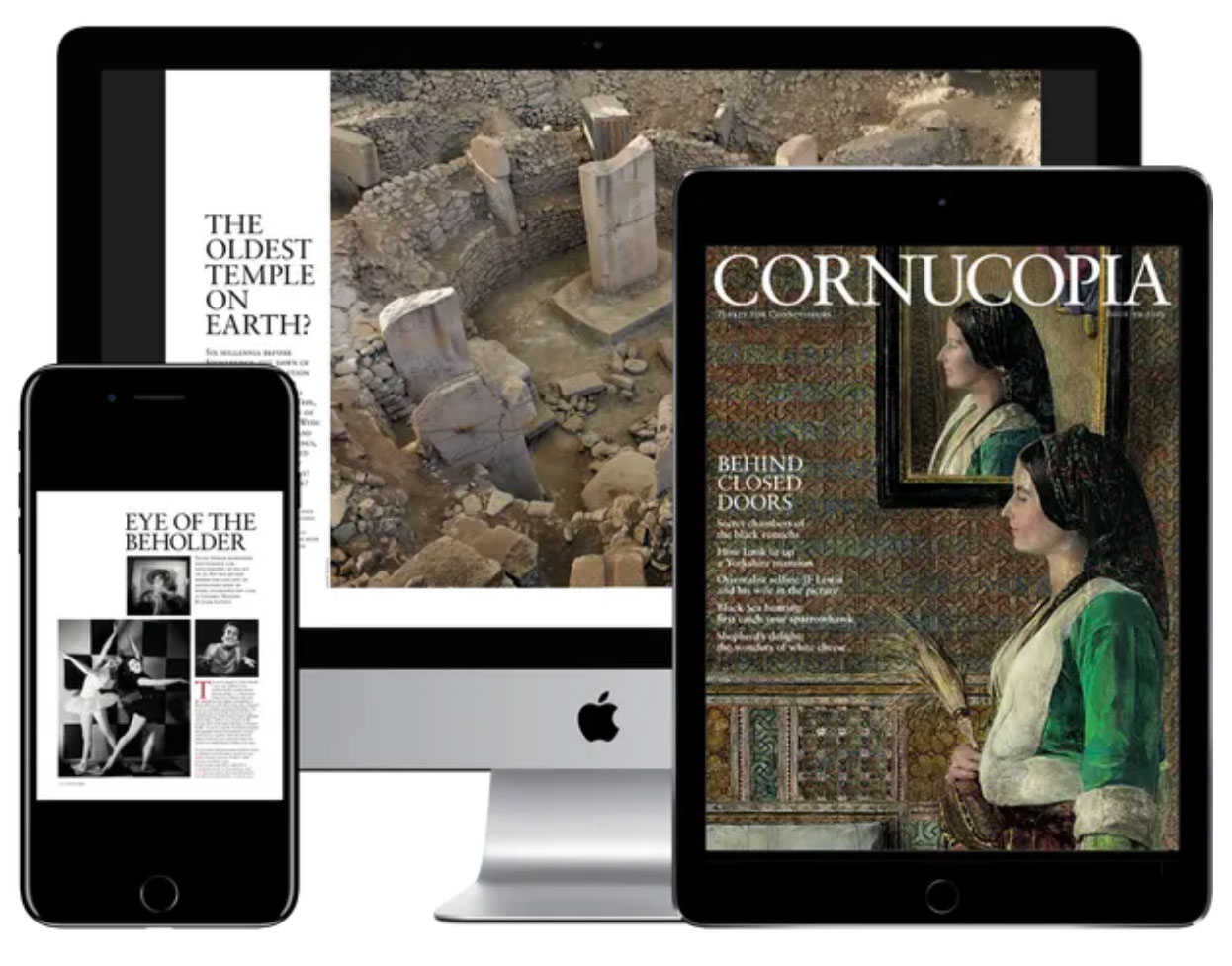
Cornucopia works in partnership with the digital publishing platform Exact Editions to offer individual and institutional subscribers unlimited access to a searchable archive of fascinating back issues and every newly published issue. The digital edition of Cornucopia is available cross-platform on web, iOS and Android and offers a comprehensive search function, allowing the title’s cultural content to be delved into at the touch of a button.
Digital Subscription: £18.99 / $23.99 (1 year)
Subscribe now