Buy or gift a digital subscription and get access to the complete digital archive of every issue for just £18.99 / $23.99 / €21.99 a year.
Buy/gift a digital subscription Login to the Digital EditionSouth from Ankara in the footsteps of Caesars with Don McCullin

This was our fifth Roman Roads trip together. On the summit of Nemrut Dağı we thought we had climbed to the end of our Roman Roads journeys. But here we were, doing what we had agreed never to do, which was to travel in southeastern Turkey in the winter, and to travel during Ramazan. Our intended route, zigzagging across the Taurus Mountains and then hugging the Syrian frontier until we met the Euphrates river, would be empty of tourists. I was affecting some knowledge of the region, but this was based on a pair of journeys undertaken 35 years ago.
We were a pair of tough, independent male travellers – one of us honed by 70 years of battlefield experience as England’s most famous war correspondent, the other by 40 years of pottering around North Africa, picnicking among historical monuments. Because of this collective travel experience, we insisted that we needed to be met at the airport by a friendly female face. It was a good call, for although we had already landed at Istanbul and were now part of a jolly domestic scrum on an internal flight, our baggage had to be retrieved from international arrivals.
A high state of security was in operation. We later found out there was a good reason for this, but in the meantime our trail of travel documents needed retrieving in the right order. This was proving difficult: I had come from a three-day book festival, and Sir Donald McCullin from the Swahili coast. We were tired, it was Ramazan and it was the middle of the night.
It is at moments like this that everyone needs Monica Fritz to pop up in their lives. Frowns get transmuted into smiles. Don was placed in command of our camera boxes, while Monica continued to charm the security guards (chatting to them about their mothers’ favourite iftar soup recipes) while I was nonchalantly pushed through a side door. The vast luggage hall was empty apart from two floodlit suitcases that were about to be carted off to the lost-luggage office.
Our hotel was a converted caravanserai filled with books, pictures, carpets and photographs. It stood right beside one of the ancient gates into the walled hilltop citadel of Ankara, and just above one of the world’s most fascinating archaeological museums. Monica warned us to enjoy ourselves, for this one night was the smooth part of our journey; the rest would be rough. But instead of going off to sample our comfortable bedrooms and marble bathrooms, we spread open a map and ordered drinks. The dark shade of the Taurus Mountains on the map determined everything on this journey.
We had already explored the Roman cities of Pamphylia in the southwestern corner of Turkey, overshadowed by these mountains. This pentapolis occupied the narrow coastal plain like a string of pearls: Attaleia (Antalya), Perge, Sillyum, Aspendos and Side. These five sister-cities were close enough together to be visible to each other from their high places.
As you head east, the mountains edge closer to the shore, and the sickle-shaped province of Pamphylia (“the place of all peoples”) is replaced by a highland region known as Rough Cilicia. This is a magnificent landscape, riven by gorges and streams, with a series of small bays tucked into the shore. The complex topography can take a lifetime to unravel. One of my heroes, Terence Mitford, tried to do just that, using his scholarship to record ancient inscriptions scattered in villages and hamlets, or hammered into cliff faces. Our map showed that Rough Cilicia occupied that bulge in Turkey’s southern Mediterranean coast that leans out towards Cyprus. It was natural bandit country, known to the ancient world as the haunt of pirates. It is studded with medieval castles and was known as Gâvur Dağı (“mountain of infidels”) to the early Turkic emirates established on the horse-friendly high plains. We planned to be diligent and keep to our classical Roman period. We would stumble on wonders.
ROMAN ANKARA
Citadel, temple, capital and history
ROMAN ANKARA Citadel, temple, capital and history
The Temple of Rome and Augustus was lit up by the diffused light of an Ankara morning set against a pale blue continental sky. I have loved this place for years. It has no columns or capitals or statues, but it has something equally precious, which is a patina of continuity – “the true rust of the barons’ wars”, as Horace Walpole would exclaim.
The temple sanctuary has stood for 2,000 years, recorded by travellers, artists and merchants. Its high walls have been incorporated into a succession of sanctuaries. There is a raised altar and a little flight of windows cut through the classical masonry to recall its centuries of use as an Orthodox church. Then, for the last 500 years, it served as a medrese (a place of teaching) within the compound of a 15th-century Ottoman mosque. When the Ottoman travel writer Evliya Çelebi visited, he counted 300 dervishes within the complex, and many more buried on the surrounding hill. This great mosque remains a working neighbour of the temple ruins, as does the small domed tomb of Hacı Bayram, who is the spiritual guide of Ankara, the founder of a mystical brotherhood and ancestor of many of the city’s merchant dynasties.
How did Ankara first rise here?
Ankara had risen to become the citadel-capital of the kingdom of Galatia in the 3rd century. Twenty thousand Celtic horsemen had been recruited from out of Thrace in 278BC to serve as a mercenary army for King Nicomedes of Bithynia. This army of Gauls would shed their obedience to this paymaster, but after 50 years of fighting and raiding they were persuaded by the armies of all their neighbours to settle down in central Anatolia. They kept their tribal structure, so Galatia was a confederation of three rival tribes (the Tectosages, Tolistobogii and Trocmii). The Galatian kings that we know of (such as Deiotarus) ruled as Tetrarchs, keeping the three tribal rivalries in balance but perhaps also honouring the great mother goddess, often addressed as a trinity.
There are certainly many triple-sanctuary citadels to be found in the lands of the Celts that we can compare with Ankara: be it Trimontium in the Scottish Borders, Trentino in the Italian Alps, or the English sanctuary of Trisentona (on the banks of the River Trent) formed from the junction of three rivers. These places were all the designated meeting places of three warlike Celtic tribes marked by a sanctuary of the great goddess.
One of King Deiotarus’s sons, Amyntas, rose to eminence as commander of Galatian cavalry serving in the armies of Rome. Label him ally, mercenary or auxiliary commander to your taste. He served under Brutus and Cassius (but defected just before the battle of Philippi, 42BC), then fought beside Mark Antony for many years before once again reading the signs, and neatly defected to Octavian just before the battle of Actium (31BC), after which he was acknowledged as King of Galatia by Augustus. He surrendered this kingdom to the Romans on his death.
I have often thought it curious (if not tragic) that such a battle-hardened warrior and sagacious politician should have meekly surrendered his homeland to become yet another, mere subject province of the vast Roman Empire. But once again he had read the political wind with accuracy. The Roman Empire flourished by toppling kings and liberating cities, which allowed them to make allies with local landlords. King Amyntas’s timely submission would allow his family to drop rank but flourish as Romanised landlords, making their way through the networks, joining the administrative career ladder and being recruited into the ranks of the Roman Senatorial aristocracy. This required patience, but from inscriptions we know that one of his great-grandsons would become the Roman governor of Bithynia (northwest Anatolia), while another served as the tribune of a legion on the eastern frontier. King Amyntas did not die in his bed (within the palace-citadel Ankara) but was assassinated in the Taurus Mountains.
His immediate heir was Pylamenes, who built the Temple of Rome and Augustus at Ankara. He chose an existing holy place, an old shrine on a hill beside the citadel dedicated to the great Anatolian mother goddess and her consort-son, the god Men. The temple was built very quickly, completed in AD14, with 15 columns on each of the long sides and eight at the front. On the temple walls you can still identify the names of 20 Galatians who served their year as high priest alongside four provincial governors. These local grandees also commissioned statues for the temple and paid for doles of grain and olive oil to be distributed to the populace, alongside big sacrifices and games. These were always given in the name of the Emperor, which provided a politically legitimate excuse for all the tribes to come together and feast and race their horses against each other. As an inspired afterthought, the bronze inscription that had been placed before the entrance of the Emperor Augustus’s mausoleum at Rome was cut into the stone on the walls of the temple porch and on the south wall.
The original was melted down for coin in the Dark Ages when Rome was repeatedly sacked. All other copies have been lost (with one exception, as we will later discover), so it is one of the additional wonders of this temple that the Res Gestae was rediscovered for the world from these walls at Ankara in 1555 by Ogier de Busbecq, Habsburg envoy to the Ottoman Empire. It could be cross-referenced as it had been carved in both Greek (on the outer wall) and in Latin (on the inner walls of the temple porch).
These are Augustus’s own words, which he drafted in the last month of his life, to be read out to the Senate of Rome after his death. As a schoolboy, I was much impressed by that opening line: “At the age of 19 I raised an army at my own expense and saved the Republic.” To be later followed by that chilling mandate from the Senate, “to let the state come to no harm”.
The face of the god Men is best known to us from a single carving on display at the Museum of Anatolian Civilizations in Ankara. It is one of thousands of exhibits housed in a magnificent (ten-domed) old Ottoman bedesten and a neighbouring han. I have long been bewitched by the astonishing collection of this museum, which tunnels back into the vast and complex history of Anatolia, so that however well armed you are with names and facts, you become travel-sick and disordered with the vastness of ancient history. It felt odd confining ourselves to just the classical corridor of the Ankara museum, but this was a fundamental part of the travel agreement that I had made with Don.
Here, I found a bust of Men. He wears the Phrygian cap, which later ages would adopt as the cap of liberty, but which also labels him as an Anatolian deity. From inscriptions we know that Men was worshipped in Pontus (northernmost Anatolia) and Phrygia (central Anatolia). This bust does not come from Ankara but was found just north of the Taurus Mountains, in a temple (dating back to the 4th century BC) raised to the god Men Askaenos in the highland city of Psidian Antioch.
I had to catch my breath as I looked once again on the face of the “oath and women protecting Wanderer”, the silver god of wisdom and the moon. We had met before on the summit of Mount Nemrud and at his great sanctuary at Sumatar, “unquestionably one of the most atmospheric religious sites in Turkey”, in the words of Francis Russell. Men was worshipped by the Hittites as Arma, by the pre-Christian Georgians as Armazi, and throughout Mesopotamia as Sin. He is associated with bulls and lions, and as with many young male gods there are tales of an expulsion from heaven and being rescued by his all-powerful mother/lover, the great goddess. Men would be assimilated with the mysterious heroic rider god who, as in the cults of Hercules, Castor and Pollux, was also touched by the tale of a half-divine mortal being tested on this earth. He would become one with Mithras.
It was an extraordinary, adroit piece of diplomacy by the citizen Pylamenes (the son of the last King) to combine the deified hero Augustus as an avatar of this ancient Anatolian deity of wisdom, worshipped under so many forms. Rome was associated with the powerful great goddess, always known to be both nurturing and also at times relentlessly destructive. It is no more than a curious chance that at both Ankara and Psidian Antioch, the god Men was worshipped, and it is at these two cities (alone in the world) where Augustus’s Res Gestae inscription would survive.
Our historical host in Ankara was Professor Musa Kadıoğlu, who waved aside our concerns about Ramazan. You are travellers; you must eat. He also wanted us to have energy to comprehend recent excavation sites, such as the theatre and great baths, that are peeling back fragments of Roman Ancyra (Ankara), as well as to walk beside the wide, handsome Roman road that has been permanently exposed beside the old city centre, Ulus Meydanı. Roads have always been at the centre of Ankara’s history. It is the natural stopping place, the epicentre of a compass-like choice of routes spanning out in every direction, as well as sitting astride the old Persian Royal Road that connected Sardis to Susa.
The citadel of Ankara was traditionally founded by King Midas in 1000BC as an emergency seat of power, after an earthquake shattered the walls of Phrygian Gordion. Ankara was useful, but it was never the royal capital of Phrygia. That honour remained with Gordion, still ringed with tumuli raised over the chariot-riding Phrygian kings – redolent of their steppe-land origins.
We were also determined to see the Emperor Julian’s column – though Professor Musa warned us that it was a mobile monument, which has been physically moved about by town-planning architects and was owned under a number of different labels. It is at one and the same time the minaret of Balkız, an Anatolian folk heroine, “the Daughter of Honey”, but also that of Belkis, the Queen of Sheba, the beloved of King Solomon. The French traveller Tournefort claimed to have discovered an inscription in honour of the Emperor Julian, “ruler of the whole world, victorious over Barbarians from the Sea of Britannia to the Tigris”, when he passed this way in 1702. But Tournefort might have been airing some light Anglophobia alongside Enlightenment tendencies.
Historians now date this ribbed column (made of 14 masonry drums that reach over eight metres in height) to the 6th century AD. We might never discover whose statue sat on the summit, but this does allow for some fast name-dropping as one runs through some of the candidates. Trajan was here in AD114, and Hadrian (117), Septimius Severus (195), his son Caracalla (215), Valerian (255), Aurelian (277), Constantine (324), Constantius II (347), Julian (362), Valens (366) and Arcadius (405) all passed through Ankara. My favourite candidate is the Emperor Anastasius, already known for his massive military building programme in southern Anatolia, and whose dates also match the suggestions of the art historians.
KONYA
The crossroads of Anatolia
None of us needed reminding of recent history, when Greek military columns were pushing ever eastwards towards Ankara (1919–21), but were turned back by Atatürk. Don was very caught up in this epic struggle for Turkish survival, after the attrition of three Balkan Wars and the killing fields of Gallipoli. I had recently stumbled on one of those bizarre happenstances of history: the father of Britain’s beloved Prince Philip had trained as a career cavalry officer and was one of the front-line generals in command of the Greek army at the midsummer Battle of Sakarya. Fifty years before that, the threat to Turkey was from the Russians coming from the east, and a generation before that it was from the south. The victorious Egyptian army of Kavalalı Mehmed Ali camped at Ankara having won the battle of Konya in 1832.
And it was in Konya that we planned to spend the night. We travelled by fast train across the Plain of Phrygia. The train was almost empty that evening, for nearly everyone was celebrating iftar with their families – as we found out for ourselves later that night, wandering through the packed-out streets of Konya. Young children played in and out of the mosques, skipping through the tolerant throngs that overflowed from the prayer halls. The sound of the Koran (chanted after the last evening prayer) flowed out from the open doorways and high windows. The streets, ornate porches and minarets were all knit together by festival lights. Every café table was colonised by extended families, all elegantly dressed, sipping hot drinks and toying with yet another sweet cake.
In the morning we left Konya, the capital of the Seljuk Sultanate of Rum, by slipping into the courtyard of the local archaeological museum. We travelled back towards Iconium, which stands at the historical centre of the ancient province of Lycaonia. The Lukka people have grazed this high plateau for thousands of years, cold in winter, hot in summer. It was always a place apart, and self-determining, though important trade routes criss-crossed the region, so the historic boundaries of the ancient world appeared to constantly rearrange this land mass between the shifting political ambitions of Phrygia and Pergamon, Galatia and Cappadocia, Psidia and Cilicia. But as one of its rulers proudly asserted, it was a place of 300 great herds and three small cities. Even Iconium, the acknowledged big city of the region, liked to think of itself as “the last city of Phrygia” and not part of Lycaonia. The city was wrapped in walls and defended by stout gatehouses, as much against the local clans as against any distant kingdom. Due to excavations at Çatalhöyük and Karahöyük and the tell (mound) in the centre of Konya (Alaeddin Tepesi, which has been made into a decorative park), we know that Lycaonia was once at the centre of human civilisation. It is a key portal for our understanding of the emergence of the worldwide neolithic agricultural revolution.
The Hercules Sarcophagus would take pride of place in any national museum. It was discovered in 1958 on the edge of the small city of Pappa-Tiberiopolis, about 60 kilometres west of Konya, by Halil Ulukaya, who farmed near Yunusular village. It was undisturbed by this honest citizen, so archaeologists were able to date the bones of the two occupants to AD220–260. This period is usually identified as one of decay for the Roman Empire, exhausted by the misrule of a fast-changing caste of soldier-emperors. The frontiers of the empire were also decisively breached. The Goths, after killing the Emperor Decius in the battle of Abritus (AD251), swept through the Balkans into Anatolia. A decade later, the Persian victory at the battle of Edessa (260) threatened the entire eastern half of the empire. But nothing about the virile marble carvings expressed anything other than an assured confidence.
We were also shown the inscriptions that helped identify the small cities of Derbe and Lystra (journeys of a day or two from Konya), mentioned in the letters of St Paul. Derbe was the hometown of St Timothy (his most trusted follower), and Lystra was where Paul and Barnabas were offered sacrifices after performing a miraculous cure.
Not least of the many contrasts inherent in Lycaonia is that this outwardly backwater province is the homeland of the two greatest poets of Anatolia. Rumi is buried in Konya, and Yunus Emre at Karaman. But there is sublimity in this harsh highland landscape, a clarity to the air that provides a vast reach to the horizon. The isolated dark profile of Karadağ (“Black Mountain”) and the snow-covered Özyurt Dağı stood like watchtowers guarding the approaches of Karaman, eponymous capital to a medieval dynasty of emirs. These over-powerful Turkic border lords would serve and then succeed the Seljuk Sultanate of Rum, while waging a 250-year war on Armenians and Crusaders, in alliance with the Mamelukes but rivals to the Ottomans.
In the windswept orchards, the tiniest buds were making their first brave appearance, pointillist pinpricks of bright white almond blossom set against the pink of apricot. I worried about a late frost. Yunus Emre tells us: “Only the body dies, souls can never be slain.”
TRAVEL NOTES BY MONICA FRITZ
Ankara to Silifke
Day 1 Ankara – Konya
The Divan Çukur Han Hotel in Ankara (divan.com.tr/hotel) is a restored caravanserai: luxurious, airy, excellent services, with a good terrace restaurant overlooking the city, a library and lots of lovely views from the rooms. It adjoins the Rahmi M Koç Museum – a giant playroom of an industrial museum – opposite the main gate to the Kale (citadel) and is next to the Erimtan Archaeological Museum. We only have one night in Ankara and spend the morning photographing the Museum of Anatolian Civilizations and the Res Gestae.
I foolishly volunteered to meet my two British travellers at the airport. It was just as well: they had got themselves into an awful muddle, straddled in a no-man’s land between security, immigration and their luggage.
In the afternoon, we take a train to Konya, arriving at sunset to a beautiful call of prayer. The station is very clean and efficient, which distresses one member of our party, caught up in memories of the night train from Istanbul’s Haydapaşa station to Ankara. We take a taxi from the station to a lovely boutique hotel, the Derviş (dervishotel.com). The main square has been taken over by playful children as their parents pray. We eat late, among the Ramazan crowds in a street café.
Day 2 - Konya – Bozkır
In the morning, we photograph the sarcophagi in the Archaeological Museum. The owner of the Derviş has a wonderful carpet shop in a garden kiosk. After some hours delving into and buying his treasures (all packaged for dispatch to London), we meet our driver and friend Ahmet Kömürkıran and drive south across the plain to Bozkır, where we break the evening fast at the Akgül lokanta on the Çayboyu stream. We stay at the Öğretmenevi (Teacher’s lodgement), where Barnaby and I have sahur, the midnight meal, with a charming sleepy couple in an overlit canteen.
Days 3 Zengibar Kalesi, Alahan, Silifke
After climbing up to the ruined city of Isauria Vetus, known locally as Zengibar Kalesi, we drive on to the spectacular Alahan Monastery, photograph it, have a picnic, then drive down to the coast for two nights at the Taşucu Öğretmenevi. On our first day in Silifke, the Museum director gives us coffee in her office. Then off to find the Roman bridge and a cistern up just below the castle. The Temple of Zeus is the most elusive, and, like most classical temples, remains a work in progress. Off inland to the hills to visit ancient Olba where a young archaeological professor, shows us around with grey clouds hovering over.
Day 4 Olba
We return to Olba and have an interesting picnic by the aqueduct, briefly interrupted by a black van full of diplomats and Russian-speaking businessmen. They empty out and pass beside us. All four of us were balanced on very uncomfortable, wobbly rocks, making a mess of ourselves with homemade tomato sandwiches dribbled with olive oil. Driving back down through the countryside we stop to climb up to the Demircili Tombs. Barnaby and Don are very excited but also punctured by small wounds. For the second night, we join in the iftar, put on by the hotel in a tent on the seaside terrace. Once again we arrive late, but a place is found for us. Last night there were lots of children, this night there are lots of speeches.
Day 5 To Kızkalesi in the morning light
I wander round the ruins with a friendly, knowledgeable guard, who helps me identify some wild herbs. Barnaby borrows some swimming trunks from the cafe’s waiter and jumps into the sea. Then we drive east towards Tarsus, Mersin, Adana, Antioch, Gaziantep and the Euphrates, but that’s another story…
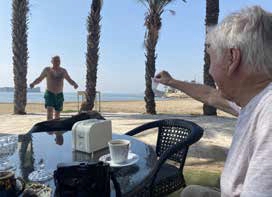
Sir Don offers Barnaby a towel. Photograph: Monica Fritz

Doyenne of curators, Nazan Ölçer, by Andrew Finkel
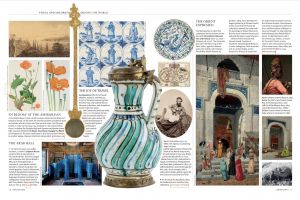
Around the World
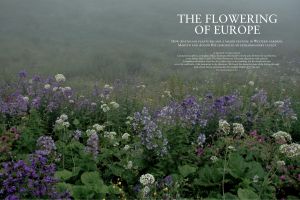
Martyn and Alison Rix chronicle Turkey’s extraordinary botanical legacy

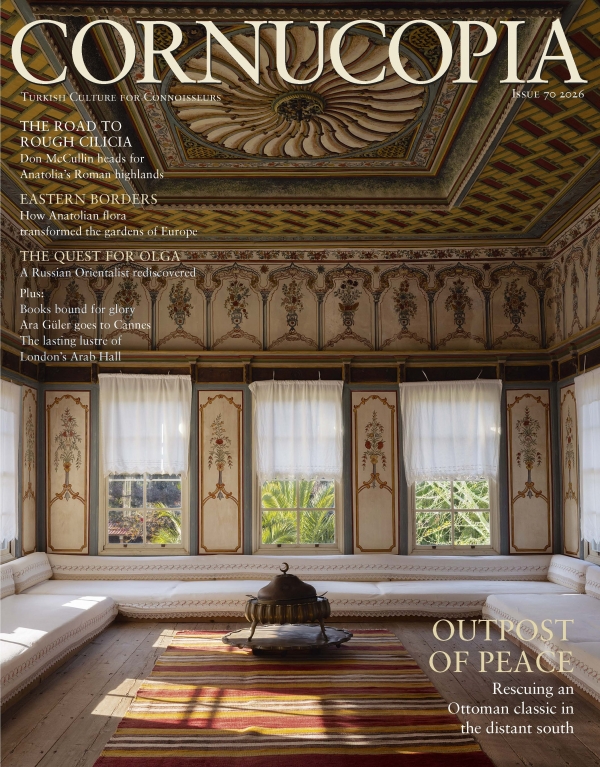
This grand mansion, an Ottoman outpost on the remote southern peninsula of Datça, was rotting away when it was rescued by an enterprising new owner. It has now regained every inch of its early-19th-century charm. By Rupert Scott. Photographs by Monica Fritz
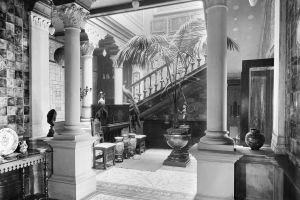
Frederick Leighton’s abiding love of the East permeates his entire mansion-cum-studio in Holland Park

A new exhibition turns the limelight on Halil Pasha, pioneer of Turkish impressionism. By Ayla Jean Yackley
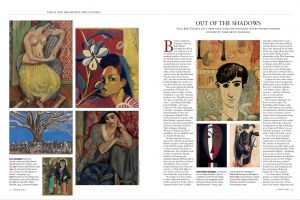
A show that turns the spotlight on two women painters eclipsed by their artist husbands
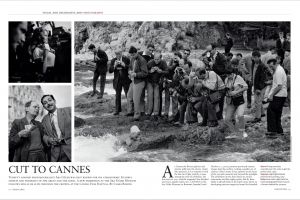
A new exhibition at the Ara Güler Museum follows Turkey’s adored photojournalist to the French Riviera

The beauty of bindings
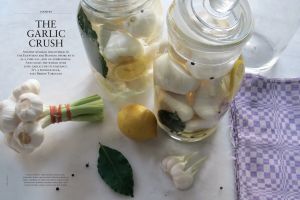
Berrin Torolsan on the wonder bulb
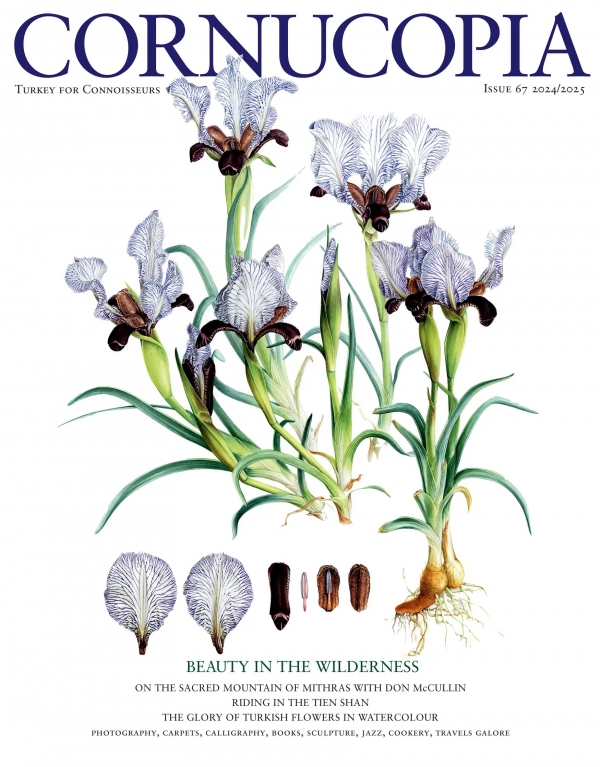


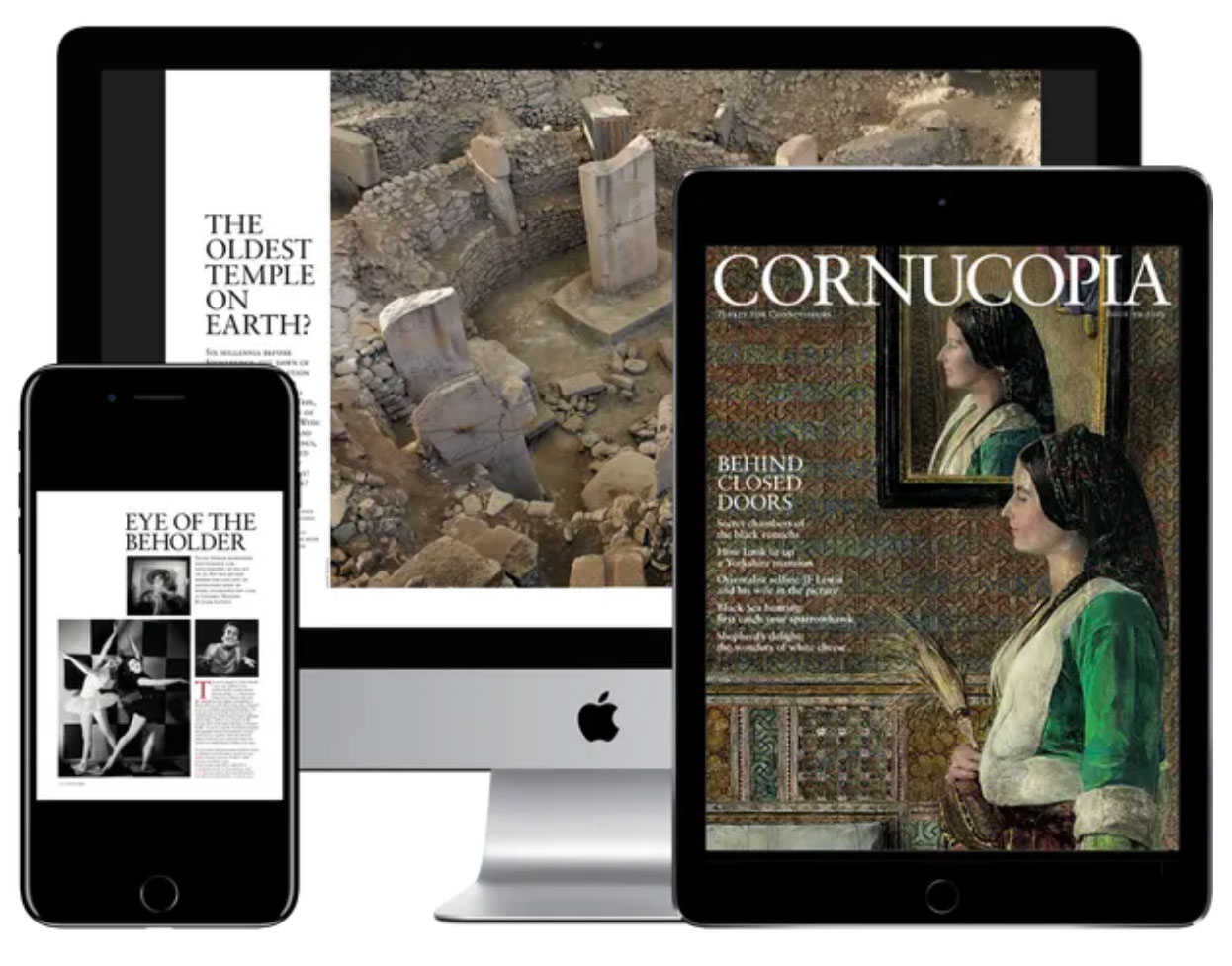
Cornucopia works in partnership with the digital publishing platform Exact Editions to offer individual and institutional subscribers unlimited access to a searchable archive of fascinating back issues and every newly published issue. The digital edition of Cornucopia is available cross-platform on web, iOS and Android and offers a comprehensive search function, allowing the title’s cultural content to be delved into at the touch of a button.
Digital Subscription: £18.99 / $23.99 (1 year)
Subscribe now