Since its establishment in 1895, the Venice Biennale has attracted art lovers from around the world. With the Venice Glass Week, and more recently Homo Faber, Venice has also found a way to reveal another essential aspect of its identity: its enduring heritage of craftsmanship. By bringing together artists, makers and audiences from across the world, these events place Venice firmly on the global art map. It allows visitors to look beyond the romantic city of canals and bridges and discover another Venice; one shaped by generations of artisans, craftsmanship and material culture.
This year, the collaborations with the Fortuny Museum, together with the exhibition at the Dries Van Noten Foundation, also offered a glimpse into the direction in which craft is evolving today. A great way to explore the fluid boundaries between art, craft and design.
Craft has shaped people’s lives and ways of living for centuries; it has been at the heart of countless stories and has given form to the cultures we inherit. To see these practices gradually pushed aside with the rise of industrialisation has always felt somewhat disheartening to me. Perhaps this is why witnessing their renewed vitality and being able to encounter them in a city as culturally significant as Venice, was particularly exciting. Venice, remaining at the background of these exhibitions, perhaps brings a different understanding to the audience. Without the city’s distinctive setting, the experience would be undoubtedly different.
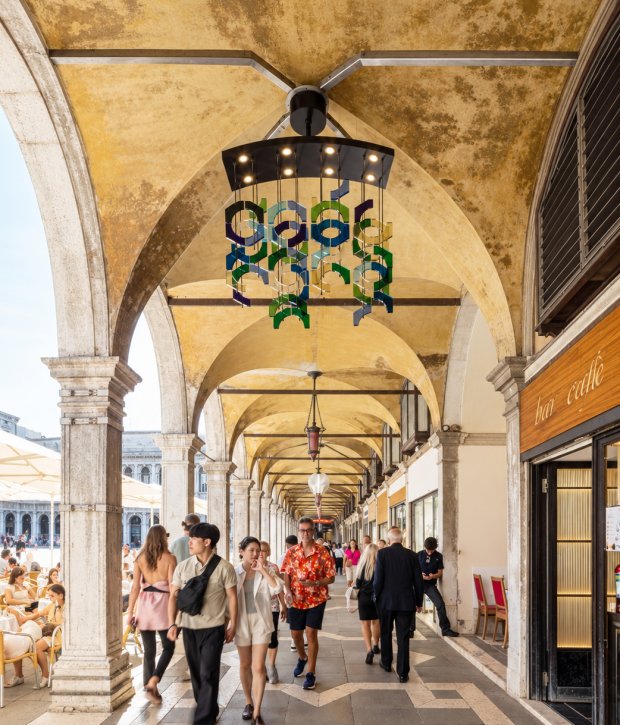
The birthplace of Murano glass, Venice continues to bring together glass enthusiasts from around the world through the annual Venice Glass Week, presenting a selection of works by international artists. This year, marking its tenth edition, the festival introduced a flagship event, Murano Illumina Il Mondo (Murano Lights Up the World). Twelve international artists were invited to work alongside Murano’s master artisans, creating new works that were exhibited at the arches of Piazza San Marco.
Taking one of Venice’s most iconic forms, the chandelier, as their point of departure, the artists offered innovative interpretations of this centuries-old object. By bringing together traditional craftsmanship and contemporary artistic visions, they created their own bridges between past and future, giving a new breath to the chandelier while remaining rooted in Murano’s long-standing glassmaking heritage.
Venice was also historically one of the westernmost destinations of the Silk Road’s vast network of trade. Caravans carrying some of the most precious goods from China through Central Asia, Middle East and eventually reached the Venetian ports, where their contents were eagerly received by European courts and aristocratic circles. Fabrics, carpets, precious stones, spices, fragrances and countless other artisanal objects travelled along these routes. This circulation of objects and knowledge contributed to Venice’s extraordinary accumulation of craft expertise and helped shape its distinctive culture.
This is particularly relevant to the longstanding relationship between Venice and the Ottoman world, shaped by centuries of commercial and cultural exchange. The exchange of objects,craftsmanship and aesthetics. While Venice received luxurious textiles and other goods travelling westward from the Ottoman world and beyond, Murano glass was exported to the Ottoman Empire. This reciprocal trade inevitably influenced the artistic and aesthetic sensibilities of both cultures.