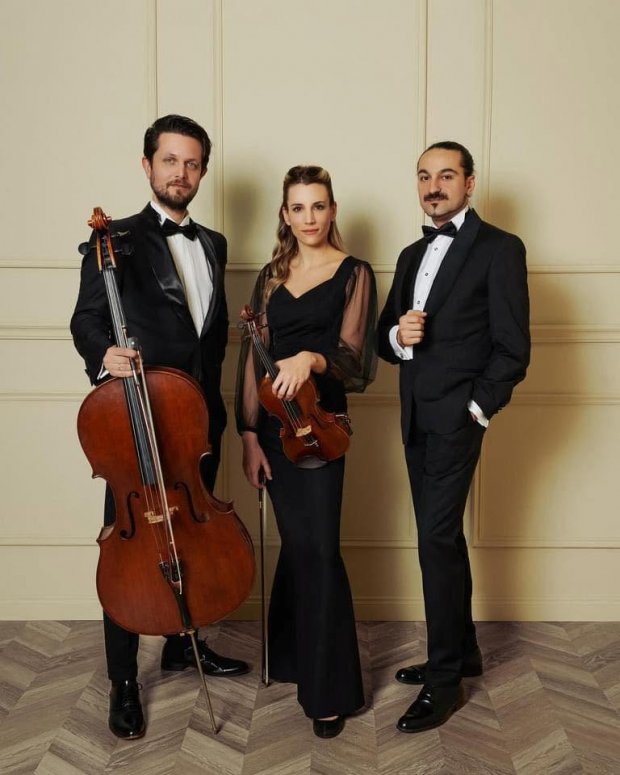
On Thursday, April 2 I attended a concert at the Notre Dame de Sion French Lycée in Harbiye, Istanbul that featured the ‘Bosphorus Trio’. Founded in 2016, this ensemble consists of violinist Özgecan Günöz, cellist Çağlayan Çetin and pianist Özgür Ünaldı. Özgecan Günöz is the Istanbul State Symphony Orchestra’s konzertmeister (i.e., first violin or ‘leader of the orchestra’). Cellist Çağlayan Çetin currently teaches his instrument at Maltepe University (Istanbul), and like Özgecan Günöz is a member of the Borusan Philharmonic Orchestra. Pianist Özgür Ünaldı, meanwhile, carried out doctoral studies at the Tchaikovsky Moscow State Conservatoire; currently based in Bursa, he is also a composer.
The first item on the Trio’s programme was Beethoven’s single-movement Allegretto for Piano Trio in B flat major, WoO 39, written in 1812. Their rendition of this piece began in a somewhat inauspicious manner with yells from a baby. However, her father soon took her out for a walk, and the musicians settled down; I noticed that the pianist was swaying in time with the music, obviously enjoying himself. Here is a performance of the work by Wilhelm Kempff (piano), Henryk Szeryng (violin) and Pierre Fournier (cello).
We then heard a piano trio by Professor Yalçın Tura (1934-), the distinguished nonagenarian founder of the Musicology Department at the Istanbul Technical University (İTÜ) Turkish Music State Conservatoire. Despite his advanced age, he continues to compose even today, being known chiefly for his music for films and the theatre. The thing I liked about his Piano Trio was its use of traditional Turkish aksak rhythms, which provide the music with an edgy bite. But the chief drawback to this work (in my opinion) was its harmonic style. The way of harmonising Turkish folk melodies that was adopted by Turkish composers of Western-style music of the 1920s and 1930s was not a particularly subtle one, but it is still, unfortunately, with us. Possibly as a result of the influence of Bartók, who used open fourths and fifths in his settings of Hungarian folk tunes, Turkish composers of the period relied too heavily on these intervals. Personally, I am looking forward to hearing something a little more original in the harmony department after all these years. But I have had my say – back to the concert.
The last piece on the programme was the Piano Trio in A minor by Maurice Ravel (1875-1937). During the summer of 1914, Ravel (whose mother was Basque) went to Saint-Jean-de-Luz, a seaside town in the French Basque country, to compose. At the same time as he was writing his Piano Trio, he was also working on a piano concerto entitled Zazpiak Bat – Basque for ‘The Seven Are One’. The concerto was eventually abandoned, but it left its mark on the Trio’s opening movement, which uses a Basque dance rhythm. The Piano Trio in A minor is a work of considerable difficulty, and I was delighted to see the members of the Bosphorus Trio rise to the occasion. The players’ technical excellence came across immediately in the first movement, which draws on the zortziko, a Basque dance form: the opening theme is in the same rhythm – a bar of eight beats divided 3+2+3 – as that of the Zazpiak Bat piano concerto that Ravel never completed.
This performance of his four-movement Piano Trio in A minor is by violinist Janine Jansen, cellist Torleif Thedéen and pianist Denis Kozhukhin. Ravel’s music has sometimes been criticised for being emotionally disengaged; however, his cold craftsmanship produced some cracking crescendos – just listen to the one that starts at 25:34.