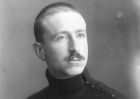
On November 28 I attended a concert at the Atatürk Cultural Centre in which the Istanbul State Symphony Orchestra was conducted by Sascha Goetzel (above, by Özge Balkan). This event, one of the DenizBank Concerts, started off with an announcement that the first item on the programme – Debussy’s Prélude à l’après-midi d’un faune (‘Prelude to the Afternoon of a Faun’) – had been cancelled. On hearing this, I gave a wry smile: knowing that in the second half the orchestra would be required to perform Richard Strauss’s long, difficult and extremely taxing Alpine Symphony, I conjectured that this work had taken the lion’s share of the rehearsal time, leaving none for the Debussy. I have to say, however, that in the event the orchestra’s superlative performance of the Strauss – a constantly-moving tapestry of rich and well-rehearsed sounds – fully justified the sacrifice that had been made to achieve it.
As a result of the programme change, the proceedings actually began with the second item – Nuits d’été (‘Summer Nights’), a song cycle completed in 1841 by the French composer Hector Berlioz (1803–69). This work consists of settings of six poems by the poet, novelist, journalist and literary critic Théophile Gautier (1811–72) in which the progress of love from youthful innocence to loss, and finally renewal, is described. Ballet fans will recognise Gautier, who was a devoted friend of the composer’s, as the author of the scenario for Giselle; art-lovers, meanwhile, will recall that as chairman (from 1862 onwards) of the Société nationale des beaux-arts, he rubbed shoulders with famous artists such as Delacroix, Manet and Gustave Doré. As if this were not enough, Gautier, whose physical strength was proverbial, was also an ace swimmer.
The reader may well wonder why I have devoted so much space to Gautier, and so little to Berlioz. The reason, I will freely confess, is that I am somewhat underwhelmed by Berlioz as a composer. It is true that the Symphonie fantastique, his most famous work, has its moments, especially in the witches’ knees-up at the end – a piece of Hollywood grotesquerie that must surely be the ultimate 19th-century Gothfest. Also, I have a soft spot for his Christmas song L’Adieu des bergers à la Sainte Famille, a piece whose title is usually anglicised as The Shepherds’ Farewell. But by and large, my less-than-generous estimation of his talents as a composer wins out over the natural sanguineness of my temperament. So it was with resignation, rather than anticipation, that I settled down to listen to Nuits d’été.
The soloist at the concert on November 28 was the Turkish mezzo-soprano Deniz Uzun. In the first of the six songs, there was a marked lack of coordination between the singer and the accompanying instruments (especially the woodwinds); this was a pity, as for my money this number is the most attractive of the six. In fact, it took until the third song for the soloist and the orchestra to gel into a harmonious ensemble. Here, things looked up: there was a palpable sense of drama, and the singer hit the high notes with tremendous force. Communication between singer and instrumentalists improved as time went on; in the last three songs their coordination was perfect, and I actually started to enjoy myself. In the finale the orchestra produced a nicely-rounded, fulsome sound. Meanwhile, the singer gave a committed performance, swinging her arms about (something she had not done previously) as she turned up the dial to the max. Here is a performance of *Nuits d’été* by the Orchestre de la Suisse Romande, conducted by Ernest Ansermet. The soloist is Régine Crespin (1927-2007), one of my favourite French singers.
Before leaving the subject of Berlioz, I would like – as an apology to the poor man for the dismissive things I have said about him – to list performances of what I see as his finest achievements: the fifth and final movement of his *Symphonie fantastique* (the witches’ sabbath) and the Christmas song for which I have such fondness. A description of the Symphonie fantastique] on the LA Phil website is by Herbert Glass describes the infatuation that led the composer to write the piece and takes you through each of its movements. Now, here is a performance of the finale, the Dream of a Witches’ Sabbath, by the Orchestre national de France, conducted by Leonard Bernstein. Note that while listening, wearing green makeup is compulsory; cackling is optional.
The Shepherds’ Farewell comes from Berlioz’s oratorio L’enfance du Christ. In the following recording, made at the Académie du Palais royal in Paris, the conductor is Jean-Philippe Sarcos, the founder and artistic director of the Orchestra of the Palais Royal.
As an encore, mezzo-soprano Deniz Uzun gave us a setting of *Haydar haydar*, a poem by the 17th-century folk poet Kul Nesîmî, who wrote in the tradition of Alawite-Bektashi metaphysical heterodoxy. This rousing number drew much more enthusiastic applause from the audience than Nuits d’été*had done, and it gave the singer a send-off that reflected well-deserved appreciation for her talents – and, of course, her powerful voice. In the second half, the orchestra played An Alpine Symphony, a tone poem by Richard Strauss (1864–1949). Written between 1911 and 1915 and one of Strauss’s largest non-operatic works, it depicts the experiences gone through between dawn and nightfall by a group of climbers who are ascending a mountain in the Alps. The story moves through the climbers’ day as they pass through idyllic scenery on their way up, then take a wrong path and have some dangerous moments. Finally, they arrive at the summit, but are caught in a violent thunderstorm on their way down.
The Wikipedia entry tells you what part of the journey each of the piece’s 22 sections is intended to represent. An Alpine Symphony calls for a huge orchestra including an organ – or, in the case of the performance on November 28, a rather more modest electronic keyboard – and some some unusual percussion instruments: a wind machine (a large cylinder rotated by means of a handle) and a long strip of metal which when waved about produces a noise that is supposed to resemble thunder.
My choice of the following recording was influenced by the preferences of Dave Hurwitz on the ‘Classics Today’ website. He is quite rude about the piece, describing it as ‘glitzy’ and ‘vulgar and bombastic’, but some of his comments are insightful and pertinent. Here is a link to his pronouncements. This performance of An Alpine Symphony is by the Warsaw Philharmonic Orchestra, conducted by Kazimierz Kord. The YouTube version gives you the score and a time stamp for each section.
I was most impressed by the Istanbul State Symphony Orchestra’s performance of this work. The woodwind section was perfectly in tune from the word go, the fanfares from the trumpets, horns, trombones and tubas were beautifully played, and each member of the expanded percussion department – including the lady playing the big bass drum – had their timing down to a ‘T’. At each crashing chord from the full orchestra the conductor leaped around on the podium; he must have trained the players well, as their many difficult entries were invariably well coordinated. Perhaps the violins’ intonation was a trifle suspect in the high register on occasions, but we will allow the bashing of drums, blarting of trombones and screaming of clarinets to drown out all criticism: it was a highly enjoyable performance.
The orchestra as a whole stayed perfectly in tune right to the end, where the organ comes in to add its stentorious voice to the musical mayhem. Considering the fact that at one time the Istanbul State Symphony Orchestra had me writhing in my seat as I grimaced over its ragged entries and winced at its hideous intonation, things have certainly come a long way. A great deal of hard work must have been carried out to bring the orchestra to this point, and though I do not know the names of the people responsible, I congratulate them. Unlike Debussy’s faun, idling on mossy banks in the heat of a summer afternoon, those conductors must have spent many hours coughing and shivering in unheated concert halls as they worked their players to exhaustion, and the players themselves must have practised until their fingers bled or their lips ached and went numb. We may admire the resulting tapestry for the work of art that it is, but the fingers that tied each individual knot equally deserve our appreciation.