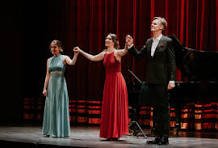
The second concert of the 2026 İKSV Istanbul Music Festival that I attended took place at the Süreyya Opera House in Kadıköy on June 22. It featured the British tenor Ian Bostridge, the Turkish mezzo-soprano Feride Büyükdenktaş and the Georgian pianist Saskia Giorgini. The concert hall was half-empty, which I thought very strange: it seemed that my own enthusiasm for chansons and lieder (French and German art songs), which dates back to the years when I regularly accompanied my bass-baritone father on the piano, is not shared by everyone. They missed a treat.
The first item on the programme was Debussy’s Chansons de Bilitis (1897), a set of three songs for mezzo-soprano and piano. These are settings of prose poems, written in the manner of Sappho, from a collection published by Pierre Louÿs (1870-1925). The author claimed they had been discovered on the walls of a tomb in Cyprus, having been penned by Bilitis, a courtesan who was a contemporary of Sappho, and the forgery was so successful that even some experts were taken in.
Feride Büyükdenktaş proved to have a fine, powerful voice; however, it was only in ‘La chevelure’ (‘The Mass of Hair’), the second item in the set, that she truly came into her own. This song is actually about an orgasm (no surprise there – Louÿs was writing erotic poetry even on his deathbed), but although I acknowledge the fact that this was the first item on the programme and the singer had yet to warm up, I thought the process of building up to the climax could have been a tad more unbuttoned. ‘Le tombeau des Naïades’ (‘The Tomb of the Naiads’), the last of the three songs, has some exquisitely lush piano chords, especially in the bars following 1:29 in the recording below. Here, I greatly enjoyed the atmosphere the performers created, and of course the ending – one of my all-time favourites. The following rendition of the Chansons de Bilitis is by the celebrated French soprano Régine Crespin (1927-2007) and the distinguished American accompanist John Wustman, who died in April this year. For some reason they perform the last song first, but I am so entranced by this singer’s voice that I don’t mind.
Saskia Giorgini then played three pieces by the highly prolific French lady composer Mélanie (‘Mel’) Bonis (1858-1938). The three we heard were ‘Desdémona’, ‘Mélisande’ and ‘Ophélie’, from her cycle Femmes de légende (‘Women of Legend’). The pianist’s arpeggios were even and well-controlled, and ‘Mélisande’ – the most harmonically interesting of the three – was played with all the fragile sensitivity the piece demands. In this recording, we hear the whole cycle played by Anna Shelest.
Next, Feride Büyükdenktaş and Saskia Giorgini gave us three songs by Robert Schumann’s better half Clara – ‘Liebst du um Schönheit’, ‘Die Lorelei’ and ‘Sie liebten sich beide’. Their excellent rendition brought out all the emotional honesty of these well-crafted pieces. Here is Anne Sofie von Otter, accompanied by Hélène Grimaud, in ‘Liebst du um Schönheit’ (‘If Your Love Is For Beauty’).
Following this, tenor Ian Bostridge made his appearance. What an amazing career this man has had! Having first taught political theory and 18th-century British history at Oxford, at the age of 27 he took up professional singing, soon establishing himself not just as a leading interpreter of Schubert, Schumann and Britten but also as a presenter and writer on music. This being said, the first thing I noticed about his performing style was the somewhat eccentric gestures: he frequently leaned on the piano, sometimes pressing down on it quite hard. In no way, however, did this detract from my appreciation of the power and directness of his singing. Before the interval we heard Robert Schumann’s Fünf Lieder, Opus 40, and after it his song cycle Liederkreis, Opus 24. In the first group, ‘Der Soldat’ – the third item in the set – was sung with admirable drama and commitment, and in the second, ‘Ich wandelte unter den Bäumen’ (‘I Wandered Among the Trees’ – again the third item) was a masterly display of suppressed emotion. In this recording, Ian Bostridge is singing Liederkreis with pianist Julius Drake.
The final item on the programme – Schumann’s Vier Duette, Opus 78 – was a series of vocal duets that involved all three performers. These lieder have oodles of warmth and lyricism, and in my opinion embody Romanticism at its finest. The YouTube recording of Ian Bostridge singing them – together with soprano Dorothea Röschmann and pianist Graham Johnson – consists of four individual items. Firstly, here is ‘Tanzlied’.
Secondly, ‘Er und Sie’.
Thirdly, ‘Ich denke dein’.
Fourthly and lastly, ‘Familien-Gemälde’.
This set of songs made a great ending to the recital. The two voices were perfectly matched; meanwhile, Giorgini’s accompanying skills were most impressive, as indeed they had been throughout the concert. Especially in No. 3 (‘Ich denke dein’ – ‘I Think of You’), I was so thrilled by the performance, which featured exemplary coordination between the three musicians, that I felt a tingle along my spine. Did I feel regret, at that moment, for the fact that the audience for this concert was so sparse? Not at all – I was too carried away by the sweep and surge of the music.

_140_88_80.jpg)