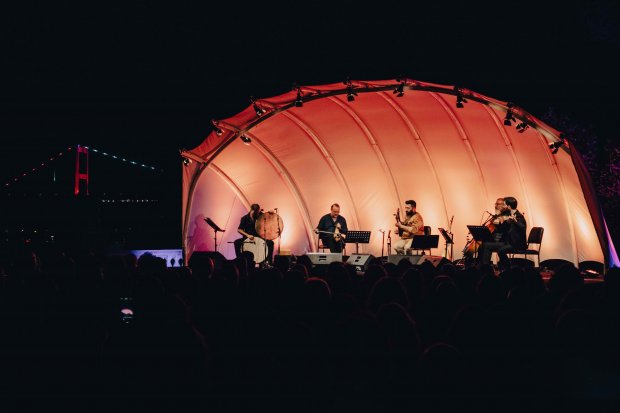
It was a great privilege to be on the Fıstıklı Terrace of the Sakıp Sabancı Museum in Emirgan once again, this time to listen to a concert of pieces performed on traditional Turkish and Azeri instruments. Tellerin Aşkı (‘Strings in Love’), an event that took place on June 23, was part of the İKSV Istanbul Music Festival, and the ‘love’ in question was, of course, of the spiritual variety.
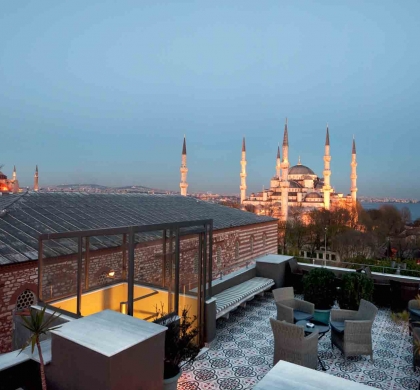
The Fıstıklı Terrace commands an extensive view over the Bosphorus from what appears to me to be the roof of ‘The Seed’ – the concert hall where the now-discontinued ‘Istanbul Recitals’ took place. The museum building, the so-called Atlı Köşk (literally, ‘Villa with Horse’), was built between 1925 and 1927 for Prince Mehmed Ali Hasan, a member of the Egyptian Royal family. Designed by the Italian architect Edoardo Denari (1874-1954), it was used as a summer residence by members of the Prince's family until 1951, when it was bought by the businessman Hacı Ömer Sabancı. The following year, a bronze statue of a horse cast in Paris in 1864 by the sculptor Louis-Joseph Daumas (1801-87) was purchased at an auction at the home of Mahmut Muhtar Pasha in Moda and transported to the front garden of the villa in Emirgan, which thus acquired its current name. In fact, this garden is also home to another statue of a horse – a copy of one of the four that once graced Constantinople’s Hippodrome and were half-inched (Cockney rhyming slang for ‘pinched’) by the Latins during their occupation of the city (1204-61) and taken off to sit on the façade of St Mark’s Basilica in Venice.
But enough of horses and horse thieves. What of the musicians? Coşkun Karademir, leader of the ensemble, is an expert performer on the kopuz and the bağlama – stringed instruments that resemble the lute and are plucked rather than bowed. The kopuz, traditionally played by folk bards, is said to be the ancestor of the bağlama. A special feature of both is that they are tuned to play the (almost, but not quite) quarter-tones that occur in the makam – let us call them ‘scales’ – of traditional Turkish music. The instrument Karademir was playing looked like a twin version of the bağlama, with two fretboards attached to one body.
Karademir began playing the bağlama as a child, learning his art from a succession of Anatolian masters. Specialising in folk music and the music of Sufi mysticism, he has released albums in both genres. He has also taken on an academic role as a university lecturer and performed Turkish music to audiences at home and abroad. In addition, he has written and performed the music for several films, as well as for a number of the television series that have gained popularity in Turkey. Call of the Birds (2016), his first album, recorded with The Secret Ensemble and featuring the Iranian singer Mahsa Vahdat, attracted a good deal of interest worldwide, sparking enthusiasm for the mystical music of Turkey and Iran. This was followed by Endless Path (2018), an album that once again juxtaposes the traditions of both countries and has been acknowledged to be ‘a masterpiece of mystical music’.
As an introduction to his style, here are two recordings. In the first, he is playing and singing a Turkish folk song from the Malatya region. Entitled Kara Tren Gelmez M’Ola (‘The Black Train Won’t Come’), it has been described as ‘a poignant reflection on unrequited love and the pain of separation, using the metaphor of a train that never arrives’. In my opinion, if you wish to get the feel of Turkish folk music, you need to listen to it on a sleepless 20-hour bus journey through Anatolia. I subjected myself to many overnight marathons of this kind during the 1970s and 80s. However, if circumstances do not permit this luxury, wait until you wake up in the middle of the night one day and listen to this recording imagining yourself on such a bus, intermittently dozing and being jolted awake, and douse yourself with eau-de-cologne for complete authenticity.
Secondly, here is an example of his mystical music in which the Coşkun Karademir Quartet is joined by Levent Güneş in a song entitled Be Hey Derviş. The words are by Shah Ismail (1487–1524), who wrote in Azeri Turkish under the nom-de-plume ‘Khatayi’. In addition to being one of the most important poets of the 16th century in this region, he also had a sideline – that of founding the Safavid Empire. One of the most powerful states in its time, his empire eventually encompassed not just Iran and much of the Caucasus but also Iraq and parts of modern-day Turkey, Syria, Pakistan, Afghanistan, Uzbekistan and Turkmenistan.
Performing alongside Karademir on the Fıstıklı Terrace were players of the kemençe (a three-stringed folk instrument similar to a violin), the higher-pitched İstanbul kemençesi, the Western-style cello and the tar – the traditional instrument of Azerbaijan. The tar that was used at this concert had two small, round bodies attached to one another, forming a figure of eight. After the first two or three numbers, a player of the bendir drum joined in. The programme suggested that one of the members of the ensemble would be Saman Samimi, a kamancheh-player from Iran; however, in view of the fraught political situation at the time, it was no surprise that he was unable to make the journey to Istanbul.
I wish I could say that I thoroughly enjoyed ‘Strings in Love’. But the fact is, although I appreciated the skill shown by the musicians – especially Ibrahim Babayev, the Azeri tar-player – for the most part I didn’t. The reasons why I had chosen to go to this particular concert were twofold: firstly, I wanted to enjoy some musical entertainment in a congenial environment with a spectacular view of the Bosphorus as day turned to night and the stars came out one by one, and secondly, I wished – foolishly, perhaps – to demonstrate my lack of prejudice of any kind with regard to traditional Turkish music. The problem was, I found what was on offer unrelievedly solemn and – dare I say it? – monotonous. The fault lay, of course, not with the music itself but with my expectations (I thought it would be more like folk music than it actually was), and with my inability to insert myself into the cultural groove one needs to enter in order to appreciate it. I am not, I must confess, into Islamic mysticism, and so am out of sync both with the Sufi mindset and with the music that accompanies and – who knows? – fosters and intensifies it.
Nevertheless, I respect the intentions behind music of this kind, and there are indeed times when its tranquillity can be just what the doctor ordered. So here is a recording of the Coşkun Karademir Quartet playing in the grounds of the Tekfur Palace, located on Istanbul’s City Walls between Ayvansaray and Edirnekapı. The Palace has now been renovated, and is open to the public. For those who haven’t stood on the observation terrace at the top of the building, I highly recommend that you do so. The view is breathtaking – not quite so romantic as the one from the Fıstıklı Terrace, perhaps, but certainly much more wide-ranging. May the view – and this music – transport you to a realm of expansiveness and contentment!