Where are the songs of summer? Aye, where are they now? Well, they are stored in our memories, where they will hopefully allow us to fondly replay them in our minds as a respite from winter gloom. For me, one of the most memorable of this summer’s musical experiences was the opening concert of the 32nd İKSV Istanbul Jazz Festival, at which the 83-year-old Cuban jazz pianist, composer and arranger Chucho Valdés performed with his group, the Chucho Valdés Royal Quartet.
I had assumed that like the previous concerts of the İKSV Music Festival, this one, too, would begin at 20:00 hours; indeed, it said so on my ticket. Accordingly, on July 1 I turned up with my trusty notebook, pencil, monocle and ear trumpet at the Harbiye Cemil Topuzlu Open-Air Theatre, located directly below the Lütfi Kırdar International Congress and Exhibition Center, in good time – only to find that the concert was actually to begin at 21:30.
Things, I reflected while sipping my coffee during the intervening hour and a half, had come a long way since I attended a concert of Hungarian music at this venue during the long, hot summer of 1980. For one thing, the stage, which at that time had been open to the skies, now occupied a much larger, and moreover enclosed, space – no doubt because of the necessity of housing equipment for the provision of visual as well as aural entertainment. For another, several new buildings had sprung up around and above the open-air theatre since that time: the area was now dubbed ‘Congress Valley’ as in 1996 its various facilities had hosted ‘Habitat II’, the second United Nations Conference on Human Settlements. It was difficult to imagine, therefore, that until the end of the First World War this pleasant, sparsely wooded valley that sloped gently down towards the Bosphorus had been the space in which the sons of Ottoman Imperial princes who were attending the Harbiye Military School, an institution that was then devoted to their education in the military arts, practised their horse-riding skills.
In his memoirs, Ali Vâsıb Efendi, the great-grandson of Sultan Murad V, describes how one day his fellow-pupil Mehmed Abdülkerim Efendi (the son of Mehmed Selim Efendi, Sultan Abdülhamid II’s eldest son) had a fall during riding practice, and was dragged along the ground for quite a way by the animal as his feet had become trapped in the stirrups. It seems the lad was in any case nervous about getting on horses; luckily, however, he was none the worse for wear for this unfortunate experience.
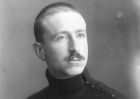
Indeed, poor Mehmed Abdülkerim Efendi was accident-prone throughout his life. In 1933, he was invited to Tokyo by some Japanese generals with the idea of having him become Head of State in ‘Manchukuo’ (the name given by the Japanese to Manchuria, which they had invaded in 1931). They thought that the appointment of a Muslim head of state – one who had, moreover, an unusually Oriental facial appearance for a Turk – would strengthen their influence in the region, especially among the Muslim Uyghurs to the west. Accordingly, Mehmed Abdülkerim Efendi arrived in Tokyo in May 1934; by that time, however, the Japanese had abandoned their plan. In September of that year, therefore, he left for New York – where nearly a year later, on August 4, 1935, he was found dead in his hotel room. Rumour has it that he was murdered by Soviet agents, purportedly because Stalin did not wish to see Russian influence in ‘Eastern Turkestan’, which in 1934 had come under the control of a pro-Russian Chinese warlord, threatened by the appearance of a Muslim ‘emperor’ in neighbouring Manchuria.
Back to the present. After what seemed an interminable wait, we were finally allowed into the steeply-descending arena that is the Harbiye Open-Air Theatre shortly before half past nine. The İKSV’s preview of the concert had provided the following information:
'Cuban pianist, composer and arranger Chucho Valdés is a towering figure in Afro-Cuban jazz. He revolutionised Cuban music by founding ‘Irakere’ in 1973, blending African rhythms with jazz and introducing Cuban dance music to percussion instruments like the batá. ... With a career spanning decades, Valdés has won 6 Grammy Awards and 3 Latin Grammy Awards. For the Festival’s opening night, he will perform alongside Horacio ‘El Negro’ Hernández (drums), José A. Gola (bass), and Roberto Jr. Vizcaíno (percussion).'
The batá, by the way, is an elongated drum that has one end larger than the other; it is used among the Yoruba people of western Nigeria in traditional and religious activities, and no doubt followed them to the Americas when some of them were enslaved. These drums have been used in Cuba since the 19th century, and in Puerto Rico and the USA since the 1950s.
When the 83-year-old maestro, who unfortunately did not seem to be completely mobile, had hobbled onto the stage and sat down at the piano, he and his group launched into a number that was marked by complex rhythms and passages of atonal improvisation in which Mr. Valdés’s hands flapped wildly – but certainly effectively – up and down the keyboard. There were two percussionists on stage, and at one point they had a most amusing mock fight with drumsticks. Afterwards, Mr. Valdés addressed the audience in Spanish. I, of course, understood nothing of what he was saying, but I admired him for not making concessions to the belief that all musicians ought to speak English to their international audiences. (As a former teacher of English as a Foreign Language who has also been a salesman, editor and publisher of English-teaching materials, I naturally applaud all attempts to stem the tide of Anglophony: in my opinion, the use of the English language – one that has an inbuilt tendency towards negativity – brings with it certain cultural and sociological assumptions that I do not necessarily share, and that I have no desire to see others adopt.)
In the next three numbers we heard a plethora of delicious Latin cross-rhythms, the first bass solo of the concert, and some bars of a Mozart piano sonata from Mr. Valdés, who in his preliminary remarks before the piece had told us (I think) that he had performed this sonata in public at the age of 8. This was followed by a medley of jazzed-up themes from Mozart’s Eine kleine Nachtmusik, his 40th Symphony and other works. The Steinway took quite a hammering at this point, and I wondered whether Cuban pianos are equipped with body armour.
Despite his advanced age, Chucho Valdés did not seem to experience any fatigue whatsoever as the concert progressed: his solos became more and more energetic, and his pyrotechnics increasingly frenetic. One could not help but admire both this octogenarian musician’s stamina and his commitment to the music that has obviously been his lifelong passion. I especially appreciated a tango that metamorphosed into swing, ultimately reverting to its original rhythm; here, the pianist’s gnarled hands were lizard-like in their elegant elasticity. In a slower number, there was a thoughtful solo from him that revealed great sensitivity, and at the end a fantasy treatment of the song ‘Bésame Mucho’ that picked up speed as the audience were strobed with fast-moving coloured lights. (Here, I hoped there were no epilepsy-sufferers among the audience. I noticed that the cats, of which there were a great number in and around the auditorium, went on washing themselves, completely unaffected by all the excitement. But then, one does not know how felines perceive the frequencies of salsa and cha-cha-cha. Does this last one come over to them as ‘chat-chat-chat’, one wonders?)
Horrible jokes aside, I must record that this concert left me with a feeling of euphoria that carried me into the next day still feeling relaxed and sanguine in mood. Oodles of respect, of course, for Mr. Valdés, who will be celebrating his 84th birthday in October. Here are three recordings of him in action. Firstly, a performance with his group ‘Irakere’ at Estival Jazz Lugano in 2015.
Secondly, a concert by the ‘Chucho Valdés Trio’ in New York.
Thirdly and lastly, a number by the Chucho Valdés Royal Quartet that features some pretty amazing drumming.