Kınalıada, the smallest of the four main Princes’ Islands in the Sea of Marmara, is a place that until this summer, despite my 48-year residence in the city, I had never visited. Accordingly, when I saw in the programme for this year’s İKSV Istanbul Music Festival that a concert was to be organised there on June 25, I betook myself to the Kabataş ferry terminal and boarded a half-empty boat, lured by the twin prospects of attending a concert in the Greek Orthodox Monastery atop Kınalı’s only hill and setting foot on the island for the first time.
The concert, entitled (appropriately enough) ‘The Island’ and one of the last in the 2025 İKSV Festival, promised to be an interesting one. The preview described it as follows:
The ‘Island’ project celebrates the shared cultural heritage of the Turkish and Greek people with the most beautiful songs from Crete, Megisti, Lesbos, Imbros and the Princes’ Islands. ... The concert will take place on 25 June at Kınalıada Christos Greek Orthodox Monastery, a millennium-old historical site, in collaboration with the Greek Orthodox Patriarchate and the Adalar Municipality.
As the boat cut its way through the Bosphorus, making for the entrance to the Sea of Marmara, I contemplated the gradually receding cityscape. Looking back over the churning spray thrown up by the boat, I gazed upon the skyscrapers of Istanbul’s financial district, with their featureless sheets of hardened glass, and asked myself the question: What is it that moves people to out-tower us groundlings, and look down on us from supercilious heights? The answer: overweening hubris, of course, perhaps compounded by the heady effects of too much caffeine. ‘Heady’ is exactly the right word here: let’s leave the heart out of this, shall we?
Kınalıada is the nearest of the Princes’ Islands to central Istanbul (*Proti*, its Greek name, means ‘first’). Having studied a map, I knew how far I needed to walk along the shore before ascending the hill. Passing gaggles of sunburnt mothers and children queueing for ice creams, I paused to admire the Kınalıada Mosque right by the water’s edge. This pleasing modernist structure, completed in 1964, is by the architects Başar Acarlı and Turhan Uyaroğlu.
Thereby hangs a tale: in 1957, Prime Minister Adnan Menderes conceived the idea of uprooting the Karaköy Mosque, which was due to fall victim to one of his many road-widening schemes, and transporting it to Kınalı. Many a slip ... The mosque, an intriguingly elegant Art Nouveau affair designed by the Italian architect Raimondo D’Aronco (who, incidentally, was also responsible for Botter Han, the building at the Tünel end of İstiklal Caddesi behind which I lived for 33 years), was indeed dismantled; each of its component pieces was dutifully numbered, and most of them – but not all – were loaded onto a ship. (Rumour has it that the mihrab, the minbar, the carpet and the chandelier were taken to the *Teberrükat Memurluğu* – the Office of Relics and Sacred Objects.) Alas! Whether or not the load was properly distributed I do not know, but the ship keeled over, dislodging its cargo of sacred objects and sending them down towards their tryst with Davy Jones.
Passing the mosque, I turned right up the hill – which was, I have to say, extremely steep. On either side, scented flowers and creepers wafted messages of laid-back opulence from palm-treed gardens, while mangy cats nosed their way into wayside dustbins in the hope of finding fish-heads left over from rakı-enhanced revelries. Coming to the end of the houses and reaching the top of the incline, I found the monastery on a flat piece of ground from which there was a spectacular view over the southern portion of the Sea of Marmara. At the entrance to the monastery compound I was courteously greeted by some ladies from the Musiki Eğitim Vakfı (the ‘Foundation for Education in Turkish Music’), whose guest I was. I then entered a most attractive courtyard with low buildings all around it, and a few trees. Facing the audience, meanwhile, was a small building whose generously-proportioned verandah did duty, on this occasion, as a stage. It was, of course, midsummer, and as the intense cerulean of the skies gradually dimmed, birds swooped and chirped back and forth above us. I was put in mind of the French composer Olivier Messiaen (1908–92), creator of Le réveil des oiseaux (‘The Awakening of the Birds’, 1953), who said that birds are ‘the greatest musicians inhabiting our planet’.
The concert was due to start at 8:30. To while away the time, I browsed through the leaflet that had been handed to me as I entered the compound. Written in both Greek and Turkish, it informed the reader that the monastery had been founded by the Byzantine Emperor Romanos IV Diogenes (c.1030–1072) on a site that contained the grave of the Emperor Leo V (known as ‘Leo the Armenian’, c.775-820).
The Romanos connection, it seemed, was far from being a happy one. Three years after he came to the throne in 1068, the Emperor had led the Byzantine army eastwards, determined to put a stop to the incursions of the Seljuk Turks, who had entered Anatolia from Iran and had recently penetrated as far as Caesarea (modern-day Kayseri). Romanos, a man whose bravery in battle was not accompanied by practicality or circumspection, had done nothing to halt the decline of the Byzantine army, and moreover did not take his Turkish adversaries at all seriously. Furthermore, by the time he arrived at Manzikert, north of Lake Van, his German mercenaries had already mutinied, and (at least according to some accounts) his ‘Uzes’ mercenaries – Oghuz Turks from the northern shores of the Black Sea and the area around the Danube – had gone over to the Turkish side.
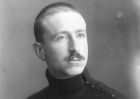
Furthermore, his reign had been marked by unpopular measures, some of which had antagonised the Doukas family, his rivals in the power stakes. So it should really have been no surprise to him that when the two armies met on August 26, 1071, Andronikos Doukas (the son of John Doukas, Romanos’s main political enemy) betrayed him, leading 30,000 men away from the battle. The Byzantines were roundly defeated, and Romanos was taken prisoner by the Seljuk Sultan Alp Arslan. Before long, however, he was ransomed and allowed to go back home accompanied by a Turkish escort bearing a banner that read: ‘There is no god but Allah and Muhammed is His Messenger’. Romanos and the Doukas family, who had declared him deposed, then gathered their forces and engaged in a battle near Konya which – once again – Romanos lost. While he was returning to Constantinople, John Doukas had him ambushed; poor Romanos was blinded, and banished to the monastery on Kınalıada that he himself had founded. There, his wounds became infected, and he died a few days after receiving a letter from the philosopher and historian Michael Psellos (who happened to be one of Doukas’s buddies) ‘congratulating’ him on the loss of his eyes.
It is definitely time to change the subject. The leaflet informed us that the monastery had served as an orphanage during the years from 1906 to the end of the First World War; from that time until 1924, it had housed refugees from the Russian Revolution. A whole page of the text was devoted to Simeon Siniosoglu (1850-1906), a Greek banker and shipping magnate well known for his good works who had left a large sum of money to the Kınalıada Monastery in his will, thus enabling the construction of an orphanage for girls. Finally, I learned that since 1952, the Christos Monastery has been the venue for a summer camp for Greek children.
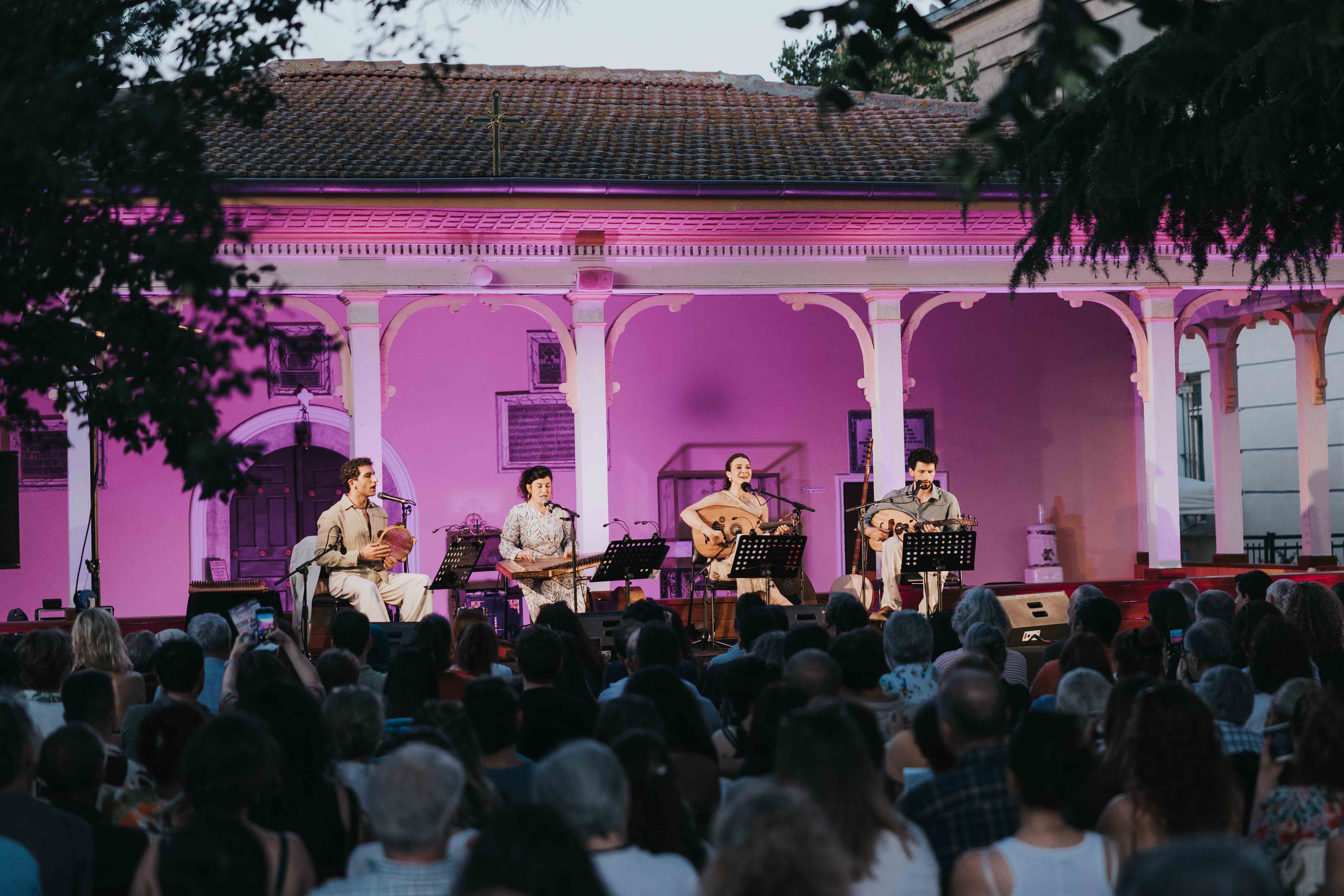
Photographs by Salih Üstundağ / IKSV
And so to the music. Taking the stage were Çağlar Fidan, a player of the tambourine and the kanun (a zither with a trapezoidal soundboard that is used in Turkish and Middle Eastern music); Ezgi Köker, an oud-player; and ‘NikoTeini’, a duo consisting of Nikos Papageorgiou, a player of the lute and the tambur (a stringed instrument with frets, a round body and a long neck that is played with a bow), and Asineth Fotini Kokkala, a player of the kanun and the cello. All four were, in addition, fine vocalists. The first number, which relaxed the audience with its cheerful mood, involved some unison singing to the accompaniment of a lute, an oud, a kanun and a tambourine. Despite the fact that they were playing and singing from cold, the performers coordinated perfectly, and I inwardly congratulated them on their professionalism.
What followed was a sequence of pieces by Turkish, Greek, Jewish and Armenian composers who were either from Istanbul or had spent time there and absorbed its musical culture. Mixed in with these, meanwhile, were songs from islands such as Kastellorizo (Megisti or Meis), Imroz (Gökçeada), Lesbos (Midilli), Santorini, Crete – and, of course, the Princes’ Islands themselves. The atmosphere thus created was one in which the listener, having been given a temporary reprieve from the metropolis, was reminded of the fact that life can be made easy and pleasant if one puts one’s mind to it; it celebrated the simple pleasure in being alive that is facilitated by a warm climate, an abundance of fish in the sea and absolute freedom from the humdrum activity that we all take for granted, and that Mr. Zimmerman so aptly describes as ‘gargling in the rat-race choir’.
The last piece I heard before last-boat anxieties prompted me to make an untimely departure was a Greek folk song in 7/8 time that transported me in my mind to Imroz, its place of origin. As I descended the darkened hill, accompanied by the susurrations of crickets and feeling at peace with the world, I hummed it to myself, even notating it in the little book that I keep for taking notes during concerts. All too soon, however, I found myself (after a short sea journey) attempting to negotiate my way across an unending stream of traffic in what was for me a garbled and unfamiliar version of Bostancı, one of the places in which I used to arrive after trips to the Princes’ Islands in the 1970s and 80s.
'It is what it is,' people say, in an attempt to reconcile themselves to things that are fundamentally unacceptable. But I am an unrepentant recidivist and enemy of progress. The ideal world, says the Dao De Jing, is one in which in the evenings, people can hear the dogs barking in the village on the other side of the hill, but none of them feels the slightest desire to go there as they are perfectly content where they are. I look forward to the day when a skyscraper-collapsing chemical is found in onion skins, or potato peelings, and – after a spate of mass demolitions – sheep nonchalantly nibble the grass among the (now barely discernible) outlines of the 40-storey fortresses of purveyors of cutting-edge financial services, pausing only to give themselves ease on the broken glass of framed Mission Statements.
But then, I am a fuddy-duddy who remembers a time when there were still gaps between the various settlements strung out along the northern shore of the Sea of Marmara from Maltepe onwards, when wood-built villas in gardens still held out against the developers’ avarice, and when the adrenaline-surge of vibrant city life mercifully subsided as soon as the train from Haydarpaşa had pulled out of Bostancı and begun making its way through a string of slumberous outer suburbs. Küçükyalı, the first of these, prided itself on being one of the few places in Istanbul that remained free of politically-motivated murders during the period preceding the military coup of 1980. Maltepe – one of the two places in which the Musiki Eğitim Vakfı operates, the other being Kadıköy – was a place of houses in gardens and muddy, unmetalled roads; between it and Cevizli, the next stop, there were fields.
For all that, I was grateful for the Marmaray and metro trains that took me home. And I am grateful to all those who had the idea of organising a concert in such an other-worldly location; all those who generously gave permission for it to take place there, and/or sponsored it; the Istanbul Foundation for Culture and Arts (İKSV), who had organised the Festival; all those at the Foundation for Education in Turkish Music, who are obviously doing a good job of teaching people to play Turkish instruments, or sing, in a variety of makam (scales), many of which feature quarter-tones; all those who stood outside the venue, answered people’s endlessly repetitive questions and gave them directions; the kind young lady whom I saw help an elderly gentleman regain his balance after he had stumbled between rows of chairs while in search of an elusive seat-number; and all those who wrote messages, ran errands and carried things. The event remains in my mind as one of the high points of the summer.
Here are the NikoTeini duo in three pieces from their extensive repertoire. First, ‘Monahos mes ti monaksia’ (please don’t ask me to translate).
Secondly, ‘Opu dis dio kiparisia’ (this one involves the tambur).