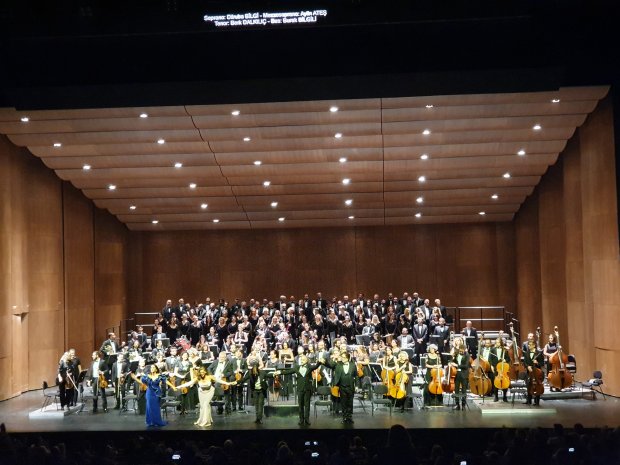
The Istanbul State Opera and Ballet Orchestra and Chorus opened their 2026-27 season with a performance of Beethoven’s Symphony No. 9 at the Atatürk Cultural Centre on 19 September. My companions and I were fortunate enough to have good seats in the middle of the auditorium, and so were able to absorb the full force of the sound. Beethoven himself was not so lucky: by the time of the work’s first performance in Vienna in 1824 he was completely deaf, and famously went on ‘conducting’ to himself (in ignorance of the far better-coordinated efforts of the real conductor, with whom he was sharing the stage) after the music had finished; some kind person turned him round to face the audience, who unbeknownst to him were applauding wildly.
The Symphony No. 9 in D minor was commissioned by the Royal Philharmonic Society in 1817, and Beethoven immediately began to plan it out; it was then that the decision to include four vocal soloists and a chorus was made. (In fact, this was not his first instrumental composition to feature a vocal add-on: in 1808 he had written a Choral Fantasy for piano, vocal soloists, mixed chorus and orchestra.) A person of strong ideals, he had long been intending to create a setting of Friedrich Schiller’s 1785 An die Freude (‘Ode to Joy’), a poem that had had a profound effect him, and this was his chance: he based the last movement of his Ninth Symphony around it, adding some verses of his own.
Things did not get off to a particularly good start at the performance in Istanbul on September 19. There must have been some cobwebs to brush off (no disrespect to our spider brothers and sisters intended) after the summer holidays: the woodwind department took its time to get in tune, and the horns were not having a good day, either. The first movement is anything but a paean of joy: what eventually emerges from the mists of the opening is a high-energy affair with lots of ‘bring-you-up-short’ orchestral hammer blows to rouse anyone who has been dozing off – lulled, perhaps, by the songs of summer.
The scherzo second movement – Beethoven was the first to place his scherzo here, rather than after the slow movement – is also quite frenetic: the staggered contrapuntal entries work themselves up into quite a frenzy. By this time, the Istanbul orchestra was better focussed, and the awkward stop-and-starts and time changes were well managed. This movement is actually quite disjointed, as if someone were fidgeting uncontrollably in their seat after two double espressos.
The slow third movement brings much-needed balmy relief after the all-over-the-place scherzo. Here, the cellos sang fulsomely (there is some gorgeous melodic writing for them), and the horns seemed to have finally got up from their sun-loungers, producing a lush solo or two. This is the kind of mellow, relaxing music you need to avoid listening to before a potentially contentious business meeting: it may make you feel good, but you will end up making some highly damaging concessions.
All this positivity serves as preparation for the öröm and boldogság (Hungarian for ‘joy’ and ‘happiness’) of the last movement. I remember singing tenor in a performance of Beethoven’s Ninth at Stockport Town Hall in or around 1968. I didn’t know then, of course, what the effect of the ‘Ode to Joy’ on the audience was: I just hope it was something approaching that achieved by the Istanbul State Opera and Ballet chorus at the performance in September 2026. Paolo Villa, their chorus master, had taught them to sing in short, staccato blasts – a little fragmented, perhaps, but definitely punchy. My companions and I were fortunate to be right in the flight path of their zippy decibels.
At the end, conductor İbrahim Yazıcı and his players and singers received much well-deserved applause; it went on so long, in fact, that in the end he made a ‘time to go to bed’ gesture, resting his head on clasped hands. So now it’s time to say Hayırlı olsun (‘Let it be productive of good’) for the new musical season. May it bring us lots and lots of spiffing concerts to enliven our darker days with öröm and boldogság.