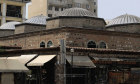
On October 19 I attended an organ recital in the crypt of ‘Saint-Antoine’ – the St Anthony of Padua Italian Catholic Church in Galatasaray. This was one of the concerts in this year’s Opus Amadeus Organ Festival, an event put on every autumn by Mehmet Mestçi, the impresario who is the subject of my article in the recent issue of Cornucopia magazine. I had previously been to two of his chamber music concerts, many of which are held in the visually arresting Naval Museum in Beşiktaş, and had been impressed by their quality. Mr Mestçi certainly has an eye for atmospheric spaces: the success of this recital was due not just to the skills of the performer, which were outstanding, but also to the architecture of the venue.
Inside the crypt there were displays of architectural drawings by the Turkish Levantine architect Giulio Mongeri (1873-1951), who designed not just this church, built between 1906 and 1912, but also a large number of other buildings in Istanbul and Ankara; he eventually became a teacher at the School of Fine Arts in Istanbul. The criss-crossing of rounded arches under a rather low ceiling, and the many nooks and crannies leading off towards the side transepts, gave this performance space an agreeable feeling of intimacy.
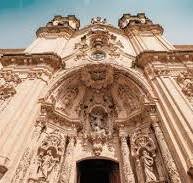
The recital was given by Ms Loreto Amarandi, chief organist of the Santa Maria del Coro (‘Saint Mary of the Chorus’) Basilica in San Sebastián, Spain (pictured above). The organ in this church is one of those built by the distinguished French organ-builder Aristide Cavaillé-Col (1811-1899), whose handiwork became famous after he had built an organ for the Basilica of Saint-Denis in Paris. The instrument in the crypt of the St Anthony of Padua Church, meanwhile, is the work of Gebrüder Rieger, and dates from 1893.
The proceedings began with a work by the early Baroque composer Juan Cabanilles that featured bird noises; whether these warbles were produced by some cunning contrivance in the organ itself, or by some other agency, I do not know. This was followed by J.S. Bach’s Organ Concerto in A minor, a Ground – i.e., a piece based on a constantly-repeated bass figure – by Henry Purcell, and Où s’en vont ces gays bergers by the French organist and composer Michel Corrette, who in 1742 wrote a so-called ‘Turkish’ concerto in honour of Yirmisekizzade (‘Son of 28’) Mehmed Said Pasha, the Ottoman ambassador to France.
There was then an abrupt transition to the 20th century with five items from the Thirty Pieces for the Small Organ by the German composer Hugo Distler (1908-1942). I found these works, which were in a variety of different styles and tonalities, quite charming; they featured some triangle-like tinklings that I initially thought were someone’s ring tone going off. We then heard an arrangement of the third movement of Haydn’s Piano Sonata in E minor, and the Fandango by the Spanish composer M.J. Marco. The Haydn was light and jolly, but I thought the Marco had little going for it except for the castanet effect.
The next two items were both by French composers. First up was the Sicilienne from the 1898 Pelléas et Mélisande Suite by Gabriel Fauré, who spent the earlier part of his career as an organist in Rennes and Paris. This gently rocking melody was followed by the (anything but anodyne) Danse macabre by Camille Saint-Saëns, written in 1874; it had the organist’s feet stomping and criss-crossing at breakneck speed on the pedals, thus showcasing her impressive technique.
The recital ended with Danza del Hacha, a lively folk-dance piece by Fray Antonio Martin y Coll (1660-1734), a Spanish Franciscan monk, organist and composer. Reus (his birthplace in Catalonia and the place where the architect Antoni Gaudí was baptised) was a far cry indeed from late 19th-century Paris, but I did not mind in the least being whisked off there. Indeed, I found the atmosphere in the crypt of the St Anthony of Padua Church most conducive to mental travel. It was, if I may be excused the irreverence, a spacey space, and I have much gratitude for all those who made the experience of listening to a concert in it possible – the Spanish Consulate-General, the Cervantes Institute, the church officials, and of course Mehmet Mestçi, whose entrepreneurial zeal continues to provide us with euphonious experiences.