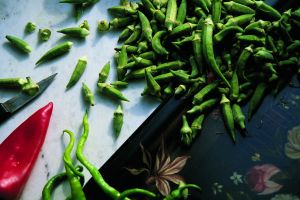
Passengers on flights leaving Gaziantep, I am convinced, are more laden with hand luggage than those from any other Turkish city. And what luggage. Trays of crunchy baklava, feathered layers oozing sugar and clarified butter, or pouches of dense, sweet red pepper paste and kilos of fresh pistachios with a mottled green and magenta soft skin covering the hard white shell. I, too, nearly dislocated a shoulder packing the overhead luggage rack with an array of delicacies: 1) Grape molasses boiled and thickened with cracked wheat that is reconstituted with butter, then smothered in walnuts a high-energy morning treat which makes Wheaties seem like the breakfast of losers. 2) Firik husked green wheat kernels that have been dried over a gentle fire of discarded grape vines and so retain a smoky, almost bacon aroma. 3) Not ordinary pistachios but tiny, guano pistachios (the Turkish is ruder) named after their intense neon green colour and mercifully not the intense flavour all of which comes from having been harvested early. 4) Bottles of soured pomegranate molasses (which, like balsamic vinegar, is tasty but oh, so-o-o-o last week), but also sumac syrup, which must be the sourest edible substance known to man. 5) A large bag of bulgur wheat, which I know you can buy in any grocery store but which was the special gift of a member of an EU project to promote its consumption. It turns out bulgur is a miracle grain, much healthier than even wheatgerm and ideal for stocking up the air-raid shelter because it resists both mould and radiation. 6) Lots of other stuff which I am sure I will never get round to using. I had been invited to Gaziantep to participate in a festival celebrating the citys deep reverence for lunch, serious dinners and voluminous breakfasts. After one weekend, I began to marvel that the Istanbul-bound plane got off the runway at all. The deeper purpose of the festival was to display the complexity of the regions fare and to correct the prejudice that the southeast of Turkey survives purely on skewered meat.
We were treated to other Gaziantep delicacies in the meals that followed. I feel guilty about describing them in a restaurant column because I am not exactly sure where they can be found. Some of the dishes were regional variations of well-known dishes. The hot vine-leaf dolmas are rolled long and thin and make use of that sumac sourness and tons of garlic, almost tasting as if they had been stuffed with a good Italian sausage. Others were things I had never tasted, like þiveydiz, a yoghurt-based stew in which the principal ingredients are chunks of garlic, green onions and sometimes leek, or a meaty breakfast broth called beyran thickened with rice and seasoned with red pepper and yet more garlic. There were salads pirpirim (semiz otu or purslane) and lots of fresh fruit. The great revelation was a pilav made from firik (green wheat grains) given a lighter texture by being mixed with bulgur. It is cooked in a lamb broth with chickpeas then covered with meat as well as almonds and those bright green pistachios. However, there were still plenty of kebabs kebabs with onions, kebabs with aubergine, with tomato, with roasted mashed tomato and of course kebabs skewered with cloves of garlic. I believe I have been spoiled for life after a lunch in a garden owned by the most famous restaurant in Gaziantep, Iman Cagdas. Here I had perfectly cooked sebze (vegetable) kebab full of parsley and (who would have guessed it?), garlic. | The art of making a kebab made from chopped meat is lies in the balance of meat and fat. The heat should not be too fierce or the meat will cook before the fat melts away. The result should be a delicate lattice of crunchy, well-cooked meat which, if it doesnt actually melt, at least disintegrates in your mouth. Much depends on the type of lamb. Kebabs in Gaziantep are made from the halik breed of sheep in which the fat is well distributed throughout the animals body. Curiously enough, I first visited Gaziantep in the late 1980s, a time when Istanbul sophisticates sneered even as they gorged themselves on spicy thin kebabs then regarded as foreign ethnic food. Istanbul has changed since then and the kebab has climbed upmarket much in the way that Indian food has become chic in towns and cities far from its origins. Umami and Mabeyin are two Istanbul kebab restaurants I have not mentioned in this column before. They serve similar sorts of food in very different surroundings. Umami, in Levent, on the European side of the city, takes its name from a supposed fifth flavour (after sweet, sour, salty and bitter) best described as the fermented aftertaste of a very good tomato or the muskiness of a shiitake mushroom. How this relates to the Adana kebab on offer, I am still trying to unravel. The meat is tasty and seems a great deal leaner than would be the norm back in Adana. The décor is closer tothat of a brightly lit noodle shop or the waiting room of a streetwise ad agency than the smoky, tiled kebab restaurant of yesteryear. By contrast, Mabeyin, on the Asian side near the Altunizade exit of the first bridge, swarms with busboys and has the feel of a gilded, overstuffed armchair. It occupies a huge reconstructed mansion (konak) and in fine weather boasts a large, atmospheric garden with tables scattered beneath elegant, mature trees. It is the flagship of the Çavusoglu brand famous for being pioneers of Gaziantep food in the 1970s in the Laleli neighbourhood near the Covered Bazaar. It also boasts extremely good baklava so good that it seems if you arrive after eight for dinner they have sold out. I am fond of the Oruk kebab at Maybeyin, which has a high content of that life-enhancing bulgur mixed into the meat, so that there is also an extra element of crunch. Although the Gaziantep kebab has made it to Istanbul, its journey further west has been slow. Elsewhere in this magazine I write about the kebab culture that has penetrated Great Britain, but these are largely great chunks of meat. The skill of hand-chopping and grilling minced lamb is not easily learned. I had a go on the other side of the Atlantic, in Washington. Zaytinya, as its name suggests (an Anglicisation of zeytinyag, the Turkish for olive oil), is Turkish but not quite. It might seem like the work of a second-generation American embarrassed by his ethnic origins. In fact it is the work of José Ramón Andrés, a Catalan chef, and satrap of the DC restaurant scene. His many establishments have introduced the city both to tapas and Heston Blumenthal-style factory techniques to deconstruct dinner. No such high-tech wizardry goes on in Zaytinya, although it has the air of a food factory. On weekend night it can serve a thousand covers. Its easy to see how the stylishly long bar and an exterior high-glassed wall attract followers of fashion. The restaurant serves Mediterranean Food, but this, too, is something of a deconstruction, or at least an invented tradition. Mez(z)e are Mediteranean small plates, the menu explains earnestly. | Apparently the term means middle something between lunch and dinner. Well, this may be true in Italy, where you might eat your meze in the mezzogiorno but it is an absurdly false etymology of meze, which comes from the Persian for taste or gusto. The Adana Kebab Tike was not cut into tike (or bits) at all. But never mind. I watched sympathetically as one of my dining companions, someone who actually comes from Adana, stuck her fork into it. She flinched and almost looked ill when the meat bled. And it tasted of cumin. We sent the kebab back. It came back bloody. We tried to send it back again. Its on the house, the waiter told us with a withering look. I dont think many halik sheep graze inside the Beltway. Umami: Nisbetiye Cd 21, 1. Levent, Istanbul 90-212-279 7474 Mabeyin: Eski Kősőklő Cad 129, Istanbul 90-216 422 5580 www.mabeyin.com Imam Çagdas: Eski Hal Civarő, Uzun Çarső 14, Sahinbey, Gaziantep 90-342 231 2678 or /220 7080 www.imamcagdas.com Zaytinya: 701 9th Street NW, Washington DC 20001 (Pepko Building) 1-202 638 0800 www.zaytinya.com |