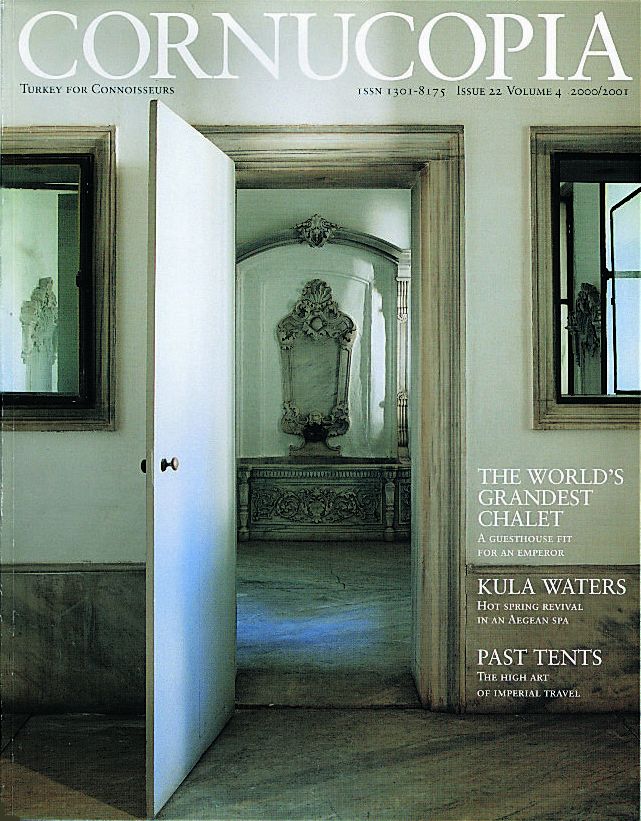
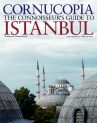
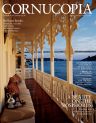
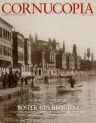
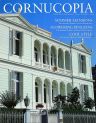
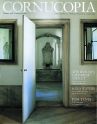
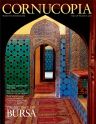
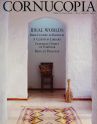
The Sultan's chalet by Philip Mansel with photographs by Fritz von der Schulenburg
The world's grandest chalet was built by Abdülhhamid II for the visit of Kaiser Wilhelm II in 1889 and was a powerhouse of political activity in the final years of the empire. Today the house, set in the grounds of Yildiz Palace on a hill in Istanbul, is all but forgotten, Philip Mansel treads softly through its silent halls.
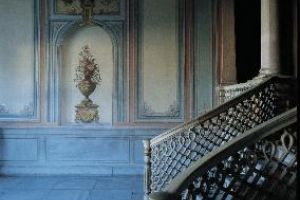
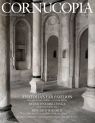
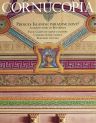
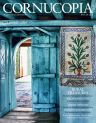
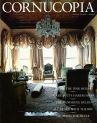
Top: The pierced marble balustrade is part of the last and grandest section, designed by d'Aronco for thr Kaiser's second visit, in 1898.
Below: The Orientalist Gothic dining room. In the haste to complete the building for the Kaiser's visit in 1889, the doors, inlaid with mother-of-pearl, had to be borrowed from the nearby Ciragan palace. The enamel-inlaid chandelier may be from Barbedienne, the great Paris foundry.
Related Cornucopia articles
Also by Philip Mansel: Cornucopia 34: Painting his Way into History: the lasting legacy of the last Caliph
The bard of Byzantium A tribute to Sir Steven Runciman by Antony Bryer
Sir Steven Runciman was a supreme story teller, whether at the dinner table or in the majestic sweep of his historical writing. Fellow-Byzantinist Anthony Bryer recalls an elegant figure for whom history was about the destinies of man.
The Hon Sir Steven (James Cochran Stevenson) Runciman, born July 7, 1903, died November 1, 2000; Professor of Byzantine Art and History, Istanbul University, 1942–45; President of the British Institute of Archaeology at Ankara, 1962–95; President of the Society for the Promotion of Byzantine Studies, 1983 - 2000.
Runciman in the 1920s photographed by Cecil Beaton
Berlin brain drain German exiles in Turkey by Norman Stone
With illustrations from Haymatloz: Exil in der Türkei 1933-45
In the period surrounding the Second World War, many of Germany's greatest brains found a haven in Turkey. Their influence was wide - from economics to town planning, from medicine to music. Norman Stone looks back at the leading lights of this remarkable exodus.
Of all the great German brains that took refuge in Turkey between 1933 and 1953, the most human seems to have been Professor Gerhard Kessler. Professor Kessler had been brought out of a Nazi concentration camp in 1933 by the Turks; he had been a democratic Party member of the Saxon parliament, had become professor of sociology at the new Ankara University, and greatly loved Turkey. The Turks loved him, too: he was a generous and generous-minded polymath, who put up poor students in his own house, gave unstintingly of his time, wrote several very useful textbooks, and had a curious hobby - Jewish surnames.
Kessler eventually went back to Germany - and a very high academic position - but he pined for Turkey and returned in the mid-1950s to the new American-funded University of Erzurum. By then, to hold a Turkish chair, you had to become a Turkish citizen, and there was a ceremony: flowers tears, the national anthem, medals, men kissing each other on the cheek, and emotional speeches from the head of this and the head of that. Professor Kessler's salary was halved, as Turks were paid less than foreigners, but I very much doubt he minded - peace to his soul (he died in 1963)...'
Top left: The composer Paul Hindemith (1927) photograph courtesy of Hindemith-Institut.
Top right: Carl Ebert set up the state opera. photograph courtesy Akademie der Kunste. Berlin
Lower left:The architect Bruno Taut (1933)
Lower right: Hanna and Ernst Reuter (1946)
Return of the native by Ates Orga
When Cornucopia sent Ates Orga to cover the Istanbul Festival, it was no routine assignment. It was a chance for him to retrace the footsteps of his famous father - the writer Irfan Orga - and to see his homeland again after an absence of half a century
'I left Istanbul for London on December 27, 1947, at the age of four, a winter moon on solstice rise. I returned fifty-three years later, a summer sun at solstice rest. I cannot remember much of that childhood flight.... Read the article
Ates Orga is director of Music Management Studies at the Dr Erol Üçer Center for Advanced Musical Research, Istanbul Technical University. He has produced several music CDs of Ottoman Court music with Emre Araci (see below)
The secret garden of Kasnak text and photographs by Kate Clow
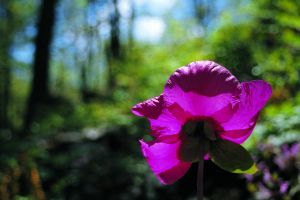
High in the Taurus Mountains. Chris Gardner finds the remote Kasnak Forest carpeted with peonies in spring.
Dawn reveals towering limestone peaks tinted with soft sunlight and mirrored in the calm of a vast inland lake. It is a cool May morning at Lake Egirdir, in Turkey's southwest, and we are here to search out the rare orchids and tiny alpine flowers which thrive in this rugged landscape. As any self-respecting botanist will tell you, Turkey in spring is a land off bewildering variety. Here, within the Taurus Mountains, lie many different habitats, each filled with myriad floral gems. Yet one particular day, the day we spent among carpets of peonies, stands out from all the rest...'
Other articles on Turkey's lakes district:
Silence of the lammergeiers: walking high above the lakes, by Kate Clow Cornucopia 17
La vie en rose: the Isparta rose harvest, by Martyn Rix Cornucopia 23
Books that touch on Turkey's lakes district:
St Paul Trail Kate Clow's book of walks leads across the Taurus Mountains from Aspendos in the south to Lake Egirdir in the north. See Caroline Finkel's review.
Hot news from Kula by Roger Williams with photographs by Jean Marie del Moral and Roger Williams
Dramatic volcanic domes dramatically dominate the landscape around Kula. Unseen, though are the underground thermal waters that may one day breathe new life into the town and its remarkable Ottoman houses.
Roger Williams is the author of the novel 'Lunch with Elizabeth David'
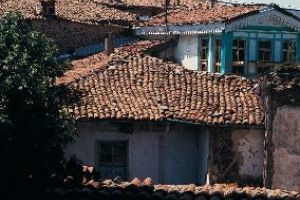
Beneath the lime-washed plaster, Kula’s houses are timber-framed, crossed to give support against earthquakes, and infilled with straw, clay and stone. Some of the lanes in the old quarters are so narrow that you can almost shake hands across them between the overhanging bays of the upper floors. High walls conceal shady gardens where women still weave the famous Kula carpets, though the last factory has moved away to Izmir.
Painting
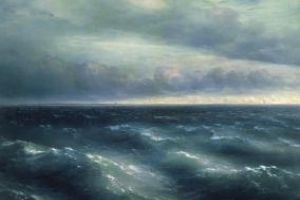
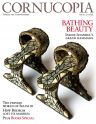
Ivan Aivazovsky: painter to four tsars, two sultans and a pope by Ivan Samarine
The Russian artist Ivan Aivazovsky may have been derided by the avant-garde, but his dreamy seascapes and atmospheric panoramas won him patrons in high places. Ivan Samarine rediscovers a 19th-century virtuoso
Seas Cities and Dreams The Paintings of Ivan Iavazovsky
Classical Music
Music to a Sultan's ear by Emre Araci
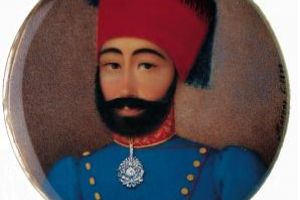
Visitors to 1830s Istanbul were astonished to hear the strains of Rossini and Donizetti performed by Turkish musicians. As Emre Araci reveals, Western music was the passion of Sultan Mahmut II
Dr Emre Araci is a composer and musicologist who is an expert on Ottoman Court music of the nineteenth century. He has arranged and directed several music CDs on the Kalan label
Meatball Wizard: by Berrin Torolsan
From Alaska to Australia, from Mongolia to Mexico, meatballs come in a thousand guises. Berrin Torolsan works magic with mincmeat.
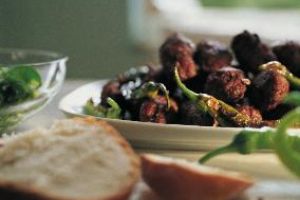
Three koftes stand out in my memory. Just thinking of them makes my taste buds ache. The first was in my early childhood: freshly grilled cizbiz kofte, a round patty the size of a flattened walnut, so named because it makes a delicious 'jiz-biz' sizzling sound as it cooks...'
Antony Wynn reviews A Soup for the Qan: Chinese dietary Medicine of the Mongol Era as Seen in Hu Szu-hui's Yin-shan Cheng-yao Ed. Paul D Buell and Eugene N Anderson