The magazine for Connoisseurs of
  Home
CORNUCOPIA FEATURE

The Caliph's Daughter
by Omar Khalidi
Cornucopia 31

The Caliph, Amir al-Muminin, Successor to the Prophet Muhammad, Commander of the Faithful, The Shadow of God on Earth – these exalted titles convey the symbolic importance of the caliphate to the community of Islam. In theory, the caliph – a position held from the sixteenth century by the sultan – was both the spiritual and temporal leader of the Sunni Muslims, ensuring the defence and expansion of the rule of divine justice on earth and helping to assure eternal salvation for all Muslims.

After the First World War, however, these titles were about all that remained of the glory of the Islamic caliphate. The Ottoman Empire was finally defeated and dismembered and revolutionary forces were unleashed in Turkey. On November 1, 1922, under the leadership of Mustafa Kemal (who later took the name of Atatürk), the newly formed Turkish Grand National Assembly abolished the sultanate, and the last sultan, Murad VI Vahdeddin, fled from Istanbul aboard a British battleship.

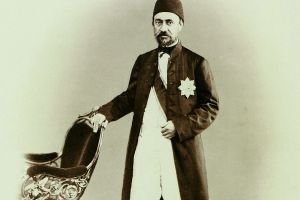
A little over two weeks later, Mustafa Kemal offered the position of caliph to Abdülmecid Efendi, the third son of an earlier sultan, Abdülaziz, and previously heir to the throne. The new Caliph was installed on Friday, November 24, 1922, in a ceremony held in Topkapi Palace. He attended Friday prayers at the Fatih mosque, after which he paid a visit to the shrine of Eyüb Ensari, before returning to take up residence in Dolmabahçe Palace on the European shore of Istanbul, which was then still the capital.

Abdülmecid Efendi was a cultured man who spoke Turkish, Arabic, French and German, and called France a second fatherland. He had spent his seclusion (kafes) composing classical music, reading the complete works of Victor Hugo and the latest numbers of Revue des Deux Mondes and cultivating his park. Like other educated Ottomans of his day, he painted in a modern Parisian style, mainly peyzaj (landscapes) and scenes from Ottoman history.

At once cosmopolitan and patriotic, Abdülmecid Efendi encouraged the revival of Turkish culture. His earlier house was in the neo-Turkish style, with wide eaves, brightly painted walls and fireplaces lined with Kütahya tiles; he himself designed the neo-Seljuk gate. He held gatherings of Turkish writers and musicians, and put on plays in his garden. He had two children, Prince Ömer Faruk Efendi and Princess Dürrüsehvar.

After the abolition of the sultanate, there were fears for the future of the caliphate. On November 24, 1923, as rumours spread through the Muslim world that this was about to happen, the Aga Khan and Sayyid Amir Ali, a renowned scholar, wrote to the Grand National Assembly voicing their concerns. They were expressing the deep commitment of Indian Muslims – the largest body of Muslims in the world – to the caliphate as an institution. But their letter gave Mustafa Kemal a pretext to denounce the move as foreign intervention. The Caliph had been in office barely four months when the caliphate was abolished by the assembly, on March 3, 1924 in Ankara, the new capital.

Dolmabahçe was surrounded by troops. Abdülmecid Efendi was reading the Koran (or by some accounts the essays of Montaigne) late at night when Adnan Adivar, Mustafa Kemal’s representative, and the prefect of police came to tell him that he had to leave at dawn. His family and servants began to weep. The freedom of life in the West was offered as consolation. The Caliph’s daughter, Dürrüsehvar, sole survivor of this melancholy scene, is said to have remarked in tears: “I do not want that kind of freedom.” The Caliph took his immediate family, three officials and two servants into exile in Europe aboard the Orient Express. They settled in Paris and Nice.

At this critical time, financial help came from Mir Osman Ali Khan, the Nizam of Hyderabad, said to be the wealthiest man in the world. According to Sir William Barton, the British Resident at the Nizam’s court, the Caliph “received a pension of £4,000 a year from the Nizam’s government: other members of the Turkish royal family also enjoy his bounty”. Before the Nizam could make good on his promise of the pension, the British government in India wanted to know whether it had been offered because of the Nizam’s desire to revive the caliphate or continue it in some other form, or whether it was merely an act of charity. Reassured that it was the latter, the British consented to the Nizam’s benevolence. Somewhat relieved of financial worries, the Caliph “attended Friday prayers and enjoyed classical concerts” in Paris. He was rarely in the news, but he was spotted in Nice by the correspondent of Time magazine, who was writing a story about the Nizam’s silver jubilee: “Almost any sunny day he may be seen strolling with a mien of great dignity along the beach near Nice, attired in swimming trunks only, carrying a large parasol. ‘I live apart from worldly vanities here in Nice,’ recently observed the Caliph, whose favourite reading is Anatole France. ‘I read, I play the piano, I paint. Nice is perhaps the only foreign city which is popular with the Turkish people.’”

Like any father in Islamic society, the Caliph’s main worry was to find a suitable match for his beautiful and talented daughter, Princess Dürrüsehvar. His rescuer in this matter was the same man who had solved the Caliph’s financial worries, the Nizam.

In Nice, on November 12, 1931, a double wedding took place. Princess Dürrüsehvar was married to Azam Jah, Prince of Berar and heir apparent to the throne of Hyderabad; and her cousin, Princess Nilüfer, great-granddaughter of Sultan Murad V, married Muazzam Jah, the second prince of Hyderabad.

“The wedding ceremony was not attended with any of that oriental splendour which is supposed to be inseparable from royal marriages,” noted the author of Pictorial Hyderabad. “It was simple, with the dignified simplicity of Islam. Only some members of the ex-Caliph’s family at Nice, some Turkish nobles, and a few personal friends were present. The Hyderabad delegates to the Round Table Conference [in London], namely Sir Akbar Hydari, Sir Richard Chenevix Trench, and Nawab Mahdi Yar Jang… and Marmaduke Pickthall [translator of the Koran], witnessed the nikah [ceremony], performed by the ex-Caliph himself.”

When the royal couples arrived in Hyderabad on December 31, 1931, the Nizam broke with protocol and was at the railway station to receive them. A British correspondent wrote: “After embracing his two sons and having them blessed on their arrival by some holy men, the Nizam first saw his daughters-in-law. It is to be surmised that His Exalted Highness approved of what he saw, for he seemed quite joyful when he reappeared, and the speech which he delivered to the people on the platform was in happy vein... Wild applause and shouts of blessing accompanied the Nizam and the princes along the miles of road... The temperature was about that of a summer’s day in Lombardy. The princesses, it is said, were astonished at the coolness, and remarked that the climate of Hyderabad was like that of Nice.”

Their nuptials may have been simple, but once they settled in Hyderabad, in the lakeside palace of Bella Vista, life for the princesses was a good deal more sumptuous.

A state banquet was held at the Chowmahalla Palace, where, according to an article in Asiatic Review, the Court of Honour, illuminated with myriad fairy lights which were reflected in the waters of the central basin, “was like a scene from The Arabian Nights”. The guests assembled on the steps before the throne-room awaiting the arrival of the Nizam and the princes and princesses – noblemen in Mogul court dress, ladies in rich saris mingled with British officers in uniform and civilians in full evening dress. There were so many English ladies quite at home amid the throng. To the strains of ‘The Roast Beef of Old England,’ played by an excellent band, the guests went in to the dinner tables, which were laid with the Nizam’s famous gold plates.”

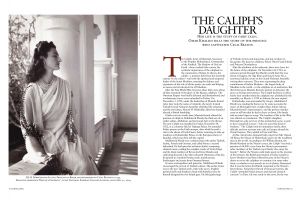
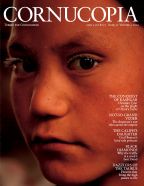
Princess Dürrüsehvar evidently made a strong impression on all those who met her. Cecil Beaton, who took the portrait of the princess in India that opens this article (see Cornucopia 31), was often waspish about those he photographed. But for the princess he had nothing but praise. Writing in US Vogue many years later, when much of her time was spent in London, he noted her “sensational” looks (aided by her spectacular jewels), the “climate of restfulness and serenity” she created, her love of philosophy and literature, her fluency in many languages, and “the Ottoman perfection of her taste”.

These are the same qualities that the Turkish writer Halide Edib Adivar remarked on when she met the young princess on a visit to India. It was her husband, Adnan Adivar, who, as Mustafa Kemal’s representative, had come to Dolmabahçe to deliver his fiat to the Caliph to leave the country. Since that time, Halide Edib and Adnan Adivar had fallen out with Atatürk, as he was now known, but it must still have been an awkward moment when she and the princess met at the residence of Sir Akbar Hydari, the prime minister of Hyderabad. Nevertheless, the writer was captivated:

“She happens to be an Ottoman Princess, but she has ceased to be anything but an Indian Princess, so well does she seem to have adapted herself to her environment, and taken to heart the duties that go with her position, both as a wife and mother and as a woman of an unusually deep culture...

“She is, I believe, about six foot tall, so she towers over the tallest. In spite of her queenly and dignified figure, she has a modest and somewhat timid air...

“She was in a simple sari when I saw her, and innocent of all make-up and jewels. Her head, framed in muslin, stood erect on her powerful shoulders. It was a longish face, with a broad forehead, fair hair brushed back, and delicate but rounded chin. She had wide-apart and very large blue eyes, with level and well-arched strong eyebrows. The mouth was very small, very red, and fancifully chiselled, disclosing the whitest teeth imaginable. The nose begins straight and in the classical line, but it is long and turns slightly over the mouth.

“Where had I seen this face? I wondered. And I knew at once. It was the portrait of Mehmed the Conqueror, as painted by Bellini. Strange that of all the members of that somewhat degenerate family she has inherited from the strongest and ablest of the dynasty. And it was a kindness of destiny that had placed her where she should be, for the early Ottoman mentality of those days was above all racial and religious differences. And, like the Conqueror, she also had a talent for poetical writing, and a passion for education.

“She spoke Urdu quite fluently, and English like a native. That she was Turkish once I remembered when she called her pretty son ‘My sugar’, in Turkish. As she has never been in Purdah she moves around freely, and is, I am told, a fine rider...”

Halide Edib pronounced the princess, who was still only twenty-three at the time, to be a “woman of thought andjudgment”, with a conviction that women should be taught “the dignity of work”. She quotes her as saying: “Every woman ought to be in a position to support herself by means of an honourable livelihood should the occasion arise. It is a matter of pride and not humiliation to add to the meagre family income by one’s own endeavour.”

A lasting legacy of the marriage of the two princesses was the fading of purdah among the Muslim elite in Hyderabad. Masumah Begum, a social worker and politician, recalled how the change took place gradually. Before the princesses arrived, a wife might stay at home if men would be present at a gathering who were not friends of her husband. But when the princesses issued an invitation, it was a “command performance” that could not be refused, nor could one inquire who would be there. In this way, purdah began breaking down.

Philip Mason, an Indian Civil Service officer, became tutor to the princess’s children, Prince Mukarram Jah and Prince Mukhaffam Jah. He was equally struck by Princess Dürrüsehvar: “I met a most impressive person, a few years younger than myself, a commanding figure, handsome of feature, with a clear fair complexion and auburn hair; she wore superb saris, which suited her most imposing height. No one could ignore her or slight her. She was always, essentially and indefinably, royal, and it seems to me that if fate had so willed she might have been one of the great queens of the world. She would have been as imperious as Elizabeth of England and she would have demanded as much from the young of her court, sent them as readily to their death on the Spanish Main, teased them as merrily and as cruelly. She would not have seen so clearly the virtues of compromise. I came to know later that she had skill – which she neglected – as an artist and wide appreciation of painting and that she could observe with humorous detachment any situation that did not too closely concern the future of her children.”

At about the same time, another Briton, the constitutional lawyer and politician Sir Walter Monckton, arrived in Hyderabad as Lord Mountbatten’s special emissary to negotiate the difficult question of the Nizam Dominions’ future relations with India. According to Monckton’s biographer, Lord Birkenhead, the princess seemed “in many ways the most remarkable person in Hyderabad, a woman tranquil yet resolute, whose personality dominated any room she entered”.

“They became friends on this first visit, and their friendship was to endure, precious and unbroken, until Walter’s death; and years later he would remember her as he first saw her in her own house, tall and lovely, looking as though she might have stepped out of a picture by Edmund Dulac. To Walter, so restless in temperament, her presence was extraordinarily soothing. He found that in character as well as in appearance she had the quality of tranquillity: ‘I learnt from her,’ he said, ‘what everyone must learn who has Muslim friends – how unnecessary it is talk just for the sake of talking, and that there is no unfriendliness, and should be no awkwardness or embarrassment in silence.’”

Princess Nilüfer seems to have attracted quite as much admiration as her cousin. “Her violet eyes and blue-black Circassian hair were enough to ruin a man’s appetite,” remarked the British official Sir Conrad Corfield, who declared her “the loveliest creature I had ever set my eyes on”. When she accompanied the Nizam to Delhi, the Viceroy, Lord Willingdon, was equally enchanted, much to the annoyance of his wife.

What became of this cast of royals? The Caliph, Abdülmecid Efendi, died in Paris in 1944 and was later to be buried in Medina. Princess Nilüfer had no children, and her marriage to Muazzam Jah ended in divorce in 1952. She moved back to Paris, then went to live in Istanbul when the ban on female members of the Ottoman royal family entering Turkey was lifted in 1951. In 1963 she married Edward J Pope, an American businessman, in Paris, where she died in 1989.

Princess Dürrüsehvar’s first son, Prince Mukarram Jah, succeeded as Nizam on his grandfather’s death in 1967. Her husband, Prince Azam Jah, died in 1970, and the princess, who celebrated her ninetieth birthday in January, now lives in Hyderabad and London.

Clearly, her power to captivate the public imagination has not deserted her. In the early 1990s she opened a hospital that she had set up in Purani Haveli. So keen were the crowds who attended the inauguration to catch a glimpse of the princess that they totally ignored the chief minister of Andhra Pradesh, NT Rama Rao, who was no doubt disconcerted, being himself a film legend used to cheering fans.

Omar Khalidi is a staff member of the Aga Khan program for IslamicArchitecture, Massachusetts Institute of Technology.