The Journey East

Text and photographs by Raf Jah

PART I: BY OVERNIGHT EXPRESS TO KARS

We arrive at Karaköy in time for the 7am Istanbul Maritime Lines ferry to Asia: my wife, Francisca, my friend Mike Eggars and myself. The vessel’s diesel turbines shake the decking and the brass propellers churn the water as we surge away from Europe. Avoiding the occasional tanker, bulk carrier and numerous fishing skiffs, we plough between two continents. The weak morning sun shines on Dolmabahçe Palace and the high-rises of Taksim and fiiflli. All too soon we are docking at Haydarpafla railway station, a German schloss parked beside the Bosphorus.

My experience of restaurant cars on Turkish trains has been mixed: sometimes there will be one, sometimes not. Just in case, we have a reasonable breakfast at the station, whose restaurant is one of my favourites. With its blue-tiled walls and simple painted ceilings, it is a secret gem enjoyed only by commuters – the first bread of the day for the incoming businessman, the last glass of rakı before the train home.

haydarpasarailwaystationrestaurantThe restaurant at Haydarpaşa Station. © Raf Jah

The Doğu Ekspresi (Eastern Express) is, I believe, Turkey’s longest domestic train journey. Leaving Haydarpaşa, it trundles down to Eskiflehir, up to Ankara, down to Kayseri and up to Sivas, then east to Erzincan and Erzurum before it finally halts at Kars, 30 miles from the old Soviet border. In earlier times the express would continue to Yerevan in Armenia for a direct connection to Moscow, but it was never a deluxe, Orient Express affair. When I first took the Eastern, in 1991, it was a grimy train with a few carriages of old but comfortable Pullman seats, filthy couchettes and, if you were lucky, a snack bar. Much has changed. Before us is a fully air-conditioned, seven-carriage express. The Pullman seats are cloth-covered, the couchettes spotless and an excellent restaurant car serves hot meals all the way to Kars. At the back is possibly the most luxurious sleeper car outside Moscow. We climb aboard, stow our stuff and wander off to the restaurant car with its large windows.

At exactly 8.30 the Doğu clangs and bangs and, with a screech, pulls out of Haydarpaşa. The electric engine pulls the short train easily along the coast for two hours. We sit at our table drinking çay and watching the small ports bordering the Sea of Marmara and the industrial arm of Istanbul slide past.

After Izmit, the train climbs into the rocky hills as we enter Anatolia proper. The people we pass are different, their attitudes, dress and demeanour softer and more colourful. When the train halts at small stations women in headscarves climb aboard or simply watch the train go by.

After five hours we slide to a halt at the Tatar-speaking city of Eskişehir. I take to my sprung mattress and snooze until someone bangs on my door. “Sir, our carriage has blown a fuse,” says our conductor. “The fuse cannot be repaired by the engineers here and so we have to change carriage.”

“Where are we?” I ask.

“Ankara,” he replies and moves on down the carriage, banging on doors.

The operation involves all the sleeper car’s passengers getting out of bed, dressing and moving to the platform.
We sit around for half an hour as our carriage is uncoupled and a replacement found. While the express disappears, minus our carriage, for a track manoeuvre, a small shunting engine arrives on the next-door platform with a fully made-up sleeper, which it drops in front of us. The express returns and with a bang and a hiss the train is whole again.

After Ankara the scenery changes to the flat of the Anatolian plateau. We watch the sun go down over a dinner of salad, köfte, chicken kebabs and cacıkof cucumber and yoghurt. The bed is a little narrow. I bounce very gently as we make our way into the night, but I sleep early and well.

divrigirailwaystationThe Doğu Ekspres at Divriği Station. © Raf Jah

“This train is as comfortable as anything in Europe,” says Mike the next morning. “More comfortable, I would say. It’s just slower.”

It is 8am and we have reassembled in the restaurant car. Central Anatolia gives way to eastern Anatolia. The rolling hills grow more jagged and the track starts to follow the course of the Euphrates. The hills become steep cliffs, then pan out into the wide valley that leads to the city of Erzincan. The station has a beautiful view of the snow-covered mountains around the city, but we halt just long enough to refuel, then carry on east. We arrive at and depart from Erzurum in twilight, then climb to 2200 metres, one of the highest points of the journey. When the lights fail in the restaurant car we eat in darkness and then sleep.

I awake with a jolt as the train bounces to a halt. It is midnight and we have arrived in Kars. I silently curse the sleeping-car attendant for not waking us. By the time we have our bags together, the train starts to manoeuvre into a siding and we are stuck on board for a further 25 minutes on top of our 40 hours. When we finally manage to get off, I ask a polite tramp in the heated waiting-room where I can find a taxi and am advised to ask the stationmaster. He and his security guard, surprisingly wide awake at 1am, direct us to walk into town, find the police at such and such a crossroads and ask them. This sounds ridiculous, but we shoulder our backpacks and set off. After 300 metres we come to a crossroads with a busy grocery store, outside which is parked a police minibus.

I ask for directions and a policeman immediately offers to call us a taxi. It arrives five minutes later and a few minutes after that, we are in the pleasant, though slightly overpriced, Simer Hotel.


hl42trains
GreatNortheastJourneyeast3a
GreatNortheastJourneyeast1a
Cornucopia 42 highlights: All aboard
GreatNortheastJourneyeast2a

PART II: BY TAXI OVER THE PLAINS OF KARS

We take a taxi to the ruined city of Ani and a small castle near Georgia. The people we pass do not seem badly off. The rich earth is being tilled by new-looking tractors. Sheep and goats wander in large flocks, watched over by flat-capped shepherds and Kangal dogs. The stone village houses all have satellite dishes.

These people walk with their sheep for days at a time. We see camps of yurts that can withstand summer rainstorms and still provide comfort – a scene reminiscent of Mongolia, but with Massey Ferguson tractors. Central Asia definitely starts somewhere near Sivas, yet access is possible in a Renault taxi.

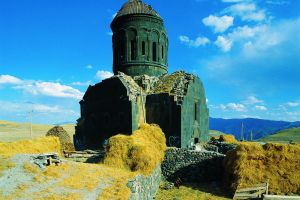
Ani, with its ruined churches, is interesting, but more intriguing is that the second half of the city was destroyed by Stalin, anxious to remove any vestige of Armenian culture. If anyone has any illusions about Russia’s influence on the Caucasus, they have only to look across to the Armenian frontier. The guard-towers are manned and the border posts, while filthy and disorganised, are active. At the main base two flags fly – one Russian, one Armenian – but every other post has only a Russian flag. The Turks are still facing the same Russian army they have faced for centuries.

aniborder2Turkish-Armenian boder at Ani. © Raf Jah

But change is in the air. Since Russia showed its primacy in the Caucasus by invading Georgia in 2008, a worried Armenia has leant towards Washington for support. President Obama has chosen this moment to visit Turkey to try to repair a relationship damaged by the rhetoric of his predecessor. The Turks, caught in the superpowers’ Caucasian clash, have had to look at who their real allies are here. I suspect most have come to the realisation that they have no friends in the region, but that they can do business with the Armenians, tired of being blockaded by a moribund Georgia, a pro-Moscow Azerbaijan and a sanctioned Iran. As I look at the Russian soldier facing Turkey from the old Soviet tower, I think that he might one day go home and this border reopen.

In the 15 years since my first visit, the weather has had a negative effect on the ruins of Ani. Where possible, the Ministry of Culture and Tourism has added discreet metal supports, but there is no denying the force of the elements.

Strangely, the Armenians have chosen to open a quarry on their side, and cranes and trucks have scarred the once-green hills and cliffs. We go inside one of the small churches and photograph the faded but impressive images of the twelve Apostles. All in all, Ani is still spectacular.

Şemsettin, our taxi driver, asks what we want to do next. He offers to take us to Çıldır and the Devil’s Castle. We agree on a price of TL200 and he drives us back towards Kars, then north towards Ardahan.

When I came down this road in 1994 the bus ground along the muddy slope that passed for a road. The sky, the houses and life in general here were grey. My diary of the time records a conversation with the bus conductor.

“This is a 24-hour road,” he informed us. “The army keep it open all day and all night because it serves the border guard stations.”

“And the tarmac road?”

“That closes after 8pm as it becomes too dangerous – you know, terrorism.”

Today we zoom along well-maintained tarmac. Gone are the soldiers, sandbags and guns at the crossroads north of Kars. Now there is a small fish restaurant. But some things have not changed. Our taxi cruises around Lake Çıldır and past three small villages. Each has its own gendarmerie, some a large infantry barracks, with the Armenian frontier on one side of the village, the Georgian frontier on the other. The numbers of howitzers and troop-carriers are up. I have the distinct impression this army is not here to ask questions of its own people, but to protect them. The Georgian border is equally well defended. One can only suspect Russia’s Caucasian ventures have made the Turks double their guard.

The road comes to Çıldır, a town of Kafkas, half-Muslim half-nothing. We drive on to a small village. The path, cut into the side of cliffs, is broad and we walk along, looking down on the tiny river below, until we pop around the corner and see the Devil’s Castle, a small fortification perched on a ridge jutting out into the steep valley of the stream. With views for miles in both directions, it guards the valley absolutely.

seytankaleŞeytan Kalesi, The Devil's Castle, near Cıldır, north of Kars. Photograph © Raf Jah

Driving back, we stop at a lakeside government rest-house.

“Is there any terror here?” I ask Şemsettin.

“No, no, it’s all gone,” he says proudly. There used to be some in Digor, where the Armenian frontier comes right down to the village and the terrorists came across easily. But that’s over now.”

“How did they end it? Did the Armenians close their border?”

“No, no, they never changed anything. Our army just came and sat on the village and closed the hole. But understand, we get on fine with the Armenians. Our animals wander over the border and they give us our sheep back, and we give them theirs when the reverse happens.”

© Raf Jah / Cornucopia 2009

Raf Jah's website:www.farhatjah.com/

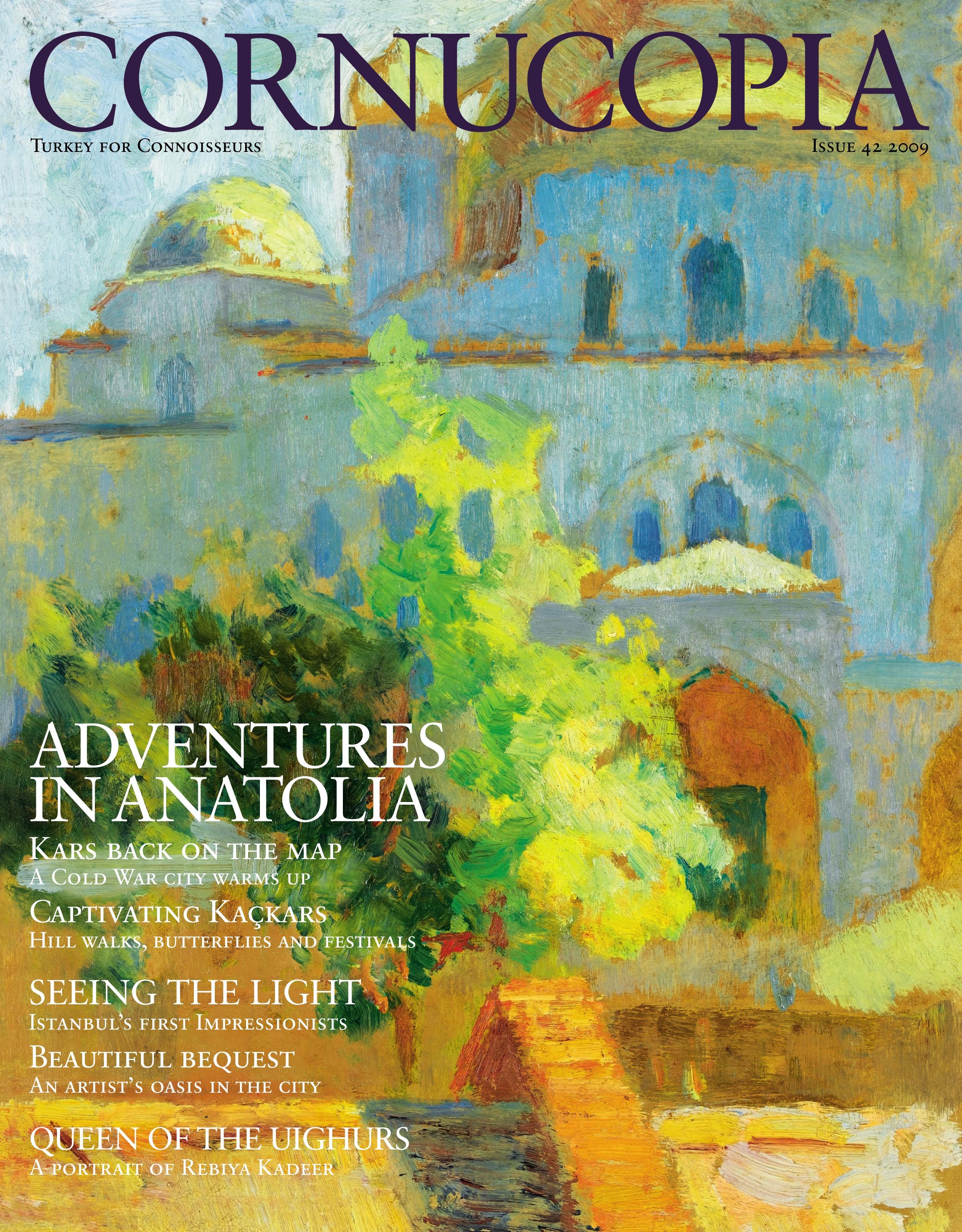
This article was published in Cornucopia Magazine, No 42,.cover42forhighliFD1

ZSsmZanzibar to Sinkiang: On Rails in Asia, by Raf Jah

All aboard for Anatolia. The
seytankale cover42forhighliFD1 ZSsm