![]() |
||
![]() |
||
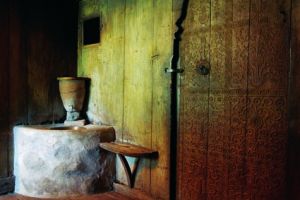
It was not until 1971 that Tevfik Cenani’s descendants decided to reopen the köflk. His granddaughter, the young Tayyibe Nedret, then in her sixth year as an architectural student at the University of Minnesota, visited Çengelköy on the hunt for a Turkish subject for her thesis. Only then did she realise that her family owned the extensive ruin of the old spirit factory straddling the shore and the coastal road. And that was the genesis of the dream that eventually resulted in Sumahan on the Water. At that time part of the factory, with its central chimney, was still used to make coal briquettes. The TMO’s sand and gravel were everywhere, and the dilapidated complex was very much in public use. Huts were spread over a makeshift sandy beach; an outdoor cinema had been set up against one wall, and village boys had colonised the recreation ground, tying their boats to it, and fishing and diving from it. But Nedret could see the beauty of the incomparable waterside location and the potential in the masonry walls, arched windows and fine chimney. Encouraged by the enthusiasm of Mark Butler, her future husband and a fellow architectural student, her thesis envisaged an ambitious complex of two distinct zones, one either side of the road, with a bridge connecting the two. Married in 1972 after graduation, Nedret stayed in the US, working first in Minneapolis, then with Mark on a postgraduate study of urban design at the Massachusetts Institute of Technology. The Sumahan dream was on hold until they settled in Istanbul in 1976. For five years they played about with a variety of proposals for the site in ever-changing applications for Ministry of Tourism backing. But the climate wasn’t right: there was no real appetite for sophisticated tourist development, and the planning process became more complex, while finance for a grandiose project remained at best problematical. The breakthrough came in 1994 when Nedret and her brother, Tevfik Ercan, decided to divide the property and he took on the buildings across the road from the distillery, together with the earlier stone portion of the complex, which incorporated the chimney. Part of this has now been turned into a restaurant. Nedret’s share, apart from the köflk in which she and Mark now live, was the long row of buildings downstream of the central chimney and the slipway to the water alongside it. With the scale of the project no longer so ambitious, or so expensive, the Butlers’ architectural plans at last got the nod, as well as financial backing. Work began. Once the debris of half a century had been cleared, standing walls were stabilised. Reconstruction required concrete foundations to be encased in steel, like a ship’s hull, and sunk deep into bedrock. The whole service area of the hotel is well below sea level – during construction two pumps were kept at work to avoid the building floating away. Now it is earthquake- as well as waterproof. The overriding aim was to keep as much as possible of the old structure and not to lose its spare but warm industrial feel. Where there is the least clue as to how the original was arranged, it has been echoed. It is fortuitous that the lie of the land, as well as restrictions on redevelopment of historic buildings, dictated one floor – the third and top one – giving on to the road, with a further two giving onto the water. The resulting privacy of the lower two storeys, meticulously designed around the factory’s series of arches, is a major bonus. The arches dictated a duplex format for many of the suites overlooking the water. From the quay, the unsurpassable view to Seraglio point and old Stamboul, seen below the span of the First Bosphorus Bridge, epitomises the reborn Sumahan: old and new combined to best effect. So the dream has been realised. Truncated perhaps, confined as it is to only part of the old distillery site, the Sumahan on the Water is nonetheless an adornment, rather than another blot on the Bosphorus: a gift to Istanbul.
Sumahan on the Water, Istanbul In addition to the Ercan family, the author would like to thank Naile Damali for her help in preparing this article. |
||||
![]() |
||||
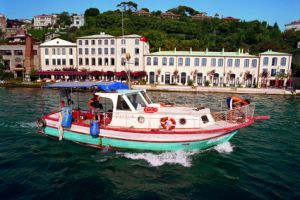
In the Spirits' Wake The derelict nineteenth-century Ottoman spirit distillery at Çengelköy has been miraculously transformed from an industrial wasteland on the lower Asian shore of the Bosphorus into a tip-top twenty-first-century hotel, Sumahan on the Water, uniquely standing on its own private quay at the very water’s edge. The Bosphorus, sinuously beautiful riband of deep water dividing Europe from Asia, has over the past twenty years been the victim of unprecedented urbanisation. In contrast to the developments that have sprung up around it, the Sumahan (literally spirit-house) is, like the two bridges halfway between which it stands, both aesthetically and functionally right. The transformation of the old distillery is the realisation of a couple’s dream, achieved over two decades of painstaking negotiation with planning authorities and backers. Fitting perhaps, if small comfort to Nedret and Mark Butler, the architects whose dream it was, since the history of the Sumahan has always been complicated and romantic. The original building dates from the reign of Sultan Mahmut II, when royal distilleries were well-constructed factory complexes built in local stone on prime sites. The distillery produced suma, or raw spirit, a clear, pungent liquid that can be made from almost any staple, from grain to grape – the Çengelköy factory used figs to distil its suma. On Mahmut II’s demise in 1839 the waterside factory passed to his wife, the beautiful Bez-i Alem Sultan Valide, mother of his two sons and successors, Abdülmecit I and Abdülaziz. She was renowned as a benefactress to the poor and to the women of Istanbul, though her reputation owed nothing to her liberality in dispensing suma. She was vehemently teetotal, even destroying the palace’s precious collection of crystal drinking vessels. Following her death, ownership of the complex becomes unclear. It has been suggested that the factory was acquired by an Armenian businessman, and there may be truth in the story that an Englishman ran it during the Allied occupation of Istanbul at the end of the First World War. At all events, it continued to produce raw spirit. By 1921 it was evidently making the traditional aniseed-flavoured spirit drunk throughout the Mediterranean region: the smell of rakı issuing from the village’s twenty-two taverns was so strong that respectable citizens were obliged to walk down the street to the ferry station with handkerchiefs dipped in cologne held to their noses. In the early 1930s the distillery changed hands for the last time. The whole complex of buildings either side of the Kuleli coastal road was acquired by Tevfik Cenani, an industrialist who had come from Ottoman Bulgaria and made good. No stranger to Çengelköy, in the mid-1920s, to escape the summer heat of Beyo€lu, he had bought the enchanting two-storey wooden köflk previously owned by the Ottoman ambassador to Vienna, Mahmud Nedim Pasha. Set like a jewel on a rise above the village, its interior painted with curious Russian murals, it was the ideal summer house for his unmarried sister, his wife and later their adopted son, the child of a close relative. Born in Burgaz in 1887, Tevfik Cenani had arrived in Turkey in 1912, probably among the hundreds of thousands of Muslims fleeing before the various Balkan armies. At the close of the Ottoman Empire he was producing aviation fuel for the infant Turkish Air Force, and owned an olive-processing factory and a freighter on which his various goods were shipped. The acquisition of the spirit distillery at Çengelköy was one of his few bad investments. Mustafa Kemal’s determination to nationalise key sectors of the new Republic’s faltering economy saw the Turkish state take over the Régie, the French-run tobacco monopoly, in 1925. Similarly, alcohol production was taken over the following year, seriously affecting the viability of private distilleries. To stem mounting losses, Tevfik Cenani – now known as Tevfik Cenani Ercan to avoid confusion with the Kanlıca Cenani family – tried his hand at the canning business and the production of briquettes for the Coal Board. On his death in 1949, the entire loss-making complex was leased to the nationalised TMO, the Soil Products Office, which was searching for a depot on the Bosphorus. When his widow, Nadire, died in 1958, the doors of the wooden köflk where the family lived were also closed, and for a decade they turned their backs on Çengelköy. |
||||