The magazine for Connoisseurs of
  Home


Next to appear were the Turks. They started moving from their presumed homeland in Siberia and Mongolia during the great nomad migrations of the fifth century. The empire they built was to dominate not only central Asia (west and east Turkestan) but also the Caucasus and Anatolia, and was to penetrate Europe. Cousins of the Mongols, they were sky-worshippers who used a runic script, and their early exploits can be read on stone stelae found on the Orkhon river near Ulan Bator.

For most of the next thousand years, apart from a span of about 100 years during the Tang dynasty (618–907) when it was wrested from them, the Turks had control of Xinjiang.

Among them was a tribe known as the Uighurs (pronounced We-gors or the more Turkic Ooey-gurze), who by the middle of the eighth century had settled down and built a city on the Orkhon. Regarding themselves in every respect as the equal of the Chinese – their khans even insisted on the custom of touching the forehead to the ground as a sign of deference, the ‘kow-tow’ – they several times helped the Chinese emperor recover his own capital. Their leaders converted to Manichaeism, the ‘religion of light’, and took up vegetarianism. Before long (and perhaps as a result) they were pushed out by their more warlike neighbours, the Kyrgyz, then living in the Altai Mountains. Driven south, they built a new capital, Kocho (now Astana) in Turfan, whose vast remains can still be seen. The Uighur kingdom lasted into the twentieth century.


The people today known as Uighurs are not all descended from this tribe, however. The name ‘Uighur’ was revived in 1921 as a generic description for the oasis-dwellers of Xinjiang. Until then they identified themselves – as some still do – by their oasis, as ‘Keriyanese’, ‘Khotanese’, or ‘Kashgari’.

Islam came late to the Tarim basin, in the second millennium. The conversion of eastern Turkestan was interrupted, however, by the Mongol conquest. Far from resisting the invaders, the Uighurs were content to do their book-keeping and teach them their alphabet so that laws could be codified. As Mongol power waned, the western Tarim came under the sway of khojas – religious nobles from central Asia – and the eastern Tarim reverted to rule by Buddhist Uighurs.

China’s imperial expansion under the great Manchu emperor Qianlong saw Xinjiang annexed in 1759. (The name means ‘new frontier’.) Among the emperor’s trophies was a beautiful Kashgari girl named Iparhan, whose body was said to give off a wonderful scent. Installed in the imperial harem, the Fragrant Concubine, as she was called, was to become ever more famous down the centuries. Contradictory stories grew up around her. To the Chinese she symbolised the amicable inclusion of Xinjiang into the motherland. The Uighurs saw her as a victim, cruelly snatched away by a foreign aggressor.

By the early nineteenth century, the Manchu soldiers garrisoning the west had grown soft. A series of revolts stimulated by envious khojas in central Asia culminated in a full-scale secession under Yakub Beg, an emissary of the Emir of Kokand (modern Uzbekistan). From 1862 to 1877, Xinjiang found itself an independent kingdom courted by both the Russian and British superpowers during the cold war known as the ‘Great Game’.

The ailing Qing court was in two minds whether to attempt the recapture of its lost territory. It succeeded thanks to the meticulous planning of General Zuo Zongtang, who is said to have had trees planted across Asia to help his army find its way home.

Despite making Xinjiang a full province of China in 1884, Beijing could not maintain control. The Qing dynasty fell in 1911, and a succession of corrupt freelance mandarins ran the province, eventually provoking a great Muslim rebellion from 1931 to 1934 which was suppressed only with the help of Soviet bombers and tanks. In the south a Muslim breakaway government briefly emerged under the Emir of Khotan. A decade later another anti-Chinese uprising, in the Ili valley, led to the creation of the secular, independent republic of Eastern Turkestan.

Under Mao Zedong, the Uighurs suffered a frontal assault on their social structure, their property and their religion – indeed, on their whole way of life. After Mao’s death in 1976, more tolerance was shown and Uighurs began to voice their grievances – the abuse, as they saw it, of their faith, and the denial of their history. The migration of Han Chinese was becoming a flood, Uighurs were denied jobs, and by the end of the century a programme of Sinicisation was in full swing.

Today the Chinese are physically stamping their vision of the future on Xinjiang’s ancient desert communities, with American-style skyscrapers, boulevards, shopping centres, flyovers and motorways for a traffic that does not yet exist. Two societies are growing up, as incompatible as ice and sand, but fighting for the same space. Although urbanisation has thrown Uighurs and Han Chinese together, there is little intermarriage. For the most part the two races eat in separate restaurants, dance in separate halls and listen to different music. They even live according to different clocks: the Chinese on Beijing time, the Uighurs on local time.

Most Uighurs remain village farmers who gain little or nothing from modernisation. The ancient way of life can still be seen along the southern desert road, and a few primitive communities survive in desert deltas deep in the Taklamakan, where seasonal rivers dry up in the sand. Some town-dwellers, employing their traditional skill as traders, have exploited the new market freedoms to become rich. Many more have been driven into poverty and unemployment, or to alcohol, drugs and prostitution.

More Uighurs are trying to join those who fled abroad before and after the Communist victory in 1949. Most of the earlier refugees went to neighbouring Kazakhstan, or to Pakistan and thence to Turkey, where they found a welcome. Some have moved on to Germany and other parts of Western Europe. Now the diaspora has spread to the UK, the United States and Australia. Emigration seems bound to increase as opportunities grow fewer and opponents of the regime are hunted down as ‘Islamic terrorists’ accused of trying to ‘split the motherland’.

If present policies continue, it seems only a matter of time before Turki culture is eradicated in China, except in the most remote areas. Yet there are hopeful signs, too. Some of China’s new leadership know that hectic development could undermine Xinjiang’s fragile environment. Others are afraid that racial and religious tensions could turn the province into another Kosovo or Kashmir. But probably the best hope for the Turks of China lies in the fact that the world is once more alive to their existence.


Christian Tyler’s book, Wild West China, is published by John Murray

For the full 36-page feature with photographs by Ashley Gilbertson and Christian Tyler - add Issue 31 to the basket

The Turks of China
by Christian Tyler
Cornucopia 31

In the centre of the Asian landmass, enclosed by towering mountain ranges and scoured by desert winds, lies a strange, wild place called Xinjiang. Until a few years ago, it was forgotten by the world.

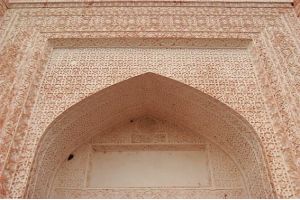
The native inhabitants of this wilderness are citizens of the People’s Republic of China. But they are not Chinese. You can see it in their faces. You can see it also in the names of their landmarks: a mountain is tagh, water is su, lake is kul. Their language is Turkic, their script Arabic, their architecture Persian and their religion is Islam.

To the puzzled visitor, it seems as if, during the great westward steppe migrations of 1,500 hundred years ago, these proto-Turks turned south too soon and ended up on the wrong side of the mountains. The land they chose seems to us fierce and barren, but there are fertile oases beneath the mountains and round the desert shore. For centuries these Turks were left alone to enjoy their new life as farmers. But as empires expanded and national boundaries became fixed, the outside world pressed in. Today, while their cousins on the western side of the Pamirs have escaped from their Soviet masters, they find themselves chafing under the iron hand of Beijing.

Rediscovered by European adventurers in the latter half of the nineteenth century, Xinjiang was closed again from the 1930s until the late 1980s. Nobody was there to report on the plight of China’s Turks as they were hammered into a Chinese mould along with Mongolians and Tibetans on either side of them.

So remote is this province of China that its ancient Turkic capital, Kashgar, is as far from Beijing as it is from Ankara. Yet the Xinjiang Uighur Autonomous Region (to give it its official name), formerly Chinese Turkestan, comprises a sixth of China’s territory, while containing a mere sixtieth of its population.

Of its twenty million people, about ten million are Turkic, mainly oasis-dwelling Uighurs, with smaller numbers of Kazakhs and Kyrgyz. There are another million or more Mongols, Hui (Chinese Muslims), Tajiks and others. Officially, the Han Chinese population is 7.5 million. In reality, it is probably nearer twelve million.

Not only remote, Xinjiang is also a country of extremes. Its mountains are among the highest in the world, soaring to 25,000 feet (7,600 metres), while the Turfan Depression is below sea level, one of the deepest pockets on earth. The Taklamakan Desert, which fills the Tarim basin, is the second largest sand desert on the globe. So dry is the region that only one of its rivers, the Irtysh in the far north, ever finds its way to the sea. The rest are swallowed by the desert sands. Temperatures in the Taklamakan swing from minus 50 to plus 50 degrees centigrade. Howling sandstorms batter the traveller along the desert margins, and the oasis towns around its shores are muffled in a pall of dust for days on end. Dwellers on the less-populated southern side of the desert fight a constant battle against the inexorable advance of the great dunes.

For centuries the chief influences – peoples, cultures, religions – came not from China but from the far side of the mountains. Xinjiang’s history defied its geography. The Chinese began their incursions during the Han dynasty (206bc–220ad), mainly to get the horses they needed to keep on terms with their steppe enemies. It took many false starts and reverses before the Chinese succeeded in mastering the people they regarded as the ‘barbarians’ of the far west. Not until the mid eighteenth century did they manage a credible military conquest. It took another 200 years, and the Communist revolution of 1949, to achieve complete administrative control. Even today, Xinjiang is not entirely subdued.

The earliest known inhabitants of the Tarim basin appear to have been Indo-European speakers from Anatolia, the Caucasus and southern Russia who arrived by way of the northern steppes. Their language, found in two forms at Kucha and Turfan and called (for no very good reason) Tocharian, proved – startlingly enough – to be closer to the European than to the Indian variants. In about 1200bc they were joined by immigrants from what is now Iran. The pale features and sandy-coloured hair bequeathed by the newcomers amazed early British explorers who climbed over the Karakoram Pass from India in the nineteenth century. They encountered, wrote one, “a purely Aryan group, who only require to be put into coat and trowsers to pass, so far as outward appearance goes, for the fairest Englishman”.

That observation was later strikingly confirmed by the exhumation of the famous mummies of the Taklamakan. With their red hair and beards, blue eyes, high-bridged noses and aquiline features, these people of 4,000 to 2,000 years ago are plainly not Mongoloid. Their clothes, woven into patterns suspiciously like tartan, seem also to point to some European or Celtic ancestry.

They lived in riverside cities which they were forced by the advancing sands to abandon early in the first millennium. It was they who helped transmit Buddhism to China when it arrived from India in the first centuryad. They decorated their cave temples and stupas with frescoes which show not only Indian but also Greek influences, the legacy of Alexander of Macedon, who reached the Hindu Kush. Seals dug from the sand-buried cities of Xinjiang carry the faces of Athena and Heracles, and wooden architraves sport Corinthian mouldings.

| home | subscribe | back issues | books | shopping directories | contact us | advertise |